
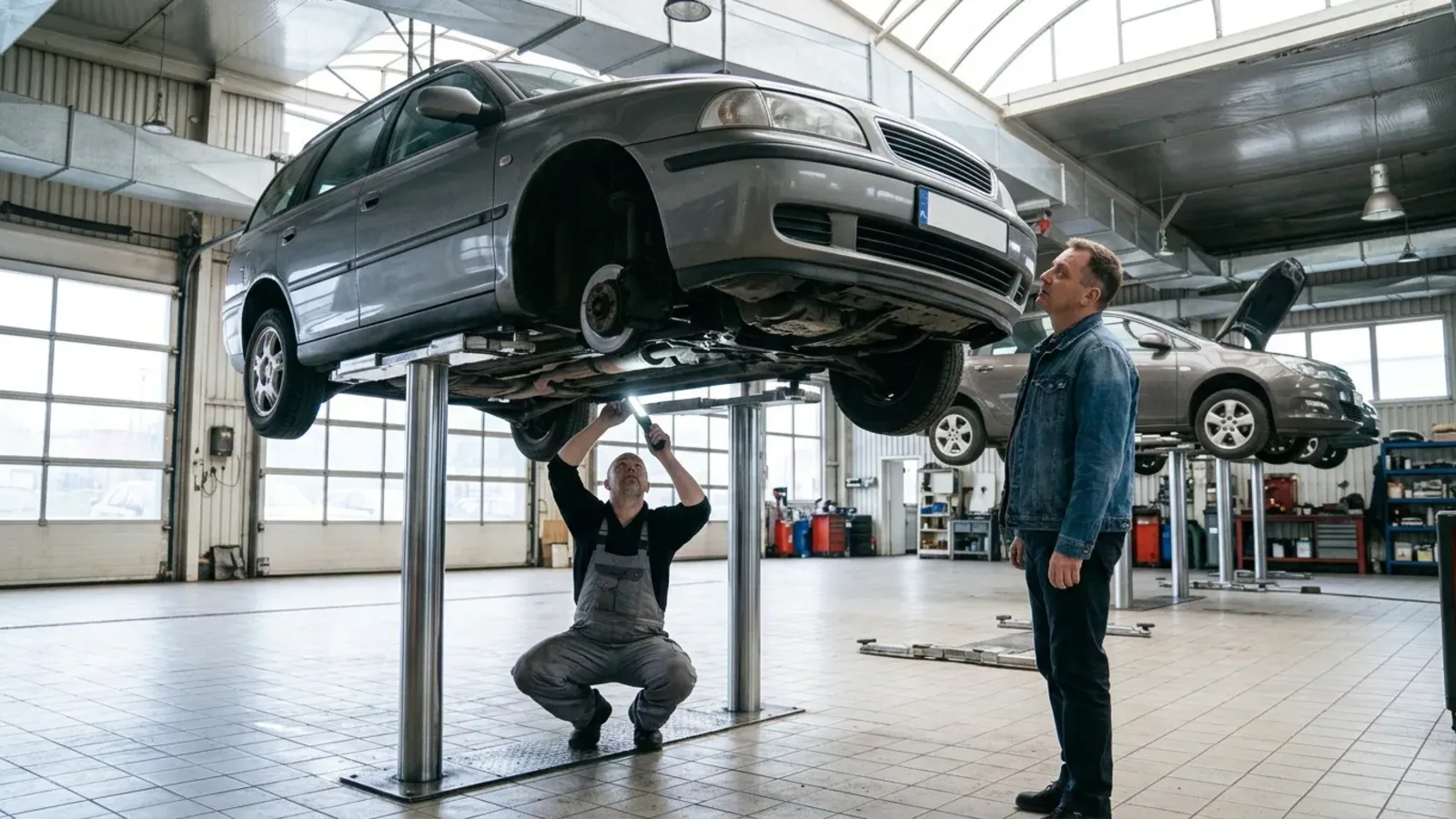
The Dacia Sandero is a simple car that is cheap to run and works well for everyday commuting. However, the TÜV results discussed by Auto Świat show that older cars have suspension, lighting and brake faults more often than average, and in the Sandero III, whining gearboxes were reported. The engines are usually rated well. We are not a Dacia authorised dealer workshop: we service the Sandero outside the dealer network as a Bosch Car Service (GVO); check the warranty terms in your booklet.
- Sandero I, II and III, Stepway
- 1.0 SCe, 0.9 and 1.0 TCe, 1.5 dCi
- Suspension, lights, brakes
- Pre-purchase inspection
What are the Dacia Sandero generations and which years are they from?
| Generation | Years | Main powertrains |
|---|---|---|
| Sandero I | 2008–2012 | 1.2 and 1.4/1.6 petrol engines, 1.5 dCi diesel |
| Sandero II | 2012–2020, facelift 2017 | 1.2 16V (also LPG), 0.9 TCe (also LPG), from the facelift 1.0 SCe, from 2020 1.0 TCe, 1.5 dCi, Easy-R gearbox |
| Sandero III | from 2020 | 1.0 SCe, 1.0 TCe (also CVT), 1.0 TCe Eco-G with factory LPG |
The Stepway is a version with raised suspension and plastic cladding, technically close to the ordinary Sandero. Underneath, the Sandero III uses technology from the Clio V, but in a simpler form.
The Sandero III is clearly more mature than its predecessor: according to the reports discussed by Auto Świat, its suspension and brakes do better, although dipped-beam and rear light faults still occur. This generation also introduced the continuously variable CVT gearbox paired with the 1.0 TCe. When servicing it, we stick to the manufacturer's recommendations for transmission oil, and on a test drive we check how smoothly it pulls away.
Which Sandero engine, and what to watch out for?
- 1.2 16V (Sandero II before the facelift): Interia describes it as trouble-free; a simple engine with a timing belt.
- 0.9 TCe: a three-cylinder turbo with a chain. Interia points to a leaking chain cover gasket and a labour-intensive timing replacement.
- 1.5 dCi: a diesel rated as very durable with regular servicing; a skipped fuel filter change can damage the high-pressure pump.
- 1.0 TCe (Sandero III): the newer successor to the 0.9 TCe, also in the Eco-G version with factory LPG.
- Easy-R: an automated manual in the Sandero II; gear changes can be jerky, so a test drive is a must.
The most common problems reported by Sandero owners
| Problem | Symptom | What we do |
|---|---|---|
| Springs and shock absorbers (Sandero II) | Knocks, floaty ride, broken spring | Checking on the lift, replacing in pairs |
| Dipped beams and rear lights | A bulb or the whole light does not work | Diagnosing the column switch, wiring and lights |
| Brakes, including the handbrake | Uneven braking, handbrake does not hold | Measuring the discs, adjusting and repairing the handbrake |
| Whining gearbox (Sandero III) | Hum at a steady speed | Diagnosing the gearbox and bearings |
| Ignition switch (Sandero II, per ADAC) | Starting problems | Diagnosing the ignition electrics |
Auto Świat lists recall/service campaigns concerning, among other things, the steering, brakes and airbags in the Sandero II, and a bonnet that opens by itself and the fuel lines in the Sandero III. A Dacia authorised dealer workshop checks by VIN whether they apply to your car.
How to service a Sandero, and does a service outside the dealer network keep the warranty?
Dacia specifies the service plan for each engine; we check it by VIN. In the 1.2 16V and 1.5 dCi we keep an eye on the timing belt date, and in TCe engines on oil to the Renault specification. At every service we inspect the suspension, brakes and lighting, because according to TÜV reports these are the weakest points of older cars.
The Sandero III may still be under Dacia's warranty. A service that follows the manufacturer's plan and is entered in the book can be done outside the authorised dealer network; warranty repairs and recall/service campaigns are carried out by a Dacia authorised dealer workshop. Check the terms in your warranty booklet.
Buying a used Sandero? What to check
- The suspension, springs and shock absorbers, and play in the steering.
- How the lights and the column switch work.
- The brakes and handbrake, and in the Sandero III, gearbox noise on a test drive.
- The underbody for corrosion, especially in the Stepway.
- The documents and recall/service campaigns for the VIN.
Sandero Eco-G and Stepway: what about the gas and the suspension?
Factory LPG in the Sandero is a popular choice, but we do not service LPG installations. We service the rest of the car: the engine, brakes, suspension, air conditioning and electrics. The Stepway has higher suspension and often works on poorer roads, so at its service we inspect the shock absorbers, anti-roll bar links and underbody shields more closely.
You can book your Sandero for a service on 58 552 55 25 or via the form. Give the VIN and tell us whether it is an LPG version or a Stepway. We will prepare a quote once the car has been identified.
Frequently asked questions
Is the Dacia Sandero a good used car?
For a driver who wants a simple, cheap car, often yes. The engines are rated well, but you need to check the suspension, lights and brakes, because in TÜV reports these are the weaker points.
Which engine should I choose in the Sandero II?
The simple 1.2 16V and the 1.5 dCi diesel have good reviews. The 0.9 TCe is livelier, but has a timing chain that needs attention. Try the Easy-R gearbox on a test drive.
Do you service the Sandero with LPG?
We service the car, but not the gas installation, because we do not work on LPG.
Are you a Dacia authorised dealer workshop?
No. We service the Sandero as a Bosch Car Service outside the dealer network (GVO); we are authorised for Opel and Peugeot.
How much does a Sandero service cost?
The cost depends on the engine and the scope from Dacia's plan. A service advisor will prepare a quote once you give the VIN.