
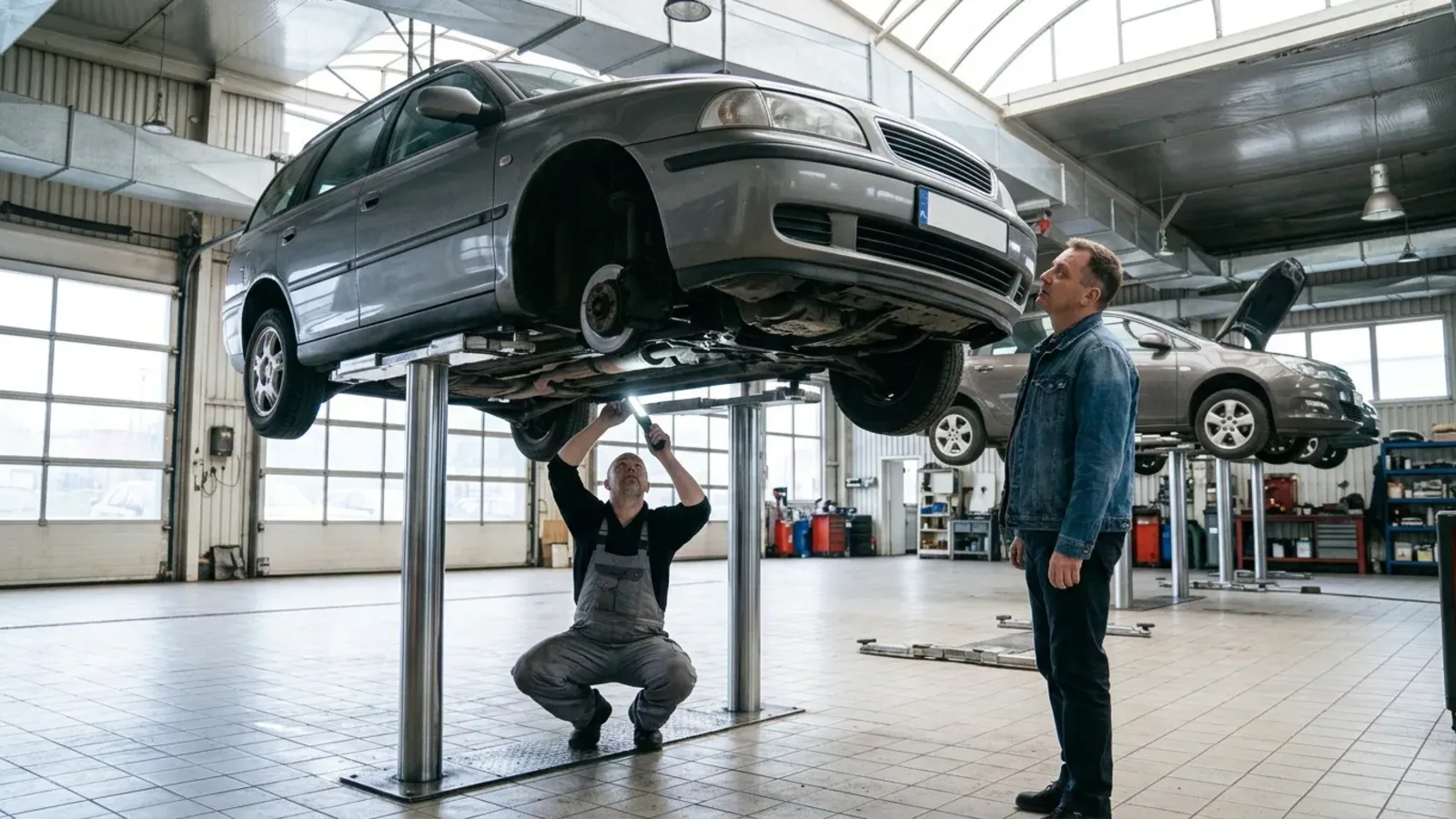
The Dacia Duster is a simple SUV for people who want a spacious car with low running costs, including with LPG or 4x4 drive. On a used Duster, look above all at the choice of engine (the 1.2 TCe in older examples is the one most often advised against), the condition of the suspension and underbody, and minor electrical faults. We are not an authorised Dacia dealer workshop: we service the Duster outside the dealer network as a Bosch Car Service, in line with the EU Block Exemption rules (GVO). Check the warranty terms in the warranty booklet.
- Duster I, II and III
- 1.0 / 1.3 TCe, 1.6 SCe, 1.5 dCi
- Factory LPG and 4x4
- Servicing to Dacia's plan
Dacia Duster generations and their engines
| Generation | Years | Engines |
|---|---|---|
| Duster I | 2010–2017 | 1.6 and 1.6 SCe (also LPG), 1.2 TCe, 1.5 dCi |
| Duster II | 2017–2024, facelift 2021 | 1.6 SCe, 1.0 TCe (also LPG), 1.2 TCe, 1.3 TCe, 1.5 dCi |
| Duster III | from 2024 | 1.0 TCe with LPG, 1.2 TCe with mild hybrid, hybrid 140 |
The Duster uses engines from the Renault-Nissan alliance, so you will find the same units in Renault, Nissan and even the Mercedes A-Class. The third generation is still young and mostly under warranty, so it is too early to talk reliably about its faults.
Which engine to choose in the Duster?
- 1.6 SCe: a naturally aspirated petrol, often paired with LPG. With gas, remember to adjust the valve clearance. Auto Świat also describes jerking and hunting revs in some examples.
- 1.0 TCe: a three-cylinder turbo, available with factory LPG. Guides rate it as a successful successor to the older 0.9 TCe.
- 1.2 TCe: the one most often advised against, especially in examples from early production, because of increased oil consumption.
- 1.3 TCe: a modern turbo with direct injection. Auto Świat mentions oil dilution by fuel, so we keep to the oil change dates.
- 1.5 dCi (Blue dCi): a diesel with a timing belt. The former bearing shell and injection problems, according to OTOMOTO, were eliminated as the engine evolved, although ancillary faults do occur.
The most common problems reported by Duster owners
| Problem | Symptom | What we do |
|---|---|---|
| Oil consumption on the 1.2 TCe | Frequent top-ups, oil light | Measuring the loss, assessing the timing and spark plugs, decision after diagnosis |
| Front suspension | Knocking, play, noisy operation | Checking shock absorbers, springs and ball joints, wheel alignment after repair |
| Rust on joints and the underbody | Seized bolts, corrosion spots | Assessing the underbody on the lift, protecting or replacing parts |
| Minor electrics | Random faults, trouble with Hands Free and phone pairing | Computer diagnostics, battery and earth test |
| Roof sealing at the C-pillar (Duster II) | Cracked sealant, dampness | Inspection and assessment by a bodywork technician |
Auto Świat regards the loud "whine" of the manual gearbox in the Duster II as usually a design feature, not a fault. If the noise grows or the gears go in with resistance, we check the gearbox oil and bearings.
Duster service plan: oil, timing, LPG and 4x4
Service intervals are set by Dacia for the specific engine and are in the service book; we check them by VIN. On the 1.5 dCi we keep to the timing belt replacement date, and on the TCe engines to Renault-specification oil. On versions with factory LPG, servicing of the gas system according to the manufacturer's plan is added, and on the 1.6 SCe a valve clearance check. We do not install or convert LPG systems.
According to OTOMOTO, the 4x4 version does not noticeably raise service costs, and the centre coupling is a simple design. At a service, however, we check its operation and leaks from the axle.
You can have a Duster under warranty serviced outside a dealer workshop in line with the EU Block Exemption rules (GVO), if the service follows the plan and is documented. Warranty repairs are done by an authorised Dacia dealer workshop.
A used Duster: what to check before buying?
A Duster often works as an all-purpose car, including off the tarmac. That is why before purchase we look first and foremost at the underbody: rust on bolted joints, guards, suspension and leaks. On top of that come reading faults, checking the oil on TCe petrols, checking the LPG system for leaks and paperwork, and testing the 4x4 drive.
Duster I or Duster II: how do they differ in the workshop?
The first generation is today a car of high mileage and age, so underbody matters dominate in the workshop. Auto Świat advises examining the underside of the car carefully, because the bodywork rusts less than the underbody, and also lists faults of the alternator or voltage regulator, coils, throttle bodies and gearbox bearings. A problem can be the earth lead, which can give symptoms similar to a weak battery.
The second generation has more modern turbo engines and more electronics: a camera, sensors, infotainment with Android Auto and CarPlay. Here computer diagnostics helps more often than a spanner. Versions after the 2021 facelift still have a simple suspension design that is repaired without great cost.
Call 58 552 55 25 or send the form. Tell us whether the car has factory LPG or 4x4 drive, and give the VIN. The advisor will match the scope of the service to Dacia's plan and prepare a quote once the car has been identified. We work Monday to Friday 7:30–17:00 and on Saturdays 9:00–14:00.
Frequently asked questions
Is the Dacia Duster durable?
Guides rate it as simple and cheap to repair. Typical faults are the suspension, minor electrics and rust on joints, and of the engines the 1.2 TCe is the one most often advised against.
A Duster with LPG: what to watch for?
Regular servicing of the system and, on the 1.6 SCe, a valve clearance check. Guides say the 1.6 SCe and 1.0 TCe usually tolerate gas well.
Do you service the Duster 4x4?
Yes: servicing, suspension, brakes and drive diagnostics. The service advisor confirms the scope by VIN.
Are you an authorised Dacia dealer workshop?
No. We service the Duster as a Bosch Car Service outside the dealer network. We are an authorised service centre for Opel and Peugeot.