
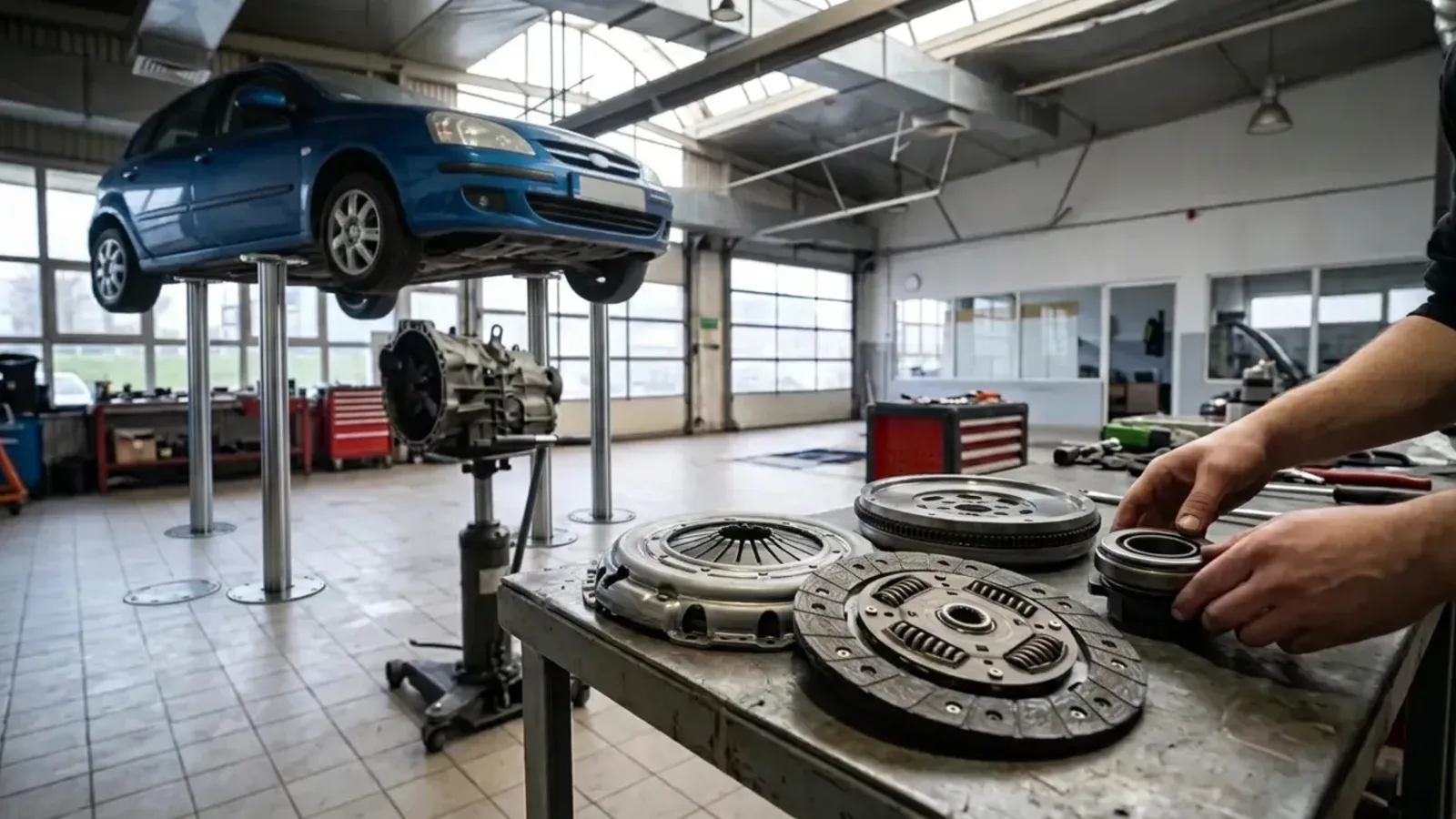
At Serwis Osowa we replace the clutch as a complete set: disc, pressure plate and release bearing, and in many cars the concentric slave cylinder as well. We assess the dual-mass flywheel once the gearbox is removed and replace it if it has excessive play, signs of overheating or grease leaks. Before we suggest a repair, we use a road test and a data read-out to check that the symptom really comes from the clutch.
- Diagnosis before dismantling
- Complete clutch kit with bearing
- Dual-mass flywheel assessment
- Bleeding and road test
Which symptoms mean the clutch needs replacing?
- slipping: under hard acceleration in third or fourth gear the revs rise but the car accelerates poorly;
- the pedal “bites” higher and higher, and the car pulls away only when the clutch is almost fully released;
- a burning smell after pulling away uphill or manoeuvring with a trailer;
- judder and body vibration when pulling away;
- gears go in hard or with a grinding noise, especially first and reverse;
- a noise or whine that changes when the pedal is pressed (a common symptom of a release bearing).
Slipping does not always mean ordinary disc wear. The cause can be oil on the lining from a leaking shaft seal, or a clutch release system that is sticking. If we do not remove the cause, the new clutch will soon share the fate of the old one.
Clutch or dual-mass flywheel: how to tell?
| Symptom | Most often |
|---|---|
| Revs rise, the car does not accelerate | Worn or oil-soaked clutch disc |
| Rattle at idle that quietens when the clutch is pressed | Dual-mass flywheel |
| Knock when starting and switching off the engine | Dual-mass flywheel, but also the starter motor or battery |
| Noise that changes when the pedal is pressed | Release bearing |
| Gears go in hard when stationary | Clutch not disengaging: pressure plate, slave cylinder, hydraulics |
Noises are often wrongly blamed on the dual-mass flywheel. Vibration at low revs can come from injectors, ignition or engine mounts. That is why, before quoting, we also check how the engine runs, e.g. the injection corrections in the control unit.
What is replaced in a clutch kit?
- the clutch disc with linings;
- the pressure plate, i.e. the pressure plate with diaphragm spring;
- the release bearing or the concentric slave cylinder (a bearing with a hydraulic actuator);
- the dual-mass flywheel, if the assessment after dismantling shows wear, together with new bolts, which are usually single-use;
- the rear crankshaft seal or gearbox input shaft seal, when it leaks.
Replacing the disc alone is a false economy, because access to each of these parts requires removing the gearbox. After reassembly we bleed the clutch hydraulics and carry out a road test. The car usually stays in the workshop for one working day, longer with 4x4 drive, a cramped engine bay or while waiting for parts.
The service advisor confirms the scope of the repair and the quote after diagnosis. We decide on replacing the dual-mass flywheel together with you, after inspecting it once the gearbox is removed.
How to extend the life of a new clutch?
- do not hold the car on the clutch uphill, use the brake or hill-start assist;
- do not rest your foot on the clutch pedal while driving;
- in traffic jams on the Bypass or in the city centre, pull away gently, without high revs;
- do not drive for long at too low revs in a high gear, as this strains the dual-mass flywheel;
- if you increase the engine's power, remember that the clutch is matched to the factory torque.
And if the car has an automatic or dual-clutch gearbox?
A conventional automatic has no clutch operated by a pedal, and fault symptoms look different: jerks when changing gear, delayed gear selection, gearbox fault messages. Dual-clutch gearboxes have their own clutches and require control unit diagnostics. We also repair gearboxes, so in both cases start by describing the symptoms to the service advisor.
Frequently asked questions
Does the dual-mass flywheel have to be replaced with the clutch?
Not always. The dual-mass flywheel is assessed once the gearbox is off. It is replaced if it has excessive play, an overheated friction surface or grease leaks. If it is in good condition, it can stay.
Can I drive with a slipping clutch?
Briefly and carefully, but it is not worth delaying. Slipping heats the disc and the dual-mass flywheel, so the longer it goes on, the greater the risk that the repair will involve more parts. In an extreme case the car will stop transmitting drive.
Do you replace clutches on vans?
Yes, we service passenger cars and light vans of all makes. Give the model and engine version when booking so we can order the right kit.