The most typical symptom of a worn clutch is slipping: under hard acceleration in a higher gear the revs rise and the car hardly accelerates. Added to this are a pedal that "bites" higher and higher, a smell of burning and juddering when pulling away. A dual-mass flywheel tends to give itself away through noise: a metallic rattle at idle, a knock when switching off the engine and vibrations at low revs.
What are the symptoms of a worn clutch?
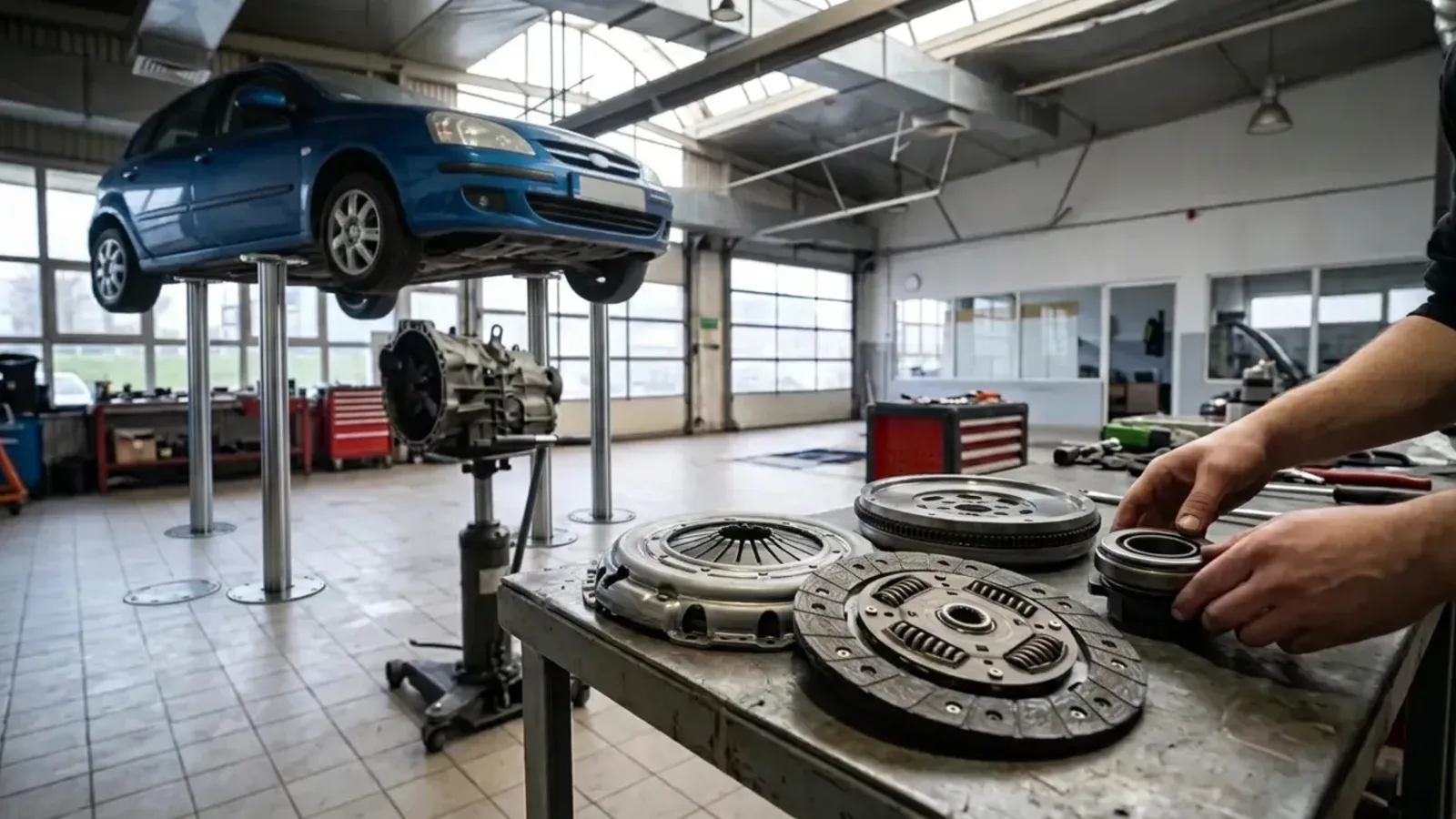
The clutch in a car with a manual gearbox is a set of several parts: the disc with friction linings, the pressure plate (with a diaphragm spring) and the release bearing, also known as the thrust bearing. The disc wears with every pull-away and gear change.
- Clutch slipping. You press the accelerator in third or fourth gear, the revs jump up and the speed rises noticeably more slowly. At first this happens only under full load, for example when overtaking or with a full car of passengers.
- A clutch that bites high. The car pulls away only when the pedal is almost released. In many cars with a hydraulic clutch system the bite point changes with disc wear, although the same symptom can also be caused by a fault in the release system.
- A smell of burning. It resembles burnt paper or hot brake linings. It appears after hill starts, manoeuvres with a trailer or after holding the car on the clutch for a long time.
- Juddering and vibration when pulling away. The car pulls away unevenly and the whole body shakes slightly. The cause may be a worn or oil-soaked disc, but also the dual-mass flywheel and engine mounts.
- Problems engaging gears. The gear goes in hard, with a grinding noise, especially first and reverse when stationary. This is a sign that the clutch is not disengaging fully.
- Noises. A hum, drone or squeal that appears or changes when you press the pedal often points to the release bearing.
ZF, the maker of Sachs clutches, notes in its materials for workshops that slipping does not always mean ordinary wear. The cause can also be oil on the linings from a leaking shaft seal, an overheated pressure plate or a sticking release system. That is why, before replacement, it is worth establishing why the clutch is slipping, not just that it is slipping.
What are the symptoms of a damaged dual-mass flywheel?
The dual-mass flywheel sits between the engine and the clutch. It consists of two masses joined by arc springs and grease. Its job is to damp the engine's torsional vibrations before they reach the gearbox. It is fitted to most modern diesels and many turbocharged petrol engines. When the springs wear or the grease dries out, the dual-mass flywheel stops damping vibrations and starts making noise.
- A metallic rattle or clatter at idle that quietens or changes when the clutch is pressed.
- A loud knock or "clunk" when starting and switching off the engine.
- Vibrations felt in the pedal, the gear lever and the floor, strongest at low revs under load.
- Knocks when applying and releasing the accelerator at low revs, and juddering when pulling away in first and second gear.
- In an advanced stage, uneven running at standstill and even the engine stalling.
Schaeffler (the LuK brand) warns in a service bulletin that noises are often wrongly attributed to the dual-mass flywheel. A knock at start-up can result from a weak battery, a poor earth or the starter motor, and vibrations at idle from the injectors, ignition or engine mounts. These causes have to be ruled out first, and only then should the flywheel be replaced.
Clutch, dual-mass flywheel or release bearing – how to tell them apart
These three components work next to each other and their symptoms partly overlap. The table below shows which component is most likely for a given symptom. It is a starting point for a conversation with the mechanic, not a diagnosis.
| Symptom | Most likely component | What else to check |
|---|---|---|
| Revs rise, car does not accelerate (high gear, full throttle) | Clutch disc (worn or oil-soaked) | Pressure plate, shaft seal, release system |
| Pedal bites right at the top | Clutch disc | Slave cylinder, fluid in the hydraulic system |
| Smell of burning after a hill start | Slipping disc | Brakes (handbrake dragging, seized caliper) |
| Hum or squeal only with the pedal pressed | Release bearing | Concentric slave cylinder |
| Hum in neutral, disappears when the pedal is pressed | Input shaft bearing in the gearbox | Gearbox oil level |
| Metallic rattle at idle, quietens when the clutch is pressed | Dual-mass flywheel | Damper on the clutch disc, engine running |
| Knock at start-up and when switching off the engine | Dual-mass flywheel | Battery, starter motor, earth, engine mounts |
| Vibrations at low revs under load | Dual-mass flywheel | Injectors, ignition, engine mounts |
| Juddering when pulling away | Disc or pressure plate | Dual-mass flywheel, engine and gearbox mounts |
| Gear goes in with a grinding noise when stationary | Clutch not disengaging (pressure plate, slave cylinder) | Synchronisers, cable or hydraulics |
The final assessment of the condition of the clutch and dual-mass flywheel comes only from inspection after the gearbox is removed. Beforehand the mechanic can narrow the cause by a test drive, listening and reading data from the engine control unit, for example injection corrections, which show whether the engine is running evenly.
How to safely check whether the clutch is slipping
The simplest test can be done during normal driving. You need an empty, straight road and conditions in which stronger acceleration endangers no one.
- Drive at a permitted speed in third or fourth gear, at low revs.
- Smoothly press the accelerator to the floor and watch the rev counter.
- If the revs rise together with the speed, the clutch is transmitting torque. If the rev counter needle clearly "runs away" upwards and the car accelerates disproportionately slowly, the clutch is slipping.
- After the test do not repeat it many times. Every slip additionally heats the disc and the dual-mass flywheel.
We do not recommend the tests circulating online that involve pulling away with the handbrake on or "kicking" the accelerator while stationary. They strain the clutch, the dual-mass flywheel and the brakes, and the result still has to be confirmed in a workshop.
What speeds up wear of the clutch and dual-mass flywheel?
There is no single mileage after which a clutch must be replaced. It is a wear item, and its durability depends mainly on how and where you drive.
- Driving in traffic jams. Every pull-away is a moment of disc slip. Daily commuting in Tricity, for example at peak time on the Bypass, on al. Grunwaldzka or around the Owczarnia interchange, means hundreds of such pull-aways a week.
- Pulling away uphill and holding the car on the clutch instead of the brake. In Gdańsk, with its moraine hills and steep estate exits, this is everyday life.
- Resting your foot on the clutch pedal. ZF in its Sachs materials points to constant light pressure on the pedal as a cause of overheating of the dual-mass flywheel bearing.
- Towing a trailer and driving with a full load, especially pulling away uphill with a trailer.
- Driving at too low revs in a high gear. The engine then runs unevenly and the dual-mass flywheel damps the greatest vibrations.
- Increasing engine power (chip tuning) without matching the clutch. The disc and dual-mass flywheel are chosen for the factory torque.
- Uneven engine running, for example because of damaged injectors. According to ZF this is one of the causes of mechanical destruction of the dual-mass flywheel.
What is replaced during a clutch repair and how long does it take?
The clutch is replaced as a kit: disc, pressure plate and release bearing, and in many cars also the concentric slave cylinder, that is a bearing combined with a hydraulic actuator. Replacing the disc alone is a false economy, because access requires removing the gearbox every time, which is the most expensive part of the labour.
- The dual-mass flywheel is always assessed after the gearbox is removed. It is replaced when it has excessive play, signs of overheating, grease leaks or a damaged friction surface.
- While at it, the rear crankshaft seal and the gearbox shaft seal are checked. An oil leak onto a new disc would quickly destroy it.
- The bolts securing the dual-mass flywheel are usually single-use.
- After assembly the clutch hydraulics are bled and a test drive is carried out.
Removing and refitting the gearbox itself takes a few hours. In practice the car usually stays in the workshop for one working day. It takes longer in 4x4 cars, in some models with a cramped engine bay and when you have to wait for parts. Cost is affected most by whether the dual-mass flywheel has to be replaced in addition to the clutch.
And if you have an automatic gearbox?
A conventional automatic with a torque converter has no pedal-operated clutch. Symptoms of problems look different: jolts when changing gear, delayed gear selection, rev "slipping", gearbox fault messages. Dual-clutch gearboxes (DSG, EDC, EAT and similar), on the other hand, have dry or wet clutches, which also wear. Their symptoms are usually vibration and juddering when pulling away, and diagnosis is made with a tester, because the gearbox control unit stores clutch adaptation data.
If you notice any of the symptoms described, come to Serwis Osowa at ul. Odyseusza 20 in Gdańsk. We are an authorised service centre for Opel and Peugeot and a Bosch Car Service, and we repair all makes, including US cars. Call 58 552 55 25 (Mon–Fri 7:30–17:00, Sat 9:00–14:00). The scope of repair and the price are confirmed by the service advisor after diagnosis.
Frequently asked questions
Can you drive on a slipping clutch?
Briefly and carefully, yes, but it is not worth delaying. A slipping disc heats the pressure plate and the dual-mass flywheel, so putting off the repair can raise its cost. When the car will not climb a hill or accelerate when overtaking, driving becomes dangerous.
Does the dual-mass flywheel have to be replaced when the clutch is replaced?
Not always. The dual-mass flywheel is assessed after the gearbox is removed and replaced if it has excessive play, grease leaks or signs of overheating. Since the gearbox is off anyway, it is a good moment for that decision, because a separate replacement later means paying the labour again.
Does a worn clutch increase fuel consumption?
Yes, if it slips. Part of the energy turns into heat on the disc instead of driving the wheels, so to keep up the pace you press the accelerator harder. With a clutch that only bites high, the difference can be unnoticeable.
Can a dual-mass flywheel be swapped for a single-mass one?
Such kits are on the market, but car manufacturers do not provide for them. A single-mass flywheel does not damp torsional vibrations like a dual-mass one, so there may be more vibration and noise in the cabin and the gearbox takes higher loads. It is worth making the decision after talking to a mechanic.
Why might a new clutch judder?
Most often because the linings were contaminated with grease or oil during fitting, a leak from a shaft seal, or a worn dual-mass flywheel was left in place. ZF recommends cleaning the friction surfaces of the flywheel and pressure plate during fitting for exactly this reason.
Sources
- ZF Aftermarket (Sachs) – Clutch slipping: causes of clutch slipping
- ZF / Sachs – Dual-mass flywheel: design and causes of damage (overheating, uneven engine running, pedal pressure)
- Schaeffler LuK Service Info 0069 – Diagnosis in case of noises (dual-mass flywheel replaced only after other causes are ruled out)
- Interia Motoryzacja – Dual-mass flywheel. Faults and symptoms