A control arm (wishbone) is a suspension link that connects the wheel hub carrier to the body or subframe and keeps the wheel in the right position when braking, turning and over bumps. The most common symptoms of a damaged control arm are dull knocks over potholes and when braking, the car pulling to one side, a “floating” steering wheel and uneven tyre wear. Usually it is not the arm itself that fails but its rubber-metal bushes or the ball joint. It is better not to drive with noticeable play: this is the part that decides where the wheel goes.
What is a control arm and what does it do?
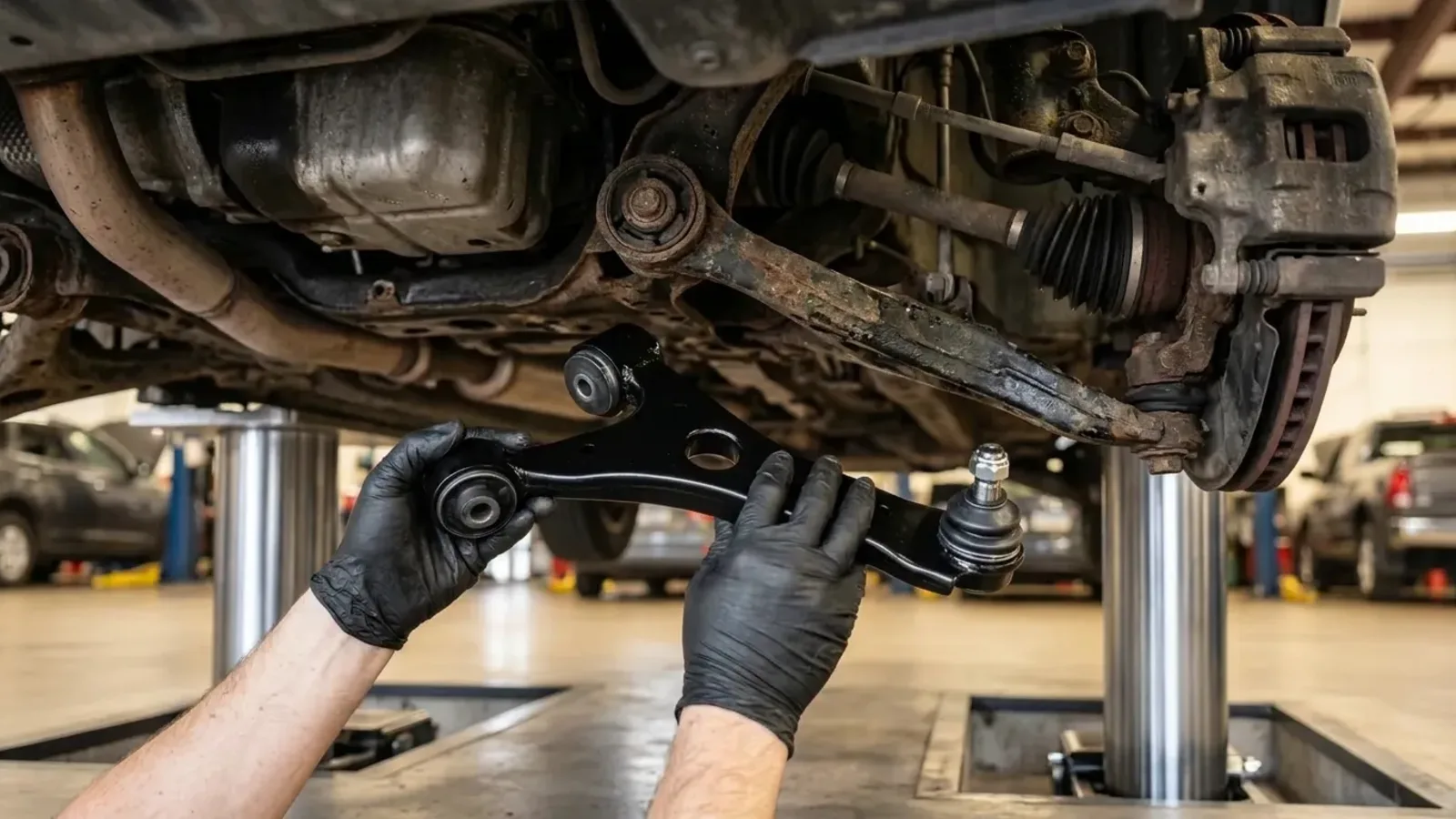
A control arm is a metal link (pressed steel, forged or cast aluminium) bolted at one end to the body, subframe or axle beam and at the other to the hub carrier, the part on which the wheel hub turns. Thanks to it the wheel can move up and down but cannot shift forwards, backwards or sideways.
Longitudinal forces (braking, acceleration), lateral forces (corners) and impacts from bumps all pass through the control arm. The wheel alignment angles depend on its condition: toe, camber and caster. The parts manufacturer Meyle describes the control arm outright as a safety-critical component, on whose geometry the work of the springs, shock absorbers and anti-roll bar depends.
- Lower control arm: the most common type in passenger cars with MacPherson struts (for example the Opel Astra, Peugeot 208 or 308). Usually triangular or L-shaped, with two bushes at the body end and a ball joint at the hub carrier.
- Upper control arm: in double wishbone suspensions, found in SUVs, pickups and many cars from the USA, among others.
- Multi-link suspension: several lighter arms and rods per wheel, typical of the rear axle in mid-range and higher-class cars. Each element has its own bushes.
What a control arm consists of: bushes and ball joint
The metal body of the arm rarely fails. It is the parts that allow it to move that wear out.
| Component | What it does | How it wears |
|---|---|---|
| Rubber-metal bush (silentblock) | Attaches the arm to the body, damps vibration and impacts, allows movement within a limited range | The rubber hardens, cracks and separates from the metal; play and knocking appear |
| Hydraulic bush | As above, but filled with fluid for better damping | Fluid leak (oily mark), loss of damping, vibration when braking |
| Control arm ball joint | Connects the arm to the hub carrier and lets the wheel steer and move vertically | Split rubber boot, washed-out grease, corrosion of the ball, play in the socket |
| Arm body | Transmits forces | Deformation after hitting a kerb or pothole, corrosion in cars from regions with salted roads |
In many cars the ball joint and bushes are pressed in at the factory and the manufacturer expects the whole arm to be replaced. In others you can replace just the ball joint or just the bushes. A cheaper repair is not always better: pressing a bush out of a seized housing can be labour-intensive, and a damaged housing means a new arm anyway.
Symptoms of a damaged control arm
Symptoms usually build up slowly, so the driver often gets used to them and notices the problem only at the periodic technical inspection or when the tyres are changed. What to look out for:
- Dull knocks from around the wheel over bumps, speed humps and tram tracks. With a worn ball joint the knock can be sharper and metallic.
- A knock or a “kick” when pulling away and under hard braking. A loose bush lets the arm shift along the car.
- Pulling to one side, especially when braking. The car changes its line even though the tyre pressure is fine.
- Uncertain handling and play at the steering wheel. The car “floats” in ruts, you have to keep correcting direction, and the steering wheel responds with a delay.
- Steering wheel vibration when braking from higher speed, often mistaken for warped brake discs.
- Uneven tyre wear, for example a worn inner or outer edge of the tread. Altered wheel alignment angles quickly “eat” a tyre.
- Visible damage: cracked bush rubber, a torn ball joint boot, rusty grease leakage, traces of fluid at a hydraulic bush.
Knocks in the suspension do not always mean the control arm. Stabiliser links, steering track rod ends or the upper shock absorber mount sound very similar. We write more about how to tell the source of the noise in our guide to suspension knocking.
Can you drive with a damaged control arm?
It depends on exactly what is worn and to what degree. Slightly cracked bush rubber with no perceptible play is a signal to plan a repair. Clear play in the ball joint or a deformed arm is already a situation in which driving is risky.
- Stop driving, or drive very gently straight to a workshop, if the car suddenly started pulling hard, the wheel has visibly changed position in the wheel arch, or the knock appeared suddenly after hitting a kerb or pothole.
- The most dangerous scenario is the ball of the joint coming out of its socket. The wheel then loses guidance, sets itself at a random angle and the car stops responding to the steering wheel. Such a failure is usually the result of play that was ignored for a long time.
- Worn bushes lengthen the car's response in a sudden manoeuvre and in emergency braking. On a wet road the difference is noticeable.
- Other suspension components and the tyres wear faster. Meyle points out that wear in one place increases the load on neighbouring parts.
Replacing control arms: in pairs or singly?
No regulation requires control arms to be replaced in pairs. In workshop practice the decision is made after inspecting both sides of the axle:
- If the damage is mechanical (a hit on a kerb on one side) and the other side has no play, replacing one arm is enough.
- If the bushes or ball joint have worn out “with age” at high mileage, the other side is usually in a similar condition. Replacing in pairs ensures the car behaves identically when braking and saves a second visit.
- In multi-link suspensions the bush manufacturer TEDGUM recommends replacing all the bushes unless you are sure the others are good, because wear on one transfers load to the next.
An important fitting detail: an arm with rubber-metal bushes is tightened to its final torque only when the car is standing on its wheels or the suspension is loaded to ride height. A bush tightened with the wheel hanging is pre-twisted and can crack after a few months. This is one of the most common causes of “premature” wear of new bushes.
After replacing a control arm, do you need wheel alignment?
Yes, in the vast majority of cases. Replacing the arm, ball joint or bushes shifts the hub carrier by millimetres, and that is enough to throw the toe out. Meyle expressly recommends checking the alignment after replacing a control arm, and in cars with a driver-assistance camera also checking whether the camera needs calibration.
TEDGUM points to a trap: if the alignment was previously set on worn components, the values can change noticeably after the repair. That is why the order is fixed: first remove the play, then set the alignment, never the reverse. Setting the toe on loose suspension will not cure pulling or uneven tyre wear.
The control arm at the periodic technical inspection (SKP)
The inspector at the vehicle inspection station checks the control arms by eye over a pit or on a lift, and the regulation recommends using a device that forces wheel jolts, colloquially a shake plate. The regulation on the scope and method of vehicle technical inspections (consolidated text: Journal of Laws 2024, item 141, annex no. 1) lists, among others:
- item 5.2.2.1: cracks or visible deformation of hub carriers or control arms, excessive play in control arm ball joints and repairs to control arms by welding – major defects,
- item 5.3.3: insecure control arm mounting, damage, cracking or excessive corrosion – major defects, and dangerous if it affects the stability of the vehicle's path,
- item 5.3.4: excessive wear of control arm ball joints – a major defect, and dangerous if there is a likelihood of loosening; a missing or split rubber ball joint boot – a major defect.
A major defect means a failed inspection, with 14 days to repair the car and return to the same station. A dangerous defect, according to the regulation, is one that does not allow the vehicle to be used further in road traffic; the inspector then retains the registration certificate. So it is worth checking the suspension before the inspection date, not only after it.
You can have control arms diagnosed and replaced, together with wheel alignment, at Serwis Osowa, ul. Odyseusza 20 in Gdańsk. We are an authorised Opel and Peugeot service centre and a Bosch Car Service, and we repair all makes, including cars from the USA. Call: 58 552 55 25 (Mon–Fri 7:30–17:00, Sat 9:00–14:00). The scope of work and the quote are confirmed by a service advisor after an inspection.
Frequently asked questions
How can I check myself whether a control arm has play?
At home you can only do a preliminary check: with the car raised and safely supported, grip the wheel at the top and bottom and try to move it. Play can come from the control arm ball joint, but also from the wheel bearing. It is checked properly on a lift with a shake plate, observing each joint up close.
What fails more often: the bush or the ball joint?
It depends on the car model and the suspension design. Bushes age with time and mileage: the rubber hardens and cracks. The ball joint usually starts to wear after the rubber boot is damaged, when water and salt get inside. That is why a split ball joint boot is a signal to act quickly.
Can you replace just the bushes instead of the whole control arm?
Often yes, if the car or parts manufacturer provides the bushes as a separate part and the body and housings are in good condition. With corroded housings, a bent arm or a worn ball joint that is permanently pressed in, replacing the whole arm is the better option.
How long does a control arm last?
There is no single mileage after which a control arm must be replaced. Durability depends on the design, the quality of the parts, road condition, the car's load and how often a wheel hits potholes and kerbs. That is why it is worth checking the suspension at every tyre change and before the inspection, rather than waiting for knocks.
Can a damaged control arm turn on a warning light?
The control arm itself has no sensors. In cars with electronic driver aids, however, altered geometry can affect the camera or the steering angle sensor. If an ESP or lane-assist light came on after hitting a kerb, it is worth checking both the suspension and reading the fault codes.
Sources
- Journal of Laws 2024, item 141 – consolidated text of the regulation on the scope and method of vehicle technical inspections (annex no. 1, items 5.2.2.1, 5.3.3, 5.3.4 – control arms and ball joints)
- MEYLE Advisor – Control arm (control arm function, wear symptoms, alignment and camera calibration after replacement)
- TEDGUM – BMW E60 control arm bush replacement instructions (tightening under load, replacing bushes in multi-link suspension, alignment after repair)