
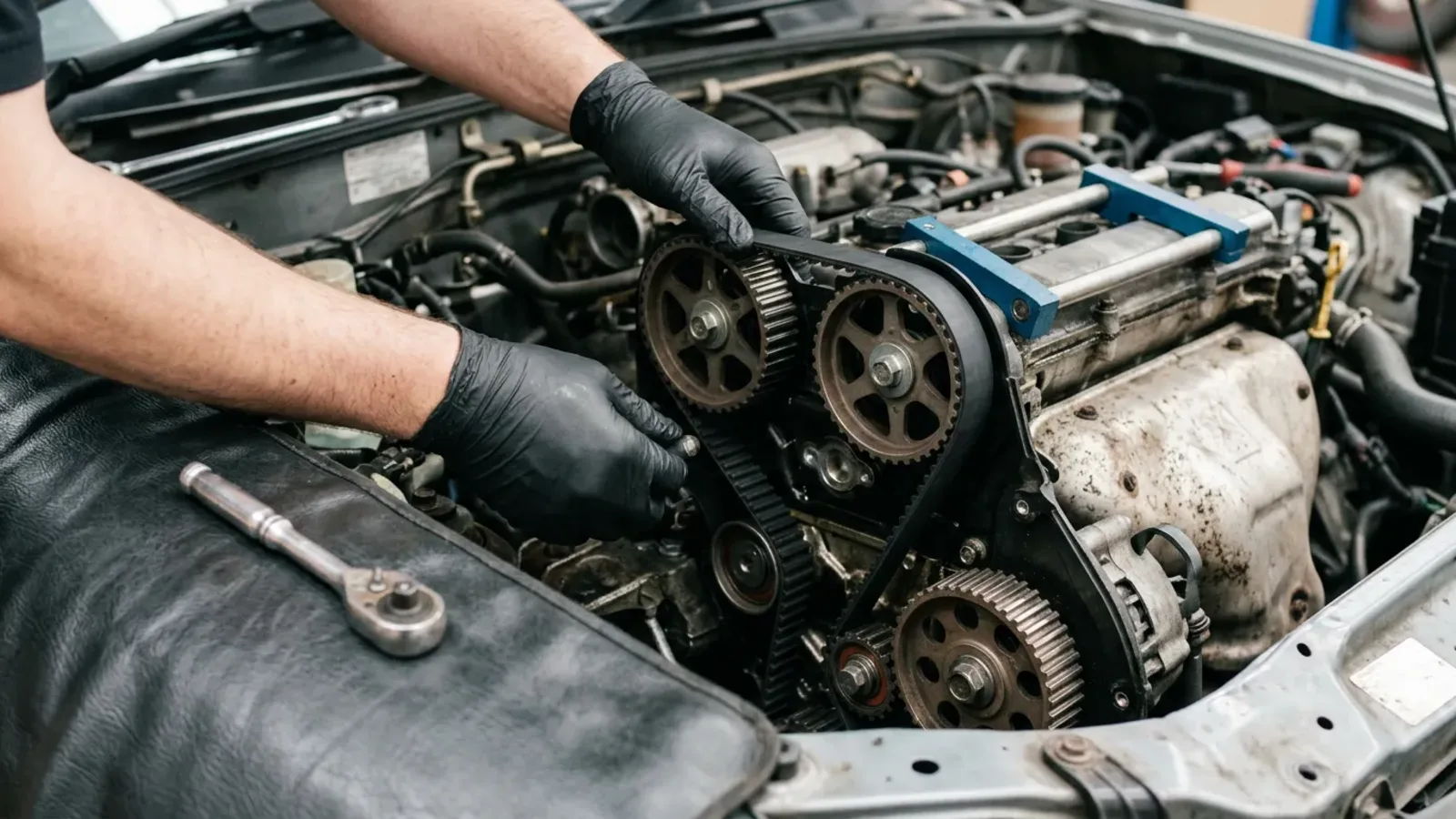
At Serwis Osowa we plan timing belt/chain replacement according to the manufacturer's recommendation for the specific engine code, in kilometres or years, whichever comes first. With a belt we replace the whole kit: belt, tensioner and pulleys, and where the water pump is driven by the timing belt, usually the pump and coolant as well. With a chain we first assess its stretch and the condition of the tensioner. We service all makes, including engines with a belt running in oil.
- Dry belt, wet belt and chain
- Kit with tensioner and pulleys
- Water pump and coolant
- Interval and recall/service campaigns by VIN
How often should the timing belt/chain be replaced on my car?
There is no single figure for all cars. In popular belt-driven engines the intervals are usually from about 60,000 to over 200,000 km, and the manufacturer also gives a limit in years. When a car does little mileage, on short city trips, it is the age of the belt that decides, because rubber ages even when the car is parked. If the manufacturer gives no time limit, about 5–6 years is assumed in practice.
The most reliable source is the service book or the service plan read out by VIN. For a second-hand car without an invoice for the timing belt/chain, it is safer to assume it has not been replaced and do it at the start.
Belt, wet belt or chain: how do they differ when replaced?
| Type | When to replace | What to watch out for |
|---|---|---|
| Toothed belt (dry) | According to the manufacturer: kilometres and years | Often snaps without prior symptoms |
| Belt in an oil bath | According to the manufacturer, intervals have been shortened at times | Sensitive to the type of oil and fuel in the oil |
| Chain | Usually after a wear diagnosis, no fixed date | Stretches if oil changes are neglected |
In many engines a snapped belt means the pistons hit the valves and a costly cylinder head repair. That is why with a belt the date matters, rather than waiting for something to start making noise. A chain usually warns you earlier: it rattles after a cold start and the control unit logs camshaft position correlation errors.
A Stellantis example: the timing drive in the 1.2 PureTech engine
The 1.2 PureTech petrol engine in its GEN1 and GEN2 generations (Peugeot, Citroën, Opel, DS) has a belt running in oil. The manufacturer has shortened the interval several times: the current recommendation for these engines is 100,000 km or 6 years, whichever comes first. A wearing belt can shed small rubber particles that clog the oil pump strainer, so the belt condition is assessed by measurement according to the manufacturer's procedure, not through the oil filler cap.
As an authorised service centre for Peugeot and Opel, we will check by VIN which engine version your car has, whether there are open recall/service campaigns and which oil is required. When the belt in oil is replaced, the oil and filter are replaced too.
What do we replace together with the timing belt?
- the belt, tensioner and idler pulleys, ideally as a complete kit;
- the water pump, if it is driven by the timing belt, because access to it requires the same dismantling;
- the coolant, when it is drained to replace the pump;
- the auxiliary belt and its pulleys, if they have to be removed anyway;
- shaft seals, when they leak, because oil on a dry belt shortens its life;
- with a chain: guides, sliders, tensioner, and sometimes the variable valve timing sprockets.
The exact scope depends on the engine. Before the repair, the service advisor will explain which parts are necessary and which are optional.
Symptoms not worth waiting on
- a metallic rattle at the front of the engine right after starting that quietens as it warms up;
- the engine warning light and timing correlation errors in the control unit memory;
- a warning light or message about low oil pressure (in that case stop the car);
- coolant leaking from under the timing cover or coolant loss, which may point to the water pump;
- squealing or whining from around the timing cover.
With such symptoms, start with computer diagnostics and an inspection. Serwis Osowa is at ul. Odyseusza 20 in Gdańsk Osowa, a few minutes from the Osowa junction on the Tricity Bypass.
Frequently asked questions
How long does timing belt/chain replacement take?
It depends on the model and the type of drive. Replacing a belt with a water pump usually fits within one working day; chains and engines with difficult access may need more time. The service advisor will confirm the pick-up date.
Does the water pump always have to be replaced with the timing belt/chain?
Not always. If the pump is driven by the timing belt, it is usually replaced at the same time, because a later failure would mean dismantling everything again. In engines where the pump is driven by the auxiliary belt or an electric motor, it is a separate decision.
Is a timing chain good for the life of the engine?
It often lasts a very long time, but there is no guarantee. If oil changes are neglected, the chain stretches and the tensioner and guides wear. The condition of the chain is assessed by diagnostics and listening to the engine.
Will you replace the timing belt/chain on a car from the USA?
Yes, we repair all makes, including American cars. Give the model and engine when booking so we can order the parts in advance.