You replace the timing belt/chain according to the manufacturer's recommendations for the specific engine, in kilometres or years, whichever comes first. In popular cars with a belt, intervals are usually from about 60,000 to over 200,000 km, and regardless of mileage it is worth replacing the belt after about 5–6 years. A chain usually has no fixed interval and is replaced when diagnostics show wear.
How often is the timing belt/chain replaced?
There is no single figure for all cars. The timing drive synchronises the crankshaft with the camshafts, and every manufacturer designs it differently. That is why the interval for your car is in the service book or in the maintenance plan available by VIN.
The range is wide. Polish motoring guides quote intervals from 60,000 to 240,000 km. The most common range is about 100–150,000 km. A time limit, usually a few years, always comes on top of the mileage. Whichever comes first applies.
How do you find the interval? Look in the service book or in the manual, in the section on the maintenance plan. If you do not have it, the workshop will read the plan by VIN. Also check whether the manufacturer changed the recommendation after the car came onto the market, because this happens more often than you think.
There is no separate rule for "how often on a diesel" and "how often on a petrol". There are diesels with a long interval and petrols with a short one. The specific engine code decides, not the type of fuel.
Belt, chain or belt in oil – what is the difference?
| Type | How often | What to watch out for |
|---|---|---|
| Toothed belt (dry) | Per the manufacturer, usually about 60–240,000 km plus a limit in years | Usually snaps without warning. Also ages when the car is standing |
| Belt in an oil bath | Per the manufacturer. Intervals have been shortened, for example in the 1.2 PureTech to 100,000 km / 6 years | Very sensitive to the type and condition of the oil |
| Chain | Usually no fixed interval, often lasts 200,000 km or more | Stretches if the oil is neglected. Replacement is more expensive |
A belt in oil (a wet belt) is used by Stellantis in the 1.2 PureTech and by Ford in some EcoBoost engines, among others. It runs more quietly and with less friction. In practice it requires oil exactly to the manufacturer's standard and keeping to the oil change dates.
Example intervals for popular engines
Below are examples for which we have a source. Treat them as an illustration of how much recommendations differ. The interval for your car depends on the engine code and year of manufacture.
| Car / engine | Timing drive | Interval or recommendation |
|---|---|---|
| VW Golf IV 1.9 TDI (2000) | Belt | 60,000 km |
| VW Golf VII 1.5 TSI (2017) | Belt | 240,000 km |
| 1.2 PureTech GEN1/GEN2 (Peugeot, Citroën, Opel, DS) | Belt in oil | Currently 100,000 km or 6 years. Previously 180, then 160,000 km |
| 1.5 BlueHDi (Peugeot, Citroën, 2018–2021) | Camshaft chain | Service campaign: chain check, and above 120,000 km replacement of the kit |
The Golf example shows that newer engines often have longer intervals. The PureTech example shows that a manufacturer can shorten a recommendation. If you bought a used car, check the current maintenance plan, not the one from a leaflet from years ago.
Why do years matter, not just kilometres?
A belt is reinforced rubber. It ages regardless of mileage: it hardens, cracks and loses elasticity. The rollers and tensioners also have bearings and grease, which wear out over time.
- A car driven little and for short distances, for example across Gdańsk to work, may not reach the kilometre limit even in 10 years. Then the time limit decides.
- Where the manufacturer gives no limit in years, guides recommend assuming about 5 years. Some mechanics talk of 5–6 years.
- For older diesels from the turn of the century, mechanics often advise shortening the interval by several tens of thousands of kilometres.
- Heavy use shortens life: towing a trailer, traffic jams, high temperatures, oil leaking onto the belt.
What is replaced together with the timing belt/chain?
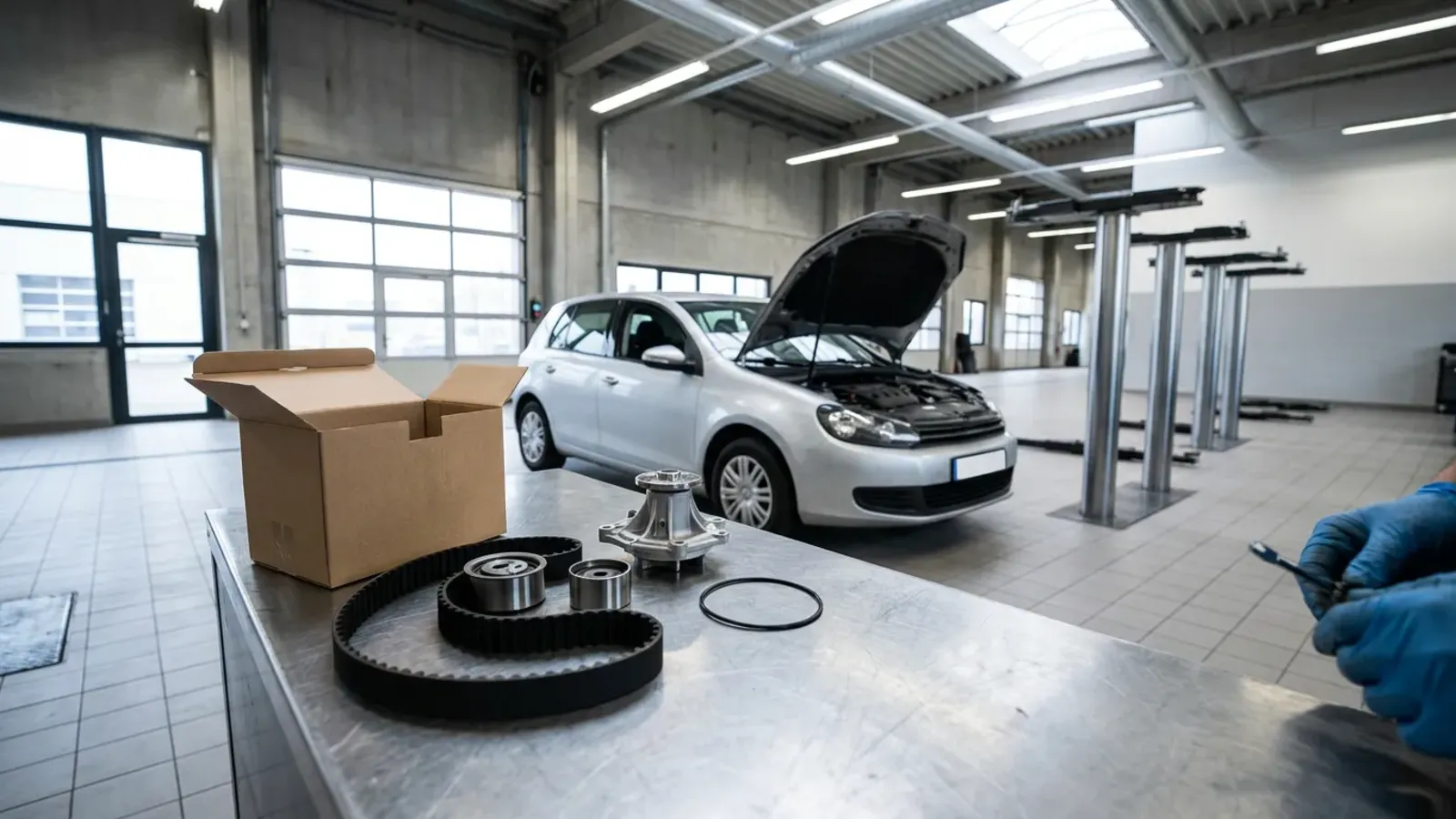
The belt alone is not enough. The whole kit is replaced, because the rollers and tensioner work as long as the belt does. A seized roller will destroy a new belt within weeks.
- The timing belt or chain.
- The tensioner (mechanical or hydraulic) and idler rollers.
- The water pump, if it is driven by the timing belt. Replacing it "while you are there" saves a second strip-down.
- Coolant, when it is drained to replace the pump.
- The auxiliary drive belt and its rollers, if they have to come off anyway.
- Shaft seals, if they leak. Oil on the belt shortens its life.
- With a chain: guides, tensioner, slides, and sometimes the variable-timing sprockets.
Symptoms of a worn timing drive
A dry belt often gives no symptoms before it snaps. That is why the date counts, not "until something starts knocking". A chain and a belt in oil usually warn earlier.
- Rattling or a metallic clatter from the front of the engine, especially right after a cold start. A typical symptom of a stretched chain.
- The engine light and camshaft correlation or camshaft position faults.
- Uneven running, juddering, loss of power, hard starting. A timing drive that has jumped a tooth can show itself this way.
- Squealing, whining or howling from the area of the timing drive. Often a worn roller or water pump bearing.
- Coolant leaking from under the timing cover, that is from the water pump.
- A drop in oil pressure and the oil warning light in engines with a belt in oil.
What happens when the timing belt snaps?
Most modern engines are interference designs. The valves and pistons partly occupy the same space, just at different times. When the belt breaks, the camshafts stop while the crankshaft keeps turning. The pistons strike the open valves.
- Most often it ends with bent valves and a cylinder head repair.
- In a worse case, the valve guides, pistons or even the cylinder head itself are damaged.
- The repair usually costs many times more than a planned timing replacement.
Bought a car and do not know when the timing was done? Without an invoice showing the date, mileage and scope of work, assume it needs replacing. A sticker under the bonnet is not proof.
At Serwis Osowa we will check your car's maintenance plan and the condition of the timing drive. We are an authorised dealer workshop for Opel and Peugeot and a Bosch Car Service, and we repair all makes, including US cars. Gdańsk Osowa, ul. Odyseusza 20, tel. 58 552 55 25, Mon–Fri 7:30–17:00, Sat 9:00–14:00.
Frequently asked questions
How long does a timing belt/chain replacement take?
In a simple engine, usually a few hours. In many modern cars it is a day's work. With a chain, or difficult access where the engine has to be lowered or removed, it can be as much as 2–3 days.
Does a timing chain have to be replaced?
A chain usually has no fixed replacement date, but it is not forever. It stretches, especially if oil changes are infrequent. It is replaced when diagnostics or symptoms, for example rattling and timing faults, indicate wear.
Can the timing replacement be put off by a few thousand kilometres?
It is not worth it. A belt snaps without warning, and the manufacturer gives the interval with a safety margin, not with a reserve for "a bit longer". Plan the replacement in advance, together with a service.
How can I check whether the timing has been replaced?
The best proof is an invoice with the date, mileage, VIN and a list of parts. An entry in the service book also helps. An inspection can suggest something, but it will not replace a document.
Does the water pump have to be replaced with the timing?
If the pump is driven by the timing belt, it is usually replaced during the same job. A worn pump can destroy a new belt, and replacing it separately means paying the same labour a second time.
Sources
- Interia Motoryzacja: Replacing the timing belt is a necessity. Neglect is a disaster (Golf IV 1.9 TDI and Golf VII 1.5 TSI examples)
- Interia Motoryzacja: Is the 1.2 PureTech engine still a minefield? (180,000 km interval shortened to 100,000 km)
- Auto Świat: Major 1.5 BlueHDi service campaign – timing chain, 28.10.2024
- Otomoto: How often to replace the timing (updated 20.01.2026)
- Cenauslug.pl: How much does timing replacement cost in 2026 (replacement time, limit in years), 01.2026