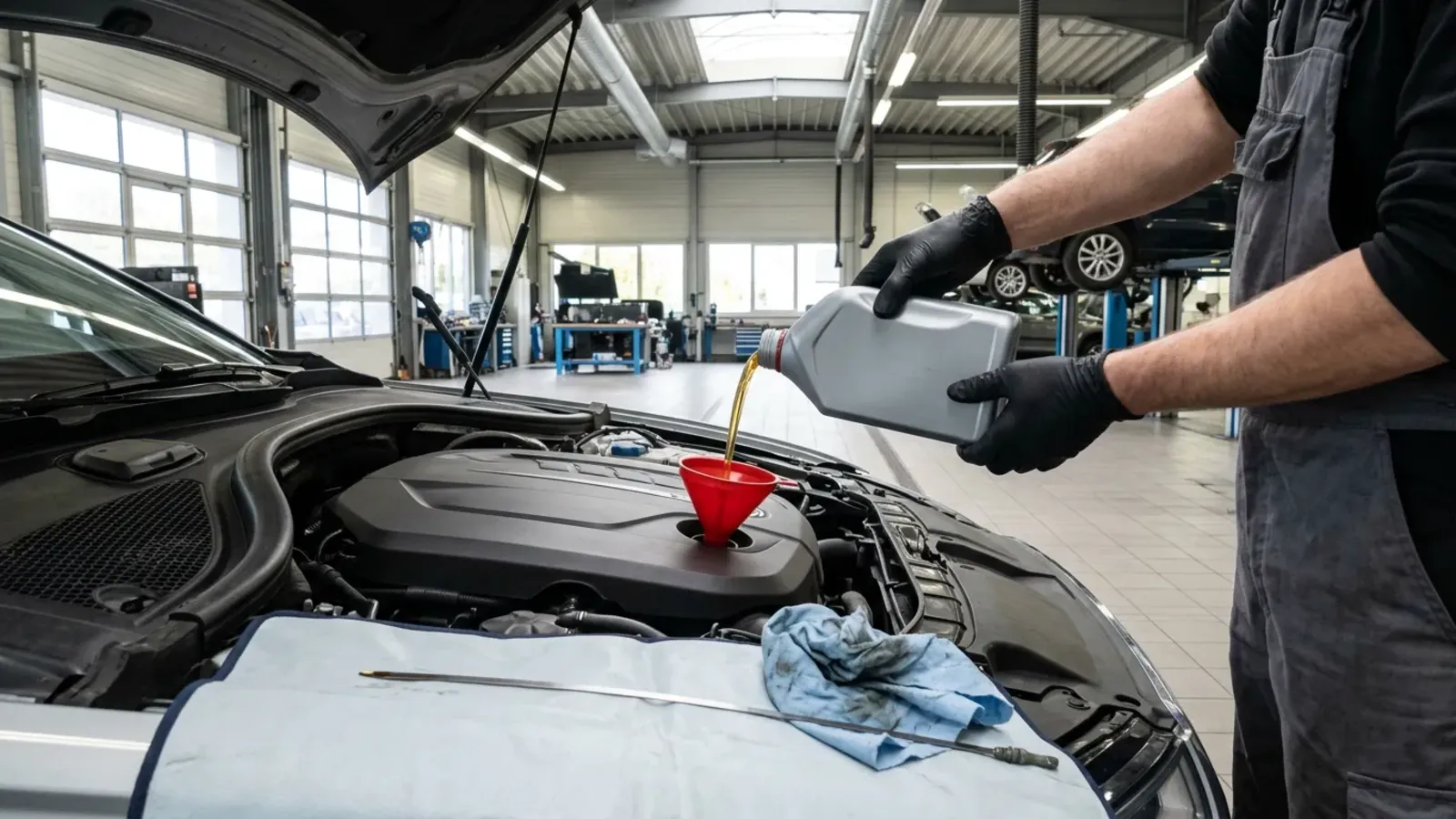
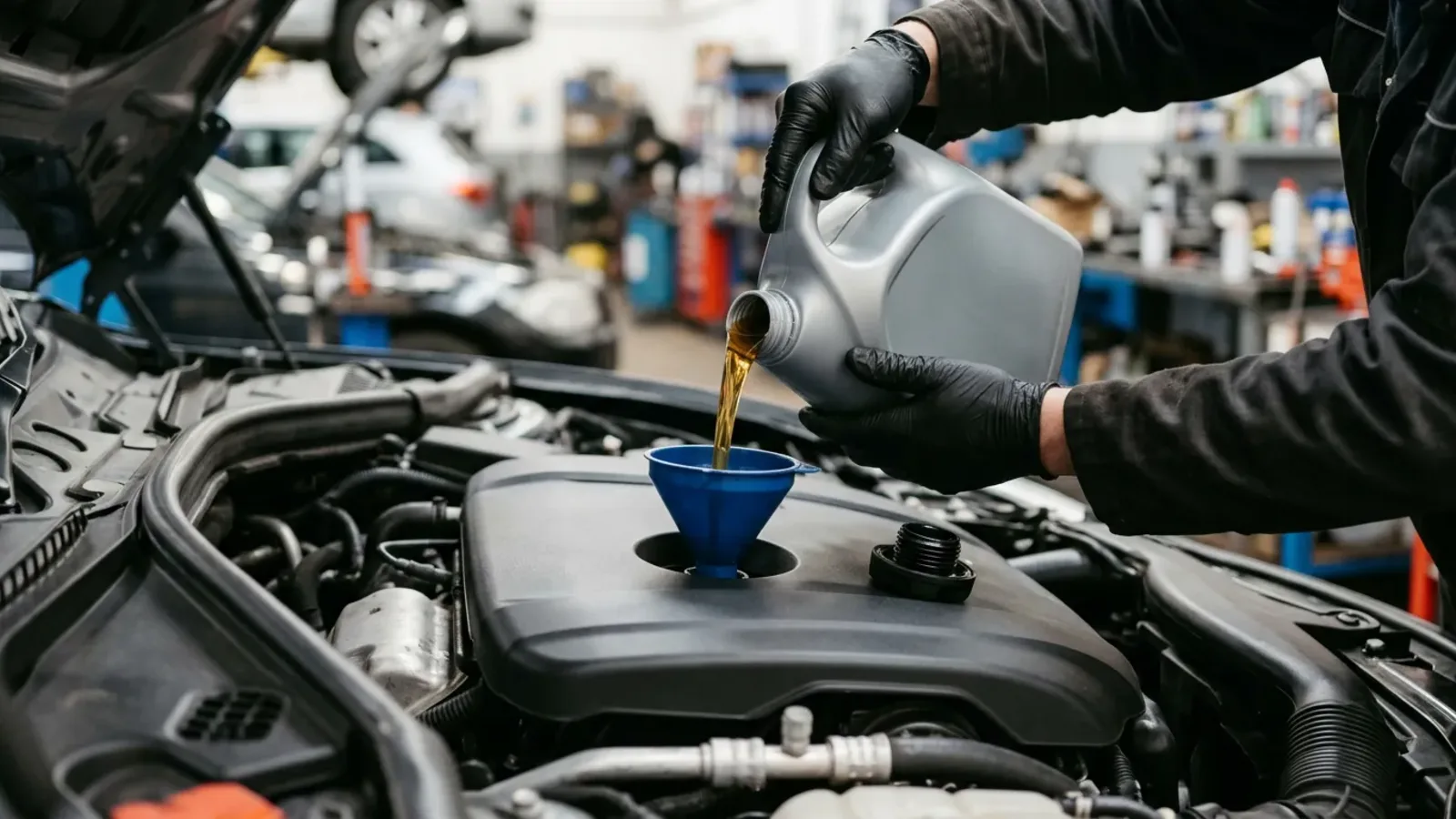
Change the engine oil according to the car's manual, but no less than once a year, even if you have not reached the mileage limit. If you drive mostly on longer routes, the manufacturer's interval is usually enough. With short city trips, LPG or a heavily loaded turbo engine, it is worth shortening it in practice to around 10–15,000 km.
How often to change oil according to the manufacturer?
The starting point is always the owner's manual or the service book. The manufacturer gives the interval in kilometres and in time, and whichever comes first applies. You will come across two approaches: a fixed interval (for example every year or every set number of kilometres) and a variable interval, often called Long Life or flexible service.
In Long Life mode the car's computer works out the change date itself based on driving style, oil temperature, the number of cold starts and engine load. For example, in Volkswagen Group cars with flexible service and calm motorway-style driving, the change may fall due after as much as 30,000 km or 2 years for petrol engines. The condition: oil with the right standard, for example VW 504 00 for petrol or VW 507 00 for diesel with a DPF.
A long interval is not a manufacturer's mistake. It is, however, calculated for specific conditions and a specific oil. If your car is driven differently from what the manufacturer assumes, it is worth changing the oil more often.
When is it worth changing oil more often?
Short trips do the most harm to oil. The engine does not warm up, and moisture and fuel that has not had time to evaporate collect in the oil. Daily commuting in Tricity traffic jams, a few kilometres to school and back, plus a Pomeranian winter with many cold starts: these are harder conditions for oil than 500 km on a motorway.
- City driving and short trips: the oil ages faster, even though the odometer shows few kilometres.
- LPG system: gas burns at a higher temperature, which puts more strain on the oil.
- Turbo engines, especially small petrol units with direct injection: an oil-lubricated turbocharger works at a very high temperature.
- Diesel with a DPF and frequent unsuccessful regenerations: fuel can get into the oil and dilute it.
- Towing a trailer, driving with a heavy load, sporty driving.
- US cars with an Oil Life indicator: the system calculates oil wear on an ongoing basis. GM states that the oil and filter must be changed at least once a year, even if no change message has appeared.
Indicative oil change intervals
The table below gives practical workshop recommendations, not manufacturer data. If your car's manual gives a shorter interval, the manual applies.
| Driving style | Interval (km) | Time |
|---|---|---|
| Mostly longer routes, few cold starts | As per manufacturer's manual | No longer than the manufacturer recommends |
| Mixed driving | approx. 15,000 km | At least once a year |
| Mostly city, short trips | approx. 10,000 km | At least once a year |
| LPG system | approx. 10,000 km | At least once a year |
| Turbo engine, towing, dynamic driving | approx. 10,000–15,000 km | At least once a year |
| US car with an Oil Life indicator | As per the indicator | At least once a year |
If the car is under warranty, stick to the scope and deadlines in the service book. You can also have the service done outside an authorised dealer workshop, as long as you meet these conditions.
Why must oil be changed at least once a year?
Oil ages not only with kilometres but also with time. The additives lose effectiveness, and the oil absorbs moisture from the air and oxidises. A car that covers 5,000 km a year is often driven in the worst way for oil: short distances on a cold engine.
That is why manufacturers give a time limit alongside kilometres. In its materials for owners, GM states outright that oil and filter should be changed at least once a year, even if the computer has not requested a change. For cars with a two-year interval, it is also worth considering an annual change if you drive mainly in town.
Which oil for the engine? How to read ACEA, API and manufacturer standards
On the bottle you will find three kinds of markings. Viscosity (for example 5W-30) is only one of them. The quality standard is more important, because it tells you whether the oil suits your engine and its exhaust after-treatment system.
- ACEA is the European classification. A/B classes (for example A3/B4, A7/B7) are oils for engines without sensitive filters. C classes (C2, C3, C4, C5, C6 and, from 2023, also C7) are oils with reduced sulphated ash, phosphorus and sulphur content, intended for cars with a DPF or GPF and a catalytic converter.
- API is the American classification. For petrol engines the current categories are API SP and, from 2025, API SQ. It matters mainly in cars from the US market.
- Manufacturer standards go further than ACEA and API. Examples: VW 504 00 and 507 00 (Long Life, usually 5W-30), GM dexos2 (European Opels with GM engines) and dexos1 Gen 3 (petrol GM cars from the US), PSA B71 2290 (5W-30, ACEA C3), B71 2312 (0W-30, ACEA C2) and B71 2010 (0W-20, ACEA C5).
- Stellantis is introducing a common system of standards, FPW 9.55535, which is gradually replacing the old PSA, Fiat and Opel standards. In newer Peugeots and Opels, check in the manual which standards the engine requires.
The rule is simple: first the standard from the manual, then viscosity, brand last. An oil from a good brand but without the required standard is not the right oil for your engine.
5W30 or 5W40 oil – what does viscosity mean?
The SAE viscosity marking has two parts. The number with the letter W (from "winter") describes how the oil behaves when cold. The lower it is, the more easily the oil reaches the bearings on a cold start. The second number describes viscosity at engine operating temperature. The higher it is, the "thicker" the oil is when hot.
5W30 and 5W40 oils behave similarly when cold. They differ when hot: 5W40 forms a thicker oil film, while 5W30 offers less resistance and helps lower fuel consumption. Many modern engines are designed for lower viscosity and narrower oil passages, so pouring in a "thicker oil to be safe" does not always help.
If the manual allows both viscosities, the choice depends on the condition of the engine and driving conditions. For a car under warranty or with a Long Life interval, stick exactly to what the manufacturer specifies.
What else to replace with the oil, and what about automatic gearbox oil?
The oil filter is replaced at every oil change. An old filter with trapped contaminants would quickly dirty fresh oil. It is also worth checking the air filter, cabin filter and fuel filter. Their intervals can differ from the oil's, so the service advisor will check them against your car's service plan. After the change, the service indicator also has to be reset.
Oil in an automatic gearbox is a separate matter. Some manufacturers describe it as lifetime oil, while others give a specific interval. In practice it is worth checking the condition of the oil in an automatic, especially in a car with high mileage, under heavy use or if it jerks when changing gear. The decision on replacement and method is made for the specific gearbox.
You can have the oil and filters changed with us in Gdańsk Osowa, at ul. Odyseusza 20. We service Opels and Peugeots as an authorised service centre, we also operate as a Bosch Car Service and we repair all makes, including US cars. Call: 58 552 55 25 (Mon–Fri 7:30–17:00, Sat 9:00–14:00). The choice of oil, scope and price are confirmed by the service advisor.
Frequently asked questions
How often should you change 5W30 oil?
Viscosity does not determine the interval. You change 5W30 oil as the car's manual and the oil standard specify, and for city driving in practice about every 10–15,000 km, but always at least once a year.
How do you choose engine oil by VIN?
The VIN lets you establish the exact version of the engine, and with it the required oil standard and viscosity. The most reliable source is the owner's manual or the manufacturer's service data. In a workshop, choosing oil by VIN is a standard procedure.
Can you mix two different oils?
In an emergency, topping up with a different oil of the same viscosity and standard will not do any harm. For everyday use it is better to top up with the same oil that is in the engine and, at the next opportunity, change all of it if the top-up was a large one.
Is topping up oil between changes a cause for concern?
A small amount of oil consumption is normal, and manufacturers give permissible values in the manual. If you are topping up more and more often, see blue smoke from the exhaust or leaks under the car, report it at a workshop.
How do you check the oil level correctly?
Park the car on level ground, wait a few minutes after driving for the oil to drain into the sump, pull out and wipe the dipstick, put it back in and read the level between the marks. Some cars have only an electronic reading in the on-board computer.