Every engine uses some oil, and the permitted limit is given by the manufacturer in the owner's handbook. Mazda's MX-5 handbook says consumption may be as high as 0.8 l per 1000 km, although a healthy engine usually uses far less. If you are topping up more and more often, first establish whether the oil is being burnt or is leaking. The most common causes of burning are worn piston rings, valve stem seals, the turbocharger and a faulty crankcase breather.
How much oil can an engine use? What is still normal
Pistons and valves work with clearances, so they are not one hundred per cent tight. A thin layer of oil on the cylinder wall partly evaporates and burns together with the mixture. A small amount of oil consumption is therefore a feature of every engine, not a fault. What matters is how much is lost and whether that figure is rising.
| Source | What it states | Converted |
|---|---|---|
| Mazda, MX-5 owner's manual | Oil consumption may be as high as 0.8 l/1000 km | 0.8 l/1000 km as the upper limit |
| MS Motorservice (Kolbenschmidt), modern passenger car engines | Usually below 0.05% of fuel consumption | Approx. 0.04 l/1000 km at 8 l/100 km fuel consumption |
| MS Motorservice, maximum for passenger cars | Up to 0.5% of fuel consumption | Approx. 0.4 l/1000 km at 8 l/100 km fuel consumption |
| Your car's handbook | The figure for the specific engine | This figure is decisive |
According to MS Motorservice, oil consumption is lowest after the engine has been run in and rises with age. Diesels usually use more oil than petrol engines, and turbocharged engines more than naturally aspirated ones, because the turbo is also lubricated with oil. A new engine that has not been run in, and a car driven hard or heavily loaded, also need more oil.
Within the manufacturer's limit, but topping up more from one service to the next? That is a signal to start measuring consumption accurately and have the engine checked before more serious symptoms appear.
Burning oil or a leak: how do you tell the difference?
Workshops distinguish two situations. Oil consumption is oil that enters the combustion chamber and burns there. Oil loss is oil that escapes from the engine through a leak. For the driver the effect is the same, as there is less oil on the dipstick, but the causes and the repair costs are completely different.
- Signs of a leak are stains under the car after it has been parked, an engine that is wet and oily underneath, drops on the engine undertray, and a smell of burnt oil after driving (oil dripping onto the hot exhaust).
- Typical leak points are the valve cover gasket, crankshaft and camshaft seals, the oil sump, the oil filter, the oil cooler, the vacuum pump and the turbocharger pipes.
- Signs of burning are a clear loss with no trace of a leak, bluish smoke from the exhaust, oil-fouled spark plugs and carbon deposits.
- Both can happen at once. That is why, with a large loss, it is worth first washing the underside of the engine and inspecting it again after a few hundred kilometres.
Watch out for the opposite situation. If the oil level rises, fuel may be collecting in the oil, usually with short-trip driving or frequent interrupted DPF regenerations. Fuel thins the oil and can mask oil being burnt at the same time, so this symptom also needs checking.
Why does an engine burn oil? The most common causes
Oil can reach the combustion chamber by several routes: from below the piston, through the valve guides, or from the intake (from the turbocharger or the crankcase breather). The table below lists the causes described by MS Motorservice in its material on oil consumption.
| Cause | What happens | How it is checked |
|---|---|---|
| Worn or stuck piston rings | Oil stays on the cylinder wall and burns, and blow-by gases increase | Compression test, cylinder leak-down test, endoscope |
| Worn valve stem seals and guides | Oil runs down the valve stems into the intake or exhaust | Observing the smoke, endoscope, inspection after removing the cylinder head |
| Turbocharger | Oil gets into the intake or exhaust, most often because of an oil return problem or crankcase pressure | Oil in the intake pipes and intercooler, shaft play, a clear oil return line |
| Faulty crankcase breather (crankcase ventilation) | Excessive crankcase pressure, oil mist is drawn into the intake | Crankcase pressure measurement, inspection of the breather valve and separator |
| Oil level too high | The crankshaft dips into the oil, creating foam and mist that the breather draws in | Checking the level and the amount of oil at the oil change |
| Leaking intake, wrong air filter | Dust gets into the cylinders and speeds up wear of the rings and cylinder walls | Inspection of the intake and filter, service history |
Oil burning is also encouraged by neglected oil changes, low-quality or off-specification oil, and fuel in the oil, which washes the oil film off the cylinder walls. Small turbocharged engines add high operating temperatures to this. How to choose the right oil is explained in our guide to choosing engine oil.
Signs that your engine is burning oil
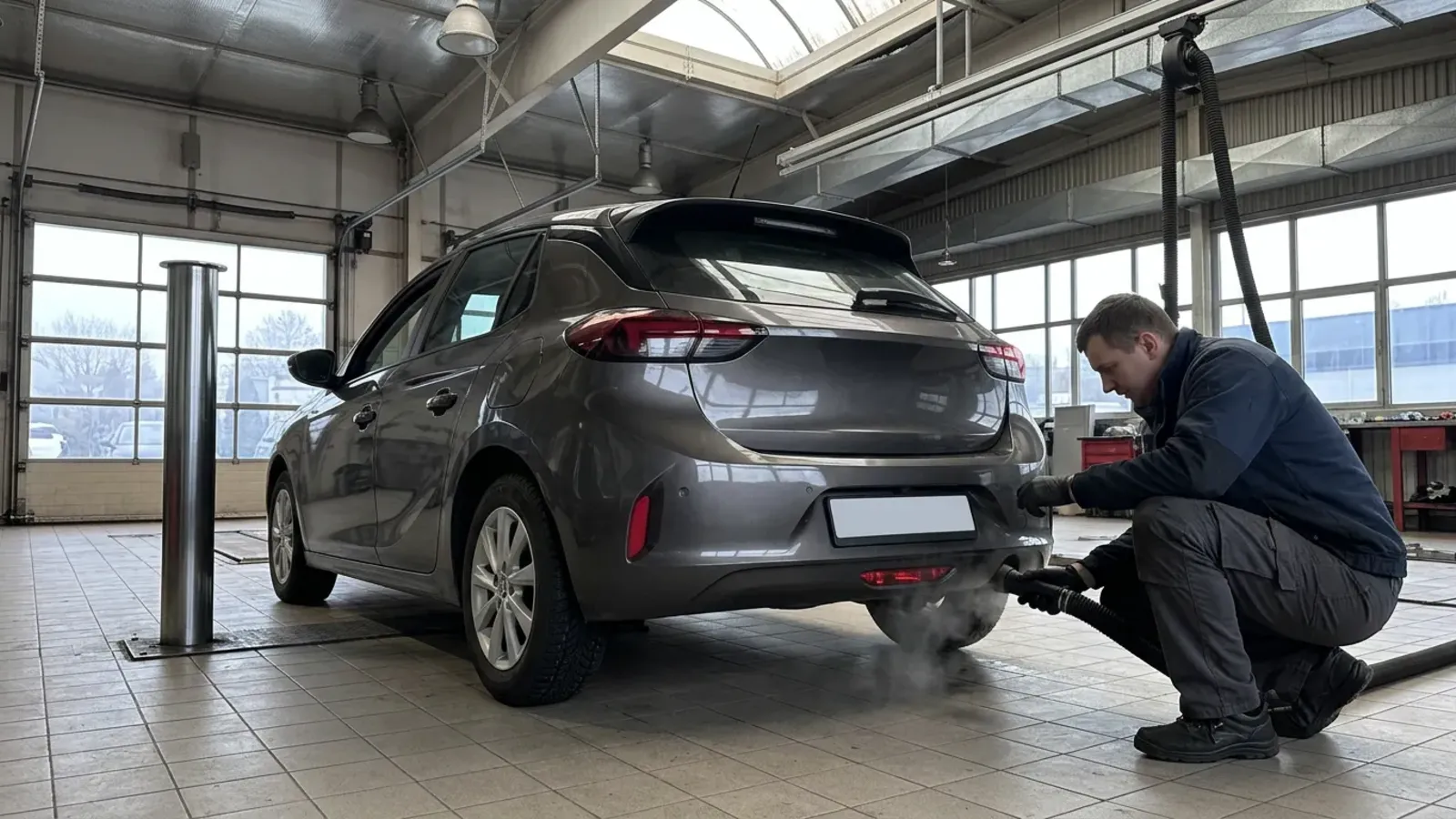
- Bluish or bluish-grey smoke from the exhaust, especially after start-up, after a long spell idling or under hard acceleration.
- A smell of burnt oil from the exhaust.
- Oil-fouled or carboned-up spark plugs, misfires and rough running.
- Oil in the intake pipes and in the intercooler (in turbocharged engines).
- Faster clogging of the particulate filter and possible damage to the catalytic converter, because ash from burnt oil builds up in the exhaust system.
- A low oil level message or the oil pressure warning light. The oil pressure warning light means you must stop the car immediately.
The colour of the smoke tells you a lot, but it is not conclusive. White smoke can mean water vapour or coolant, black smoke an over-rich mixture. We explain what the colour of exhaust smoke means in a separate guide. If a turbocharged engine is smoking, it is also worth knowing the symptoms of a failing turbo.
Oil loss is also one of the known problems of the 1.2 PureTech engine. Stellantis has extended protection for some of these engines, which also covers excessive oil consumption, so in such a car it is worth checking the conditions with an authorised dealer workshop by VIN.
How do you measure oil consumption properly?
Many "oil problems" are really mistakes in reading the dipstick. The car is parked on a slope, the oil has not had time to drain back into the sump, or the wrong amount was added at the oil change. Before you start looking for a fault, measure consumption in a repeatable way. The procedure below is based on MS Motorservice recommendations.
- Park the car on level ground. After switching off a warm engine, wait about 5 minutes for the oil to drain back into the sump.
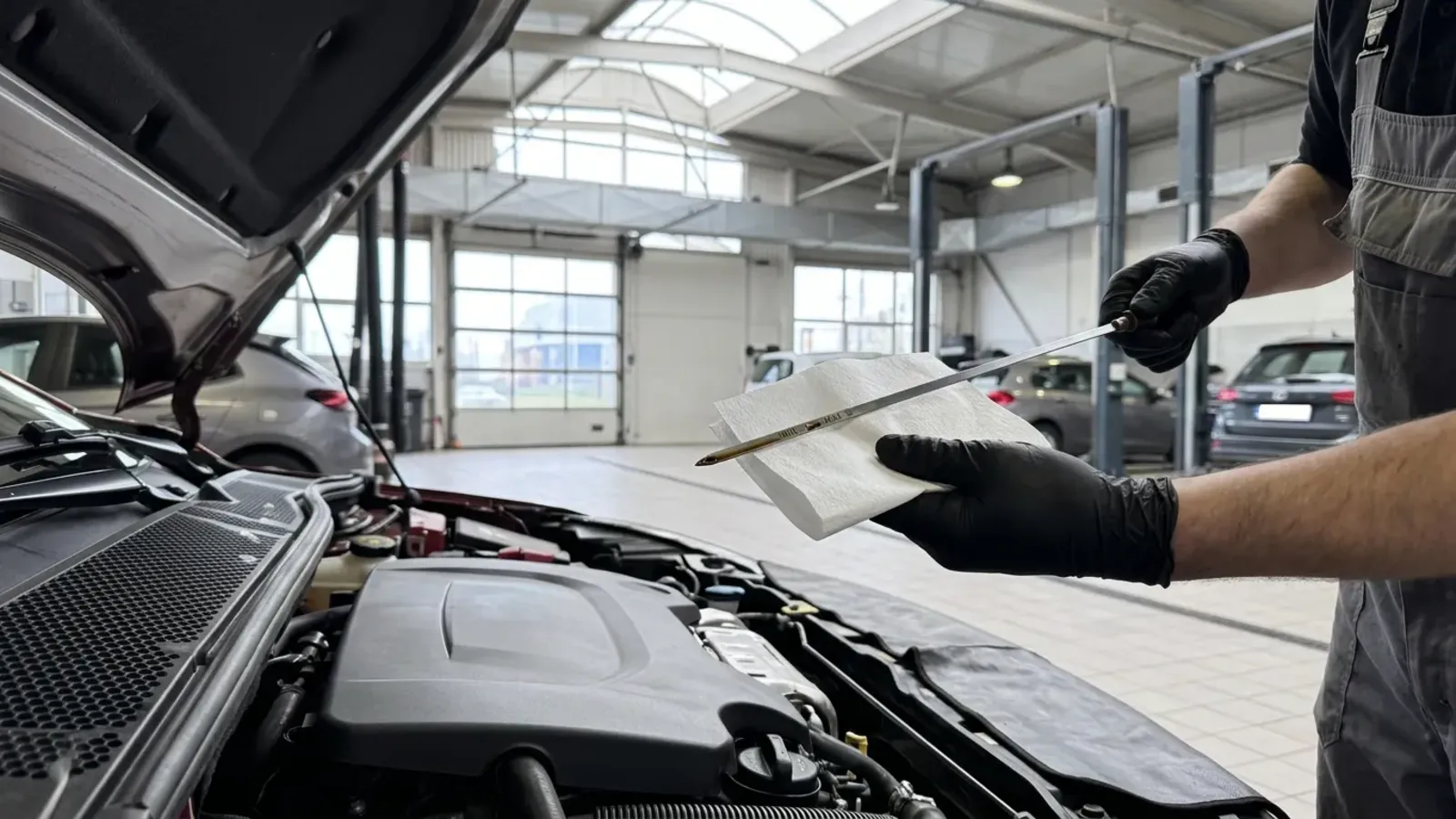
- Pull out the dipstick, wipe it, push it fully back in and pull it out again. When reading the level, hold the dipstick vertically with the tip pointing down, so the oil does not run up it.
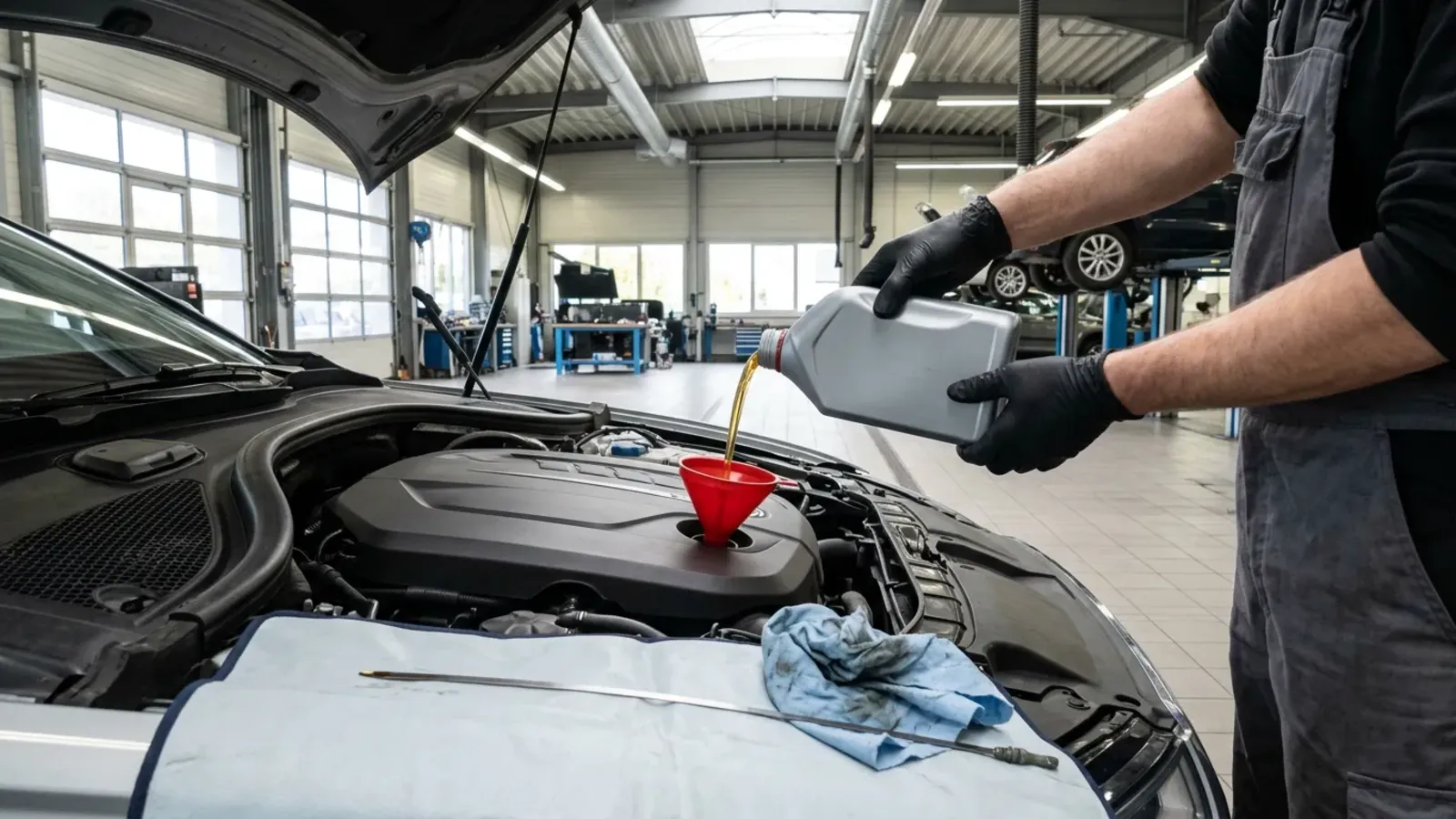
- Top up to the maximum mark, adding oil slowly, about 0.1 l at a time, and checking the level after each portion. Do not go above the maximum.
- Note the odometer reading and drive about 1000 km, recording the amount of fuel you put in.
- After 1000 km, check the level the same way and top up to the maximum. The amount of oil added is the consumption per 1000 km.
- For a more accurate result, divide the amount of oil added by the amount of fuel used and compare it with the manufacturer's figure.
In cars without a dipstick, the level is shown by the on-board computer, often only once certain conditions are met (temperature, time parked, level ground). Follow the procedure in the handbook. Also do not judge consumption in the first kilometres after an oil change, because some oil stays in the filter and passages, and the oil change quantity is sometimes confused with the capacity of a dry engine.
What does the workshop check, and when is a repair worthwhile?
Diagnosis starts with questions: how much oil is lost, since when, with what kind of driving, when the last oil change was and with what oil. The mechanic then looks for leaks, and only if there are none, or they do not explain the loss, checks how the oil is reaching the combustion chamber.
- Reading fault codes and engine parameters, e.g. misfires and mixture corrections, as part of computer diagnostics.
- Inspecting the spark plugs in a petrol engine: an oil-fouled plug points to a specific cylinder.
- A compression test and a cylinder leak-down test, which show whether the problem lies with the rings, the valves or the head gasket.
- Inspecting the cylinders with an endoscope camera through the spark plug or injector hole: traces of oil, carbon deposits, the condition of the cylinder walls.
- Checking the crankcase breather: the valve, the oil separator and crankcase pressure.
- Checking the turbocharger: oil in the intake and intercooler, shaft play, a clear oil return line.
Whether a repair is worthwhile depends on the cause. The crankcase breather, the turbo oil return line or a gasket are relatively small jobs. In many engines valve stem seals can be replaced without removing the cylinder head, while in others this requires more dismantling. The most expensive causes are in the piston and crank assembly. MS Motorservice points out that wear in an engine usually affects all components, so a partial repair, e.g. replacing only the rings, often brings little improvement. With a high mileage, you then need to compare the cost of an overhaul with the value of the car.
You can have oil loss diagnosed at Serwis Osowa, ul. Odyseusza 20 in Gdańsk Osowa. We are an authorised Opel and Peugeot service centre and a Bosch Car Service, and we repair all makes, including cars from the USA. Call: 58 552 55 25 (Mon–Fri 7:30–17:00, Sat 9:00–14:00). The scope of the repair and the quote are confirmed by a service advisor after diagnosis.
Frequently asked questions
Can you drive if the engine is using oil?
Yes, provided you check the level regularly and top up, and the loss is within the manufacturer's limit. Driving with the level below the minimum risks damage to the bearings and turbocharger, and if the oil pressure warning light comes on you must stop immediately.
Will a thicker oil reduce oil burning?
Sometimes it slightly reduces the loss, but it does not remove the cause, and an oil with a viscosity or specification not permitted by the manufacturer can harm other engine systems. It is better to find out where the consumption comes from and use oil that complies with the handbook.
Do oil additives help with an engine using oil?
Do not count on them as a repair. If the cause is stuck piston rings, any decision about flushing or cleaning is made after diagnosis. Additives will not work on worn valve stem seals, a turbo or a faulty crankcase breather.
How much oil can a new engine use?
During running-in, consumption can be higher than later, and manufacturers state this in the handbook. After running-in, consumption should settle down. If a car under warranty uses more than the manufacturer allows, document your measurements and report it to the workshop.
Does oil burning affect the technical inspection?
Indirectly, yes. An engine that smokes heavily or has a catalytic converter or particulate filter damaged by oil may fail to meet exhaust emission requirements at the periodic technical inspection (MOT equivalent). It is worth fixing the cause before the inspection is due.
Sources
- MS Motorservice – Oil consumption and oil loss (definitions of oil consumption and oil loss, limit values, measuring procedure, causes)
- MS Motorservice Technipedia – When is an engine consuming too much oil? (up to 0.5% of fuel consumption in passenger cars)
- Mazda MX-5 – owner's manual, Owner Maintenance Precautions (oil consumption up to 0.8 l/1000 km)