
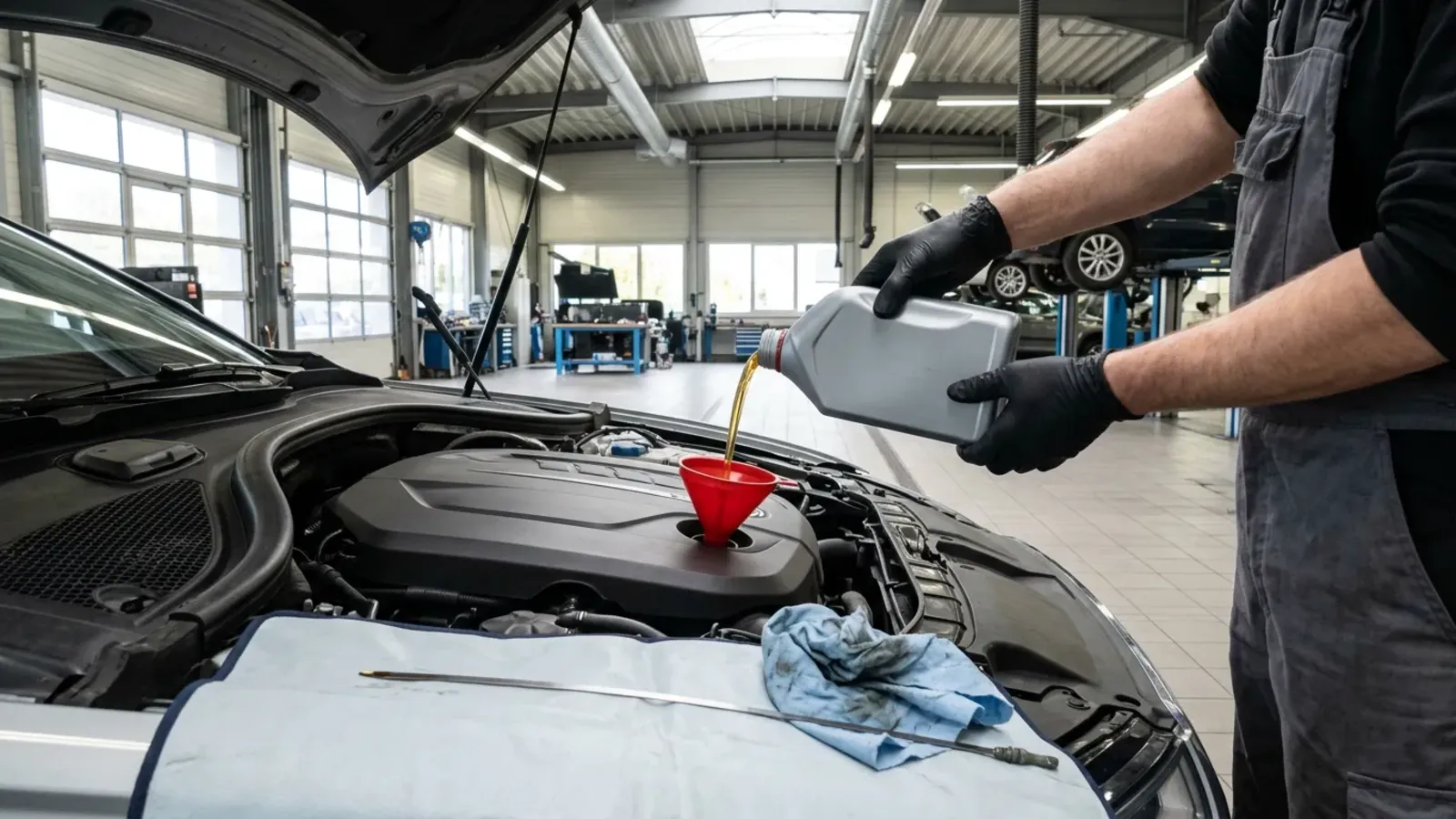
The right engine oil is one that has the specification (approval) required by the car manufacturer and a viscosity permitted in the owner's handbook. You will find the specification, e.g. VW 504 00, MB 229.52 or PSA B71 2312, in the handbook, the service book or the service data for your VIN. Viscosity alone, e.g. 5W30, is not enough, because oils with very different properties are sold under the same grade. The brand of oil is a secondary choice.
How do you choose engine oil step by step?
It is easy to get lost in front of a shelf of oils, because every bottle carries several markings and advertising slogans. The simplest approach is to choose in a fixed order and not start with the price or with what a friend with the same model recommends, because the same model is often built with several engines that have different requirements.
- Identify the exact engine version. The registration certificate, the engine code on the plate or the VIN will help; from the VIN a workshop can read the specification.
- Check in the owner's handbook or service book which oil specification the manufacturer requires. Often one specific approval is given, or several to choose from, depending on the market and the service mode.
- Check the permitted viscosities. The handbook usually gives one or more SAE grades, sometimes with a range of ambient temperatures.
- Choose an oil whose label or product data sheet shows that specification as an approval, or at least as a declaration that it meets the requirements, and the correct viscosity.
- Only at the end choose the brand and price from among the oils that meet the two previous conditions.
If the car is under warranty or runs on Long Life service, stick exactly to the specification in the service book and keep invoices or entries showing which oil was used.
What do 5W30, 5W40 and other SAE viscosity grades mean?
A marking such as 5W-30 is a viscosity grade under the American SAE J300 standard. The part with the letter W (for winter) describes how the oil behaves when cold: the lower the number before the W, the more fluid the oil is at low temperature and the faster it reaches the bearings on start-up. The number after the dash describes viscosity at 100 °C, close to engine operating temperature. The higher it is, the thicker the oil when hot.
| Grade | What it describes | Standard requirement (simplified) |
|---|---|---|
| 0W | Cold start | Cranking test at −35 °C |
| 5W | Cold start | Cranking test at −30 °C |
| 10W | Cold start | Cranking test at −25 °C |
| 20 | Viscosity when hot | 6.9 to below 9.3 mm²/s at 100 °C |
| 30 | Viscosity when hot | 9.3 to below 12.5 mm²/s at 100 °C |
| 40 | Viscosity when hot | 12.5 to below 16.3 mm²/s at 100 °C |
The SAE standard says only something about viscosity. It says nothing about the oil's resistance to oxidation, its ash content, turbocharger protection or whether the oil is suitable for a car with a particulate filter. That is what quality classes and manufacturer specifications are for.
ACEA and API specs: what do the A/B and C classes mean?
ACEA is the association of European car manufacturers, which publishes sequences of requirements for oils. In the current 2023 edition there are two groups for passenger cars. The A/B classes are for petrol and diesel engines without sensitive exhaust aftertreatment. The C classes have a limited content of sulphated ash, phosphorus and sulphur (SAPS), so that they do not clog DPF and GPF filters or harm catalytic converters.
| Class | SAPS level | HTHS viscosity at 150 °C | For which engines |
|---|---|---|---|
| A3/B4 | Full (high SAPS) | at least 3.5 mPa·s | Petrol and diesel without a DPF, also extended intervals |
| A5/B5 | Full | 2.9–3.5 mPa·s | Engines designed for low-viscosity oil; not for every engine |
| A7/B7 | Full | 2.9–3.5 mPa·s | As A5/B5, plus protection against LSPI in turbocharged direct-injection petrol engines |
| C2 | Medium (mid SAPS) | at least 2.9 mPa·s | Cars with a DPF/GPF and catalytic converter |
| C3 | Medium | at least 3.5 mPa·s | Cars with a DPF/GPF and catalytic converter |
| C4 | Low (low SAPS) | at least 3.5 mPa·s | Cars with a DPF/GPF and catalytic converter |
| C5, C6 | Medium | 2.6 to below 2.9 mPa·s | Fuel-saving oils, only where the manufacturer permits them |
| C7 | Medium | 2.3 to below 2.6 mPa·s | New 2023 class for very thin oils (e.g. 0W-16), with manufacturer approval |
HTHS viscosity is viscosity measured at high temperature and high shear, that is, in conditions similar to those in the bearings. An engine designed for oil with an HTHS of at least 3.5 mPa·s should not be given oil from a class intended for a lower HTHS, even if the SAE grade looks similar. For the A5/B5 and A7/B7 classes, ACEA states explicitly that they are unsuitable for some engines.
API is the American classification. The letter S stands for petrol engines, C for diesel engines, and the further the second letter is in the alphabet, the newer the category. Since 31 March 2025, API SQ has applied, introduced together with ILSAC GF-7, and according to Chevron SQ oils can be used where API SP was previously recommended. In Europe, API matters mainly for cars imported from the USA, whose handbooks often give API or a manufacturer specification instead of ACEA.
Manufacturer specs: VW 504 00, MB 229.52, BMW LL-04, dexos2, PSA B71
Car manufacturers' specifications are usually stricter than ACEA. The oil has to pass additional tests in that make's engines, and the oil producer obtains an approval for a specific product. That is why the approval in the handbook matters more than viscosity alone: two 5W-30 oils can carry different specifications, and only one of them will be right for your engine.
| Make | Example specifications | Worth knowing |
|---|---|---|
| Volkswagen, Audi, Škoda, Seat, Cupra | VW 504 00 (petrol), VW 507 00 (diesel) | Longlife III specifications, used with both flexible and fixed service |
| Mercedes-Benz | MB 229.51, MB 229.52 | Low-ash oils; 229.52 replaces 229.51 |
| BMW, MINI | BMW Longlife-04 | Based on ACEA C3, used in many models from model year 2004 |
| Opel (GM-era engines) | GM dexos2 | Based on ACEA C3; replaced by a newer specification in some engines |
| Peugeot, Citroën, DS, Opel (PSA engines) | PSA B71 2290 (5W-30), B71 2312 (0W-30), B71 2010 (0W-20) | Each specification has an assigned viscosity; the choice depends on the engine version |
| Ford | WSS-M2C913-D, WSS-M2C950-A | 950-A is a 0W-30 oil developed for Euro 6 TDCi diesels |
| Renault, Dacia | RN 17, RN 0720 | RN 17 is based on ACEA C3, RN 0720 on ACEA C4 for diesels with a particulate filter |
Watch the wording on the bottles. "Approved" (Freigabe) means the car manufacturer has approved that oil. "Meets" or "suitable for" is a declaration by the oil producer. In a car under warranty or on Long Life service, it is safer to choose an oil with an approval.
A special case is the 1.2 PureTech engine with a timing belt running in oil. Oil outside the specification speeds up belt degradation, so you must stick to the Stellantis specification given for that version. Depending on the version this is usually PSA B71 2312 (0W-30), and in some newer engines B71 2010 (0W-20), which Mobil lists for EB2DT units. We will check the exact specification for your car by VIN.
5W30 or 5W40: which oil should you choose?
This is one of the most common questions, and the answer is short: the one the handbook permits, with the required specification. When cold, both oils belong to the same 5W grade. They differ in viscosity at operating temperature and, in practice, also in specifications, because most 5W-30 oils are ACEA C2 or C3 oils, while among 5W-40 oils you more often find full-ash A3/B4 oils.
| 5W-30 | 5W-40 | |
|---|---|---|
| Viscosity when cold | 5W grade | 5W grade (the same) |
| Viscosity at 100 °C | 9.3 to below 12.5 mm²/s | 12.5 to below 16.3 mm²/s |
| Typical specifications on the market | Often ACEA C2/C3, VW 504/507, MB 229.51/229.52, BMW LL-04, dexos2 | Often ACEA A3/B4 or C3, older VW 502 00/505 00, MB 229.3/229.5 |
| Where it fits | Newer engines designed for lower viscosity, cars with a DPF/GPF, Long Life | Engines for which the manufacturer specifies a 40 oil, often older designs |
| Should you switch on your own | Only if the handbook permits both viscosities | Only if the handbook permits both viscosities |
Pouring thicker oil "to be safe" into an engine that requires 0W-20 or 0W-30 does not improve lubrication. Such engines have a lubrication system, tensioners and variable valve timing matched to a specific viscosity and specification, and thicker oil reaches them more slowly after a cold start. Conversely, a 5W-30 oil without the required specification in an engine intended for 5W-40 with an HTHS of 3.5 mPa·s may provide too thin an oil film under load.
Can you mix and top up with different oils?
Between changes it is best to top up with the same oil that is already in the engine. It is worth keeping a litre from the same batch in the boot, or at least an oil with the same specification and viscosity. In an emergency, when the level is at the minimum, it is better to add a different brand of oil with the same specification than to carry on driving without topping up. After a larger top-up with a different oil, it is sensible to bring the oil change forward.
- Do not top up with an A/B-class oil in a car with a DPF or GPF if the manufacturer requires a C class. A single small top-up will not destroy the filter, but it should not become a habit.
- Long Life oil only makes sense with a Long Life interval and the right approval. A long interval without suitable oil, or Long Life oil with mostly short-trip driving, is a common cause of sludge and faster wear.
- Having to top up often is a separate problem. If you top up regularly, check whether the engine is burning oil or leaking it.
- Do not fill above the maximum mark on the dipstick. Too high a level is also harmful, because the oil foams and gets into the intake through the crankcase breather.
You can have your oil changed, with the specification selected by VIN, at Serwis Osowa, ul. Odyseusza 20 in Gdańsk Osowa. We are an authorised Opel and Peugeot service centre and a Bosch Car Service, and we service all makes, including cars from the USA. Call: 58 552 55 25 (Mon–Fri 7:30–17:00, Sat 9:00–14:00). The type of oil, the scope of work and the quote are confirmed by a service advisor.
Frequently asked questions
Where can I check which oil my car needs?
In the owner's handbook, usually in the technical data or maintenance chapter, and in the service book. Some cars also have a sticker under the bonnet. If you do not have the documents, the workshop will establish the specification and viscosity from the VIN.
Is more expensive oil better?
Not automatically. The most expensive oil without the specification required by the manufacturer will be a worse choice than a cheaper oil with the right approval. Price only matters when comparing oils that meet the same requirements.
Can synthetic oil be used in an old engine?
Usually yes, if it has the specification and viscosity permitted for that engine. The problem is often not the oil itself but the condition of the engine: in a neglected engine, switching to a different oil can reveal existing leaks or carbon deposits, so it is worth discussing with a mechanic.
Which oil for a car with a DPF?
One that has the specification required by the manufacturer, most often an ACEA C class or a manufacturer specification based on that class. Full-ash oils (e.g. A3/B4) speed up filter clogging and should not be used unless the handbook permits them.
Do I need to switch to a thinner oil in winter?
Not in the Polish climate. 0W or 5W multigrade oils cope easily with the frosts found in Poland. All you need is an oil with the viscosity permitted in the handbook and regular changes according to the service schedule.
Sources
- ACEA – Oil Sequences 2023 for light-duty engines (A/B and C classes, SAPS level, minimum HTHS viscosity, C7 class)
- LIQUI MOLY – Classifications and specifications (meaning of SAE, ACEA and API classes, VW, MB, BMW, GM, PSA, Ford and Renault specifications)
- SAE J300 – engine oil viscosity grades (cold test temperatures, viscosity at 100 °C)
- Chevron Lubricants – Understanding the new API SQ category (API SQ and ILSAC GF-7 from 31 March 2025)
- Mobil – Mobil Super 3000 Formula P 0W-20 (PSA B71 2010 approval, recommended for EB2DT PureTech engines)