Fit winter tyres when the average daily temperature starts to fall steadily below about 7°C and morning frosts occur. In Tricity this is usually around the turn of October and November, and in the Kashubian hills and on roads outside the city it can be earlier. Go back to summer tyres when the temperature stays above 7°C for a dozen or so days in a row and there is no frost at night.
Where does the 7°C rule come from?
The 7°C rule is a rule of thumb, not a law. It is promoted by tyre manufacturers. It is about the rubber compound. A summer tyre is designed for warm asphalt. When it gets cold, its rubber hardens and grips the road surface less well. The winter compound stays soft even at low temperatures, and the dense tread cuts (sipes) bite into snow and slush.
7°C is a conventional threshold around which the advantage of a winter tyre starts to become clear. It is not a limit at which a summer tyre suddenly stops working. That is why you should look at the average daily temperature and at the mornings, not at a single warm day.
What counts is the temperature at the time you drive. If you leave at 6:30 and the thermometer shows 2°C, those are the conditions your tyre is judged on, not 11°C at noon.
When to switch to winter tyres in Tricity?
Pomerania has a climate moderated by the sea. In Gdańsk itself snow lies for a shorter time than inland, and autumn can be long and warm. That does not mean winter is easy here. Frequent damp, drizzle and fog mean that black ice appears on the asphalt at temperatures close to zero. Bridges, flyovers and stretches open to the wind freeze fastest, for example on the Tricity Bypass.
If you commute from Osowa, Chwaszczyno, Żukowo or further from Kashubia, bear in mind that it is colder on the moraine hills than by the sea. There, frost and the first snow can arrive a few days or weeks earlier than in the city centre. That is why, in practice, it is worth having winter tyres fitted by mid-November, and even by the end of October if you drive a lot outside the city or early in the morning.
| Temperature and conditions | Decision |
|---|---|
| Average above 10°C, nights without frost | Stay on summer tyres, but book a changeover slot |
| Average 7–10°C, cool mornings | Time to change, especially if you commute from outside the city |
| Average below 7°C for several days | Fit winter tyres without waiting for snow |
| Morning frosts, fog, wet asphalt close to 0°C | Winter tyres are a must as a matter of common sense, risk of black ice |
| Snow, slush, a trip to the mountains | Winter tyres with the 3PMSF marking and a tread of at least 4 mm |
| In spring, average above 7°C for 2–3 weeks | Go back to summer tyres |
At the peak of the season, workshop slots disappear quickly. The first forecast frost is usually the day when everyone calls at once. It is better to book the changeover in advance.
Are winter tyres compulsory in Poland?
No. Polish regulations do not require driving on winter tyres and there is no fine for not having them. You can legally drive on summer tyres all year round. There is, however, a requirement for roadworthy tyres. The minimum tread depth is 1.6 mm, and tyres on one axle must be of the same type and size. Driving on worn or damaged tyres can result in a fine, and a police officer may retain the registration certificate.
The second matter is insurance. Third-party liability (OC) insurance will cover the injured party's losses regardless of the tyres. For comprehensive cover (AC), the scope of protection and exclusions are described in the general terms and conditions (OWU) of your policy. If the condition of the tyres was related to the damage, the insurer may look into it. Check your OWU rather than assuming it will be all right.
Abroad it is different. In Germany, Austria, the Czech Republic or Slovakia, winter tyres are required in winter conditions, and some countries also require a minimum tread depth higher than 1.6 mm, for example 4 mm in the Czech Republic. Before a ski trip, check the rules of the countries you will drive through.
How to check whether your winter tyres are fit for another season
- Tread: the legal minimum is 1.6 mm, but a winter tyre loses effectiveness in snow much earlier. Experts and manufacturers recommend replacing winter tyres at around 4 mm. Measure the tread in several places, including at the inner edge.
- The 3PMSF marking (a mountain symbol with three peaks and a snowflake) confirms that the tyre has passed a snow test. M+S alone is a manufacturer's declaration without such a test. A true winter tyre has both symbols.
- Tyre age: you can read it from the DOT code on the sidewall. The last four digits are the week and year of manufacture, for example 3221 means week 32 of 2021. Rubber ages even in storage. After a few years it hardens, even if the tread looks fine. It is better to replace tyres that are about 10 years from manufacture.
- Condition of the sidewalls and shoulder: cracks, bulges and signs of kerb impact are a signal to replace, not to run another season.
- Even wear: if a tyre wears on one edge, the problem is the alignment, not the tyre. A new set will wear the same way.
All-season or winter tyres – which to choose?
An all-season tyre is a compromise. In summer it is worse than a summer tyre, in winter weaker than a winter one, especially on snow and ice. In return, you avoid changing twice a year and storing a second set.
- All-season tyres make sense if you drive mainly in town, cover low mileage, do not travel to the mountains and can stay at home on a day of heavy snowfall. Choose models with the 3PMSF symbol.
- Choose winter tyres if you commute daily from outside Gdańsk, leave early in the morning, drive a heavier car, an SUV or a van, or plan a ski trip.
- Whatever you choose, keep an eye on the tread. An all-season tyre with 3 mm of tread in winter is already a poor tyre.
What to check when changing tyres
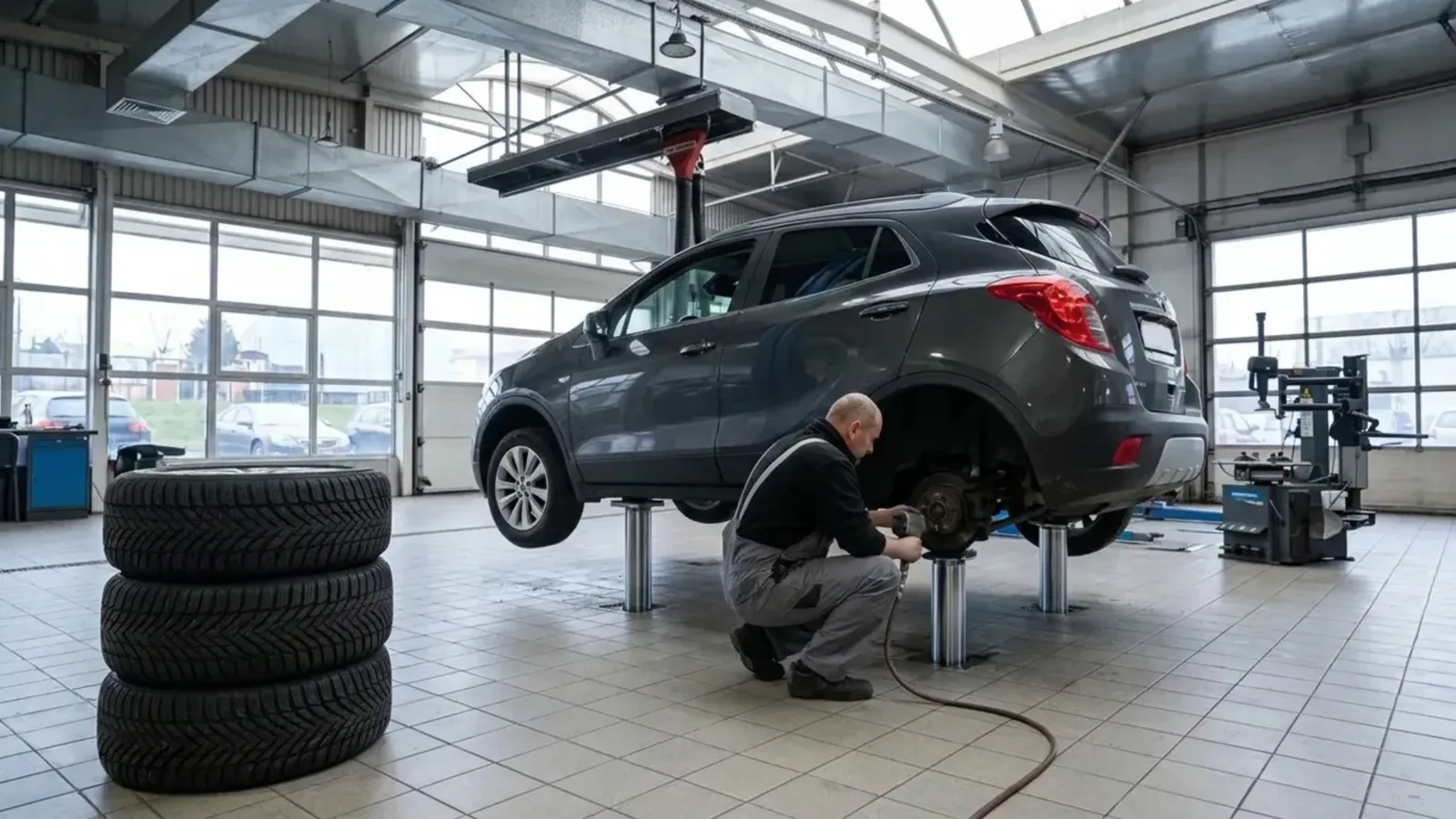
- Balancing: wheels are balanced at every change of set. Weights can fall off during the season, and the tyre and rim change over time. Steering wheel vibration at 90–120 km/h is a typical symptom.
- Pressure: set it according to the plate in the driver's door or the fuel filler flap. Check it more often in winter, because it falls with the temperature.
- TPMS sensors: new cars in the EU have a tyre pressure monitoring system. When the wheels are changed, the sensors have to be checked, and sometimes the system has to be programmed or calibrated. If the pressure warning light is on after the change, do not ignore it.
- Wheel bolts: they are tightened with a torque wrench to the torque recommended by the manufacturer. It is worth checking them after the first few dozen kilometres.
- Alignment: if the car pulls to one side or the tyres wear unevenly, have the toe set at the same time as the changeover.
- Storage: keep tyres in a cool, dry and dark place. Bosch Car Service Osowa offers tyre storage. Availability of spaces and the terms are confirmed by the service advisor when you book.
When to switch to summer tyres?
The same rule applies, only in reverse. When the average temperature stays above 7°C for two or three weeks and the nights are frost-free, fit summer tyres. In Pomerania this is usually in April. Do not rush after the first warm weekend in March, because frosts can return.
Do not drive on winter tyres all summer. The soft compound wears faster in the heat, braking distances on dry and wet asphalt are longer, and the car handles worse in corners. This way you use up a tyre that could have served another winter.
You can book a tyre change in Gdańsk Osowa, at ul. Odyseusza 20, on 58 552 55 25 (Mon–Fri 7:30–17:00, Sat 9:00–14:00) or via the form. We serve all makes, including US cars. While we are at it, we can check the battery and brakes before winter.
Frequently asked questions
Can I fit winter tyres on only one axle?
Do not do this. The regulations require the same tyres on one axle, but safety requires a set of four. Winter tyres only at the front let the rear of the car break away easily in a slippery corner, and only on the rear axle they lengthen the braking distance and worsen turning.
How much does a tyre change in Gdańsk cost?
The price depends on the rim size, the type of wheels (steel or alloy), TPMS sensors and whether you are changing whole wheels or just the tyres on the rims. The current price for your car is confirmed by the service advisor when you book.
Does a new winter tyre need running in?
Yes, to a degree. For the first few dozen to a hundred kilometres drive more gently, without hard braking or sharp acceleration. The surface of a new tyre needs a moment to reach full grip.
Does a 4x4 car need winter tyres?
Yes. Four-wheel drive helps you pull away, but it does not shorten the braking distance or improve cornering grip. It is the tyre that brakes and turns, not the drive. A heavier SUV on summer tyres in frost needs more room to stop.
How should tyres be stored with rims and without?
Whole wheels on rims can be stacked on top of each other or hung up. Tyres without rims should be stored upright and turned from time to time. In both cases keep them away from sunlight, radiators, fuels and solvents.
Sources
- Warta: Are winter tyres compulsory in Poland? (regulations, 1.6 mm tread, 27.11.2023)
- kb.pl: Is changing to winter tyres compulsory? Fines for unroadworthy tyres
- Auto Świat: Are your winter tyres still good? (recommended 4 mm tread)
- Interia Motoryzacja: Is an all-season tyre suitable for winter? The 3PMSF symbol
- Autocentrum: How winter tyres work (compound, 7°C threshold)