Suspension knocking is most often caused by worn stabiliser links, control arm bushes, ball joints, upper shock absorber mounts and steering track rod ends. The moment at which it knocks says a lot about which part is to blame: over small bumps, when turning while stationary or when braking. A reliable diagnosis comes only from an inspection on a lift with a shake plate and a test drive. A knock that appeared suddenly after hitting a pothole or kerb should be checked as soon as possible.
Where does suspension knocking come from?
A suspension consists of several dozen connections: ball joints, rubber-metal bushes, bearings and bolts. In a new car each of them works without play. When the rubber ages, grease washes out of a joint or a bolt works loose, metal begins to strike metal with every change of load. That is what you hear as a knock.
The sound travels through the body, so it is very hard to judge “by ear” which wheel and which part it comes from. A knock from the rear can sound as if it is from the front, and a knock from the right as if from the left. That is why, instead of replacing parts straight away, it is worth first noting down exactly when it knocks.
When it knocks → what to check
| When it knocks | What to check first | Notes |
|---|---|---|
| Over small bumps, cobbles, at low speed; a dull, “hollow” rattle from the front | Stabiliser links, stabiliser rubbers (bushes) | One of the most common causes; the parts are usually easy to replace |
| Over speed humps and potholes, a single hard knock | Control arm bushes, control arm ball joints, shock absorber, bump stop | On a large pothole when it bottoms out, also check that the shock absorber is not blown |
| When turning the steering wheel while stationary or when parking; a knock, clunk or “creak” from the strut | Upper shock absorber mount (top mount) with bearing, spring | NTN-SNR: noise over bumps and when turning is a typical symptom of a damaged suspension bearing |
| When pulling away and braking, a “kick” from the front | Control arm bushes (especially the rear bush of the lower arm), subframe mounts, brake caliper | A loose caliper or pad guides give a similar knock |
| When turning while driving, metallic clicks at full lock | Drive shaft joints (CV joints), to a lesser extent track rod ends | Rhythmic clicks when pulling away on turned wheels are a classic symptom of a worn outer CV joint |
| A knock transmitted to the steering wheel, play with a slight movement of the wheel | Steering track rod ends, track rods, steering rack | Relates directly to the steering system – do not put it off |
| Body bounce over bumps, knocks as the suspension works, oil marks on the shock absorber | Shock absorbers, their lower and upper mounts | A worn shock absorber also means a longer braking distance and weaker grip |
| Metallic buzzing or rattling at certain revs or over bumps, regardless of steering | Exhaust heat shields, exhaust hangers and mounts, engine undertray | This is not the suspension, but it is very often confused with it |
| A knock from the rear of the car over bumps | Rear beam or rear control arm bushes, rear shock absorbers, stabiliser links, loose items in the boot | Start by checking the spare wheel, jack and boot compartments |
This table helps narrow the search, but it does not replace an inspection. The same sound in two cars can have a completely different source.
The parts that knock most often
- Stabiliser links: they connect the anti-roll bar to the strut or the control arm. Meyle describes the typical symptom as a quiet rattle or knock from the front axle over bumps and slightly imprecise handling. Moisture gets into the joint through a damaged boot, the ball corrodes and wears out the socket.
- Control arm bushes: the rubber hardens and cracks, and the arm starts to shift when braking and pulling away. More on this in our article on the symptoms of a damaged control arm.
- Control arm ball joints: they usually wear after the rubber boot splits. Play in a ball joint is dangerous because in an extreme case the ball can come out of its socket.
- Upper shock absorber mounts and strut bearings: according to NTN-SNR, corrosion or cracking of the bearing causes noise over bumps and when turning, and increased resistance when steering the wheels.
- Shock absorbers: a worn shock absorber rarely knocks on its own, but a blown one or one with a loose mount does. More often it gives itself away by bouncing and an oil leak.
- Steering track rod ends and the steering rack: play is often felt at the steering wheel as a delayed response or a knock when driving over bumps with the wheels slightly turned.
How does a mechanic diagnose suspension knocking?
A reliable diagnosis combines a test drive with an inspection on a lift. Driving alone lets you reproduce the symptom but does not point to a specific part. Simply raising the car on a lift is not enough either, because some play shows up only under load.
- A conversation with the driver: when it knocks, since when, whether after hitting a pothole, or after a tyre change or other repair.
- A test drive over bumps and speed humps, with braking and turning, ideally together with the driver who heard the symptom.
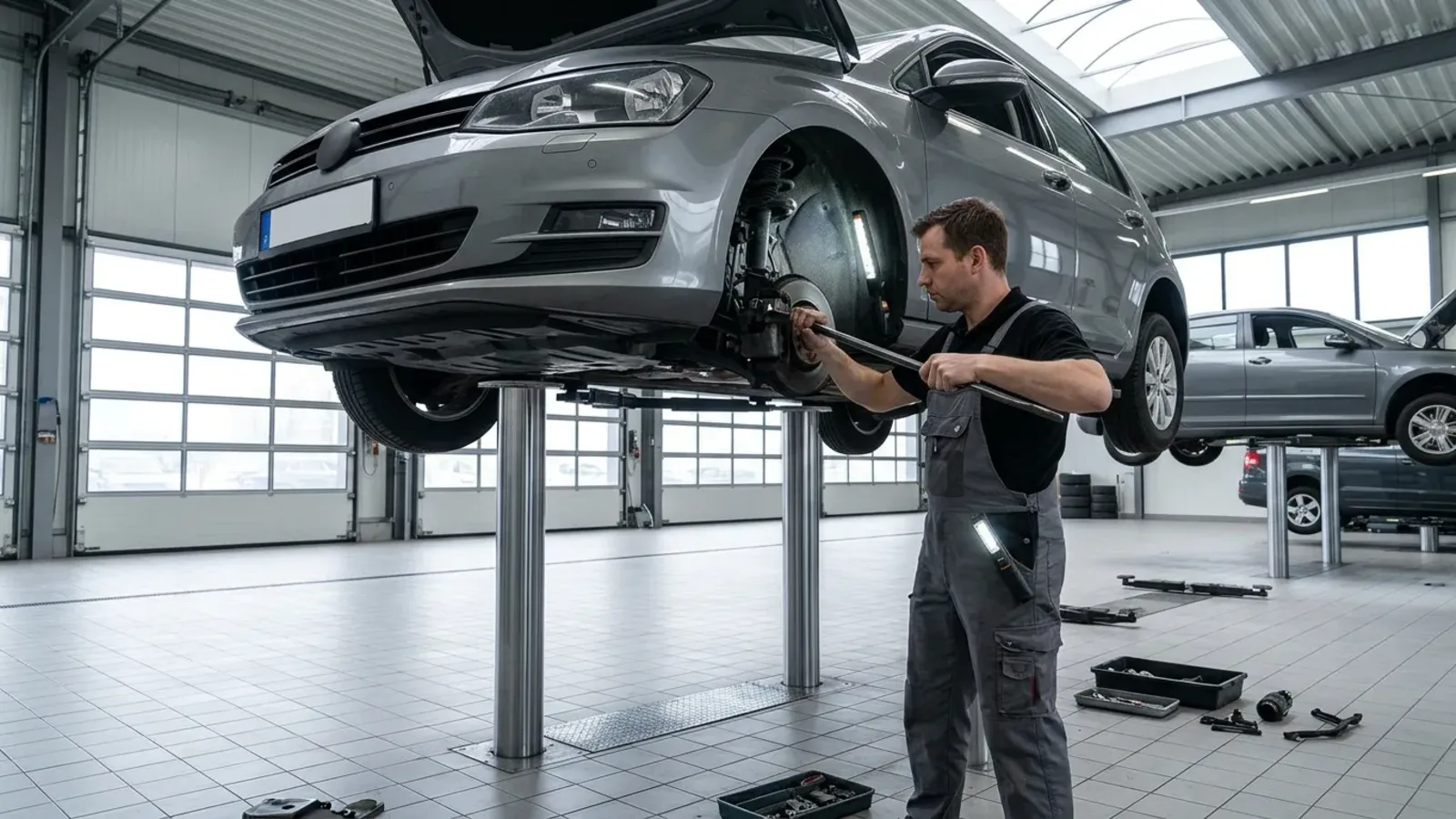
- Inspection over a pit or on a lift: the condition of rubber boots and bushes, oil marks on shock absorbers, corrosion and loose exhaust shields.
- A check on a shake plate: the wheels stand on plates that move sideways and lengthways while the mechanic with a torch observes each joint. The regulations on technical inspections recommend the same kind of device for checking the suspension at the SKP.
- Checking wheel bearing and steering play, and checking the tightness of mounting bolts.
- In harder cases, listening while driving with an electronic stethoscope with sensors on several components, or measuring shock absorber damping effectiveness on a test bench.
After repairing parts on which wheel alignment depends (control arms, bushes, ball joints, track rod ends), an alignment is usually needed. The order is always: first remove the play, then set the alignment.
Suspension knocking and safety
Not every knock means a danger, but every one is worth checking. A rattling stabiliser link will not usually immobilise the car overnight, although Meyle notes that a damaged link reduces stability and speeds up wear of other parts. Play in the steering system or in a ball joint is a part directly responsible for where the wheel goes.
- Go to a workshop as soon as possible if the knock appeared suddenly after hitting a pothole or kerb, the car started pulling, or the steering wheel sits crooked when driving straight.
- Keep driving to a minimum if you feel play at the steering wheel, hear metallic bangs at every turn, or a wheel has visibly changed position in the wheel arch.
- Plan a visit in the next few days if it is a quiet rattle on cobbles with no change in handling.
Play in the suspension and steering is also a typical reason for a failed inspection. The regulation on the scope and method of vehicle technical inspections (Journal of Laws 2024, item 141, annex no. 1) classes as major defects, among others, excessive play in steering rod joints (item 2.7.1), excessive wear of control arm ball joints (item 5.3.4) and a damaged shock absorber with a heavy leak or improper operation (item 5.3.2).
You can have the suspension diagnosed and repaired at Serwis Osowa, ul. Odyseusza 20 in Gdańsk. We are an authorised Opel and Peugeot service centre and a Bosch Car Service, and we repair all makes, including cars from the USA. Call: 58 552 55 25 (Mon–Fri 7:30–17:00, Sat 9:00–14:00). The scope of work and the quote are confirmed by a service advisor after an inspection.
Frequently asked questions
Why does the suspension knock only in winter or in frost?
The rubber in bushes and mounts hardens at low temperature, and worn parts that still damp vibration in summer begin to knock in winter. Salt, which speeds up joint corrosion, adds to this. If the knock disappears once the car warms up, that is a clue, but it does not replace an inspection.
Can the knocking come from the brakes?
Yes. Loose pads in the carrier, worn guides or a loose caliper can knock when pulling away, braking and over bumps. That is why, when diagnosing knocks from around a wheel, the braking system is checked too.
Can the suspension start knocking after a tyre change?
Swapping the wheels is rarely the cause, but it is worth checking the wheel bolt tightness and that nothing was damaged when the car was lifted. More often it is a coincidence: tyres with a different profile or pressure carry vibration better and reveal existing play.
Are stabiliser links replaced in pairs?
There is no such requirement, but where wear comes from mileage the other side is often in a similar condition. The mechanic assesses both links on the shake plate and advises replacing one or both.
Can you find the source of a knock at home?
Partly. You can check that nothing is rolling around in the boot, that the undertrays are bolted on and that there is no oil on the shock absorbers. Play in joints and bushes cannot be reliably assessed without a lift and a shake plate, and raising a car on a jack alone is dangerous.
Sources
- Journal of Laws 2024, item 141 – consolidated text of the regulation on the scope and method of vehicle technical inspections (annex no. 1, items 2.7, 5.3 – steering and suspension, devices for forcing wheel jolts)
- MEYLE Advisor – Stabiliser links (symptoms of stabiliser link wear, causes of joint corrosion)
- NTN-SNR – Top strut mount kit: recommendations and most common faults (PL)
- MEYLE Advisor – Control arm (symptoms of control arm and bush wear)