
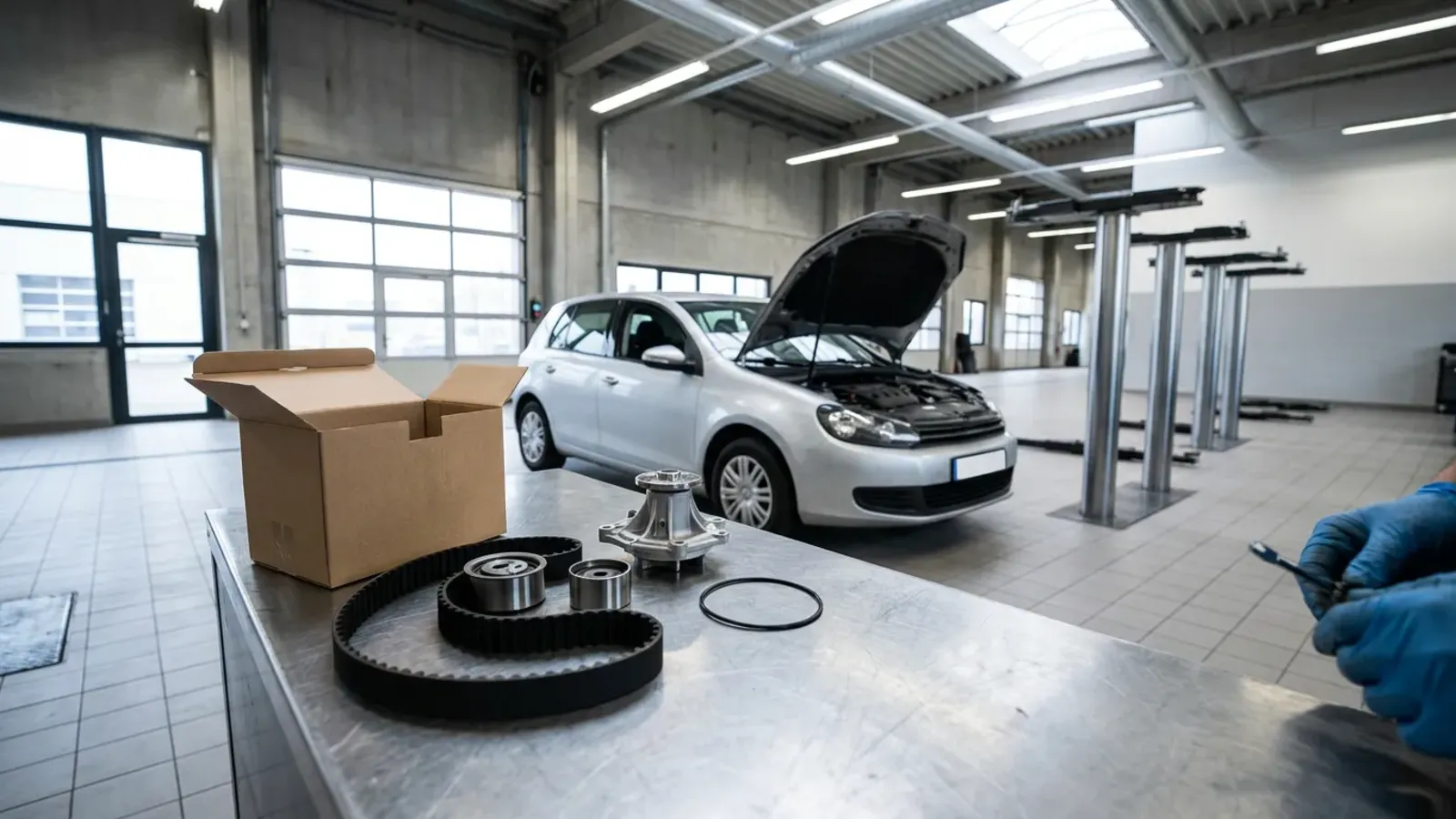
The 1.6 THP is a turbocharged petrol engine with direct injection, developed jointly by PSA and BMW (the Prince family, EP6) and fitted since 2006 to Peugeots, Citroëns, DSs and Minis. The most often described weak points are a stretching timing chain with its tensioner (especially in cars up to about 2010), oil consumption and the turbocharger. An example with frequent oil changes and timing checks can run for a long time; as an authorised Peugeot service centre we check service campaigns by VIN.
- Prince family (EP6), PSA and BMW
- Timing chain and tensioner
- Oil consumption check
- Authorised Peugeot centre: campaigns by VIN
Which cars have the 1.6 THP engine?
The engine made its debut in autumn 2006 in the Mini Cooper S, and from the turn of 2006 and 2007 it went into PSA models. In later years it was updated (a Euro 5 version around 2010, later Euro 6), and its successors from the same family now work in, among others, Peugeot and Opel plug-in hybrids.
| Make | Example models | Years (approximate) |
|---|---|---|
| Peugeot | 207, 308 I and II, 3008 I and II, 5008 I, 508 I, RCZ, 208 I (GTi) | from 2007 |
| Citroën | C4 I and II, C5 II, DS3, DS4, DS5 | from 2008 |
| DS | DS 3, DS 4, DS 5, DS 7 Crossback | from 2015 |
| Mini | Cooper S, JCW (R56 and related) | 2006–2014 |
| BMW | N13 variant: including 1 and 3 Series | 2011–2015 |
| Opel | 1.6 turbo variants in plug-in hybrids, including the Grandland and Astra L | from 2019 |
Do not confuse the 1.6 THP with the naturally aspirated 1.6 VTi. Both belong to the EP6 family, but the VTi has conventional indirect injection and no turbocharger, so it wears differently. You will find the engine code in the registration certificate, or we will check it by VIN.
How is the 1.6 THP built?
It is a four-cylinder engine with an aluminium block, two camshafts, a twin-scroll turbocharger and direct fuel injection. The timing is driven by a chain, for which the manufacturer specifies no fixed replacement date. In the first years of production the tensioner design was changed several times, which shows clearly where the main trouble lay.
The engine also has a vacuum pump for the brake servo and an oil pump on which the turbocharger's lubrication depends. That is why the condition of the oil affects not only the timing here, but all the ancillaries.
Typical 1.6 THP faults and their symptoms
| Fault | Symptom | Notes |
|---|---|---|
| Stretched chain, worn tensioner | Metallic rattling for a few seconds after a cold start, timing phasing faults | Most often in cars up to about 2009–2010; a neglected chain can jump and damage the valves |
| Oil consumption | Oil level falls between changes, bluish smoke | The cause can be valve stem seals, guides or piston rings; driving with the oil level too low speeds up camshaft wear |
| Turbocharger | Loss of power, whistle when accelerating, smoke from the exhaust | Often a result of poor lubrication; we also check the oil pump |
| Injectors | Uneven running, fuel in the oil | Described in THP variants |
| Cracked manifolds | Hissing, smell of exhaust fumes, mixture faults | Described at higher mileages |
| Vacuum pump | Harder brake pedal | Requires urgent diagnostics |
As with most direct-injection petrol engines, the intake valves are not washed by fuel, so carbon can build up on them over time. Some users then report uneven running when cold and a loss of power. The scale of the problem is judged after diagnostics, not by mileage alone.
Rattling after a cold start is a signal to come in for a timing check, not to wait for it to go quiet. A controller readout will show whether the timing phasing deviates from the norm.
How to service the 1.6 THP to avoid faults?
The manufacturer allowed oil changes every 30,000 km or 2 years. Auto Świat recommends changing it on the THP at most every 15,000 km and at least once a year. For short trips and city driving, we also suggest a shorter interval. The oil specification (for example, fully synthetic 5W-30 to the PSA specification for the given version) comes from the service plan, which we check by VIN.
- oil and filter change at a shortened interval, checking the level every few fill-ups;
- do not switch off the engine immediately after hard driving: give the turbocharger a moment to cool down;
- spark plugs, air filter and ancillary belt according to the service plan;
- coolant according to age, as the engine has an extensive temperature management system;
- up-to-date controller software; on cars at an authorised Peugeot centre we check for open service campaigns.
What do we check on the 1.6 THP at a service and before purchase?
- Cold start: we listen for chain noise straight after the engine starts.
- Computer diagnostics: camshaft correlation, mixture faults, boost pressure.
- Oil: level, smell of fuel, change history; where in doubt, a consumption measurement.
- Turbocharger: play, leaks, intake leak-tightness.
- Manifolds and the vacuum system, brake servo operation.
As an authorised Peugeot service centre, we check the service campaign history for your Peugeot's VIN in the manufacturer's system. On Citroëns, DSs and Minis we work as an all-makes workshop and Bosch Car Service, using the same engine diagnostics procedures.
Frequently asked questions
Is it worth buying a car with the 1.6 THP engine?
It is worth considering an example with a documented history of frequent oil changes, ideally from later model years in which the tensioner was improved. Before buying, check how the timing runs when cold and the oil consumption.
How do I recognise a worn timing chain on the 1.6 THP?
The typical symptom is metallic rattling for a few seconds after a cold start. Timing phasing faults may also appear. Computer diagnostics and an inspection will confirm it.
How much oil can a 1.6 THP use?
Some examples use noticeable amounts of oil between changes. The permitted value is given by the manufacturer for the given version. If you top up often, it is worth checking the cause before damage occurs.
Are you an authorised centre for the 1.6 THP engine?
We are an authorised Peugeot and Opel service centre, so on those makes we work to the manufacturer's procedures and check campaigns by VIN. We repair Citroëns, DSs and Minis with this engine as an all-makes workshop.