
The 2.0 HDi (DW10 family) is a PSA diesel produced since 1998 in many versions, from 90 to over 160 hp, used in Peugeots, Citroëns, Fords (as the 2.0 TDCi) and Suzukis. It has a reputation as one of the more durable diesels in this group: with good servicing, serious trouble rarely appears early, and faults mostly concern the ancillaries – the dual-mass flywheel, turbocharger, EGR, airflow meter and DPF. The timing is driven by a belt replaced according to the plan.
- DW10 since 1998, 8V and 16V
- Peugeot, Citroën, Ford, Suzuki
- Timing belt, DPF with additive fluid
- Peugeot authorised dealer workshop: campaigns by VIN
Which 2.0 HDi versions will you find?
| Version | Period | Notes |
|---|---|---|
| 8V, 90 hp (DW10TD) | from 1999 | Simple design, fixed-geometry turbo |
| 8V, 109–110 hp (DW10ATED) | from 1998 | Debut in the Peugeot 406; first DPFs |
| 16V, 136–140 hp | from late 2003 | Piezo injectors, DPF, dual-mass flywheel |
| 16V, 150–163 hp | from 2009 | Variable-geometry turbo, higher injection pressure |
The older 8-valve versions are today found mainly in cars more than a dozen years old, such as the Peugeot 406 and 307 or the Citroën Xsara Picasso. The 16-valve versions work in, among others, the Peugeot 308 I, 3008 I, 407, 508 I, 807, the Citroën C4, C5, C8, and as the 2.0 TDCi in the Ford Focus, Mondeo, S-Max, Galaxy and Kuga.
Is the 2.0 HDi a durable engine?
Polish motoring journalists count the 2.0 HDi among the most durable PSA diesels and stress the cheap, easily available parts. The block and head themselves rarely cause trouble. What most often fails is what surrounds the engine – and usually at high mileage or after neglect.
The 8V versions have one camshaft and are the simplest to repair. The 16V versions are more powerful and more refined, but have more elaborate ancillaries: piezo injectors, a dual-mass flywheel and, in newer variants, a variable-geometry turbo. The condition of these parts decides the running costs.
Typical 2.0 HDi faults and their symptoms
| Problem | Symptom | What we do |
|---|---|---|
| Crankshaft pulley damper (mainly early 8V) | Knocks after a cold start, ancillary belt falling off | Check and replace the pulley |
| Pressure valve in the high-pressure pump | Hard starting, rough running, smoke | Diagnose the injection system |
| Air flow meter | Weaker, uneven power, higher consumption | Read the parameters, replace the sensor |
| EGR valve | Loss of power, smoke, starting problems | Diagnostics; usually replacement, because cleaning rarely helps for long |
| Dual-mass flywheel and clutch | Vibration, knocks, clutch slipping | Assess the play, replace the kit |
| Turbocharger | Loss of power, oil consumption, smoke | Check lubrication and play, repair or replace |
| DPF and additive fluid | Filter message, limp mode | Read, top up the fluid, assess the filter condition |
On the 16V, uneven idling does not always mean a mechanical fault. Sometimes diagnostics and calibration of the injection system are enough.
How to service the 2.0 HDi?
The service plan depends on the version: different intervals apply to the first DPFs on the 8V and to the newer systems on the 16V. We check the timing belt replacement date and the oil specification by VIN.
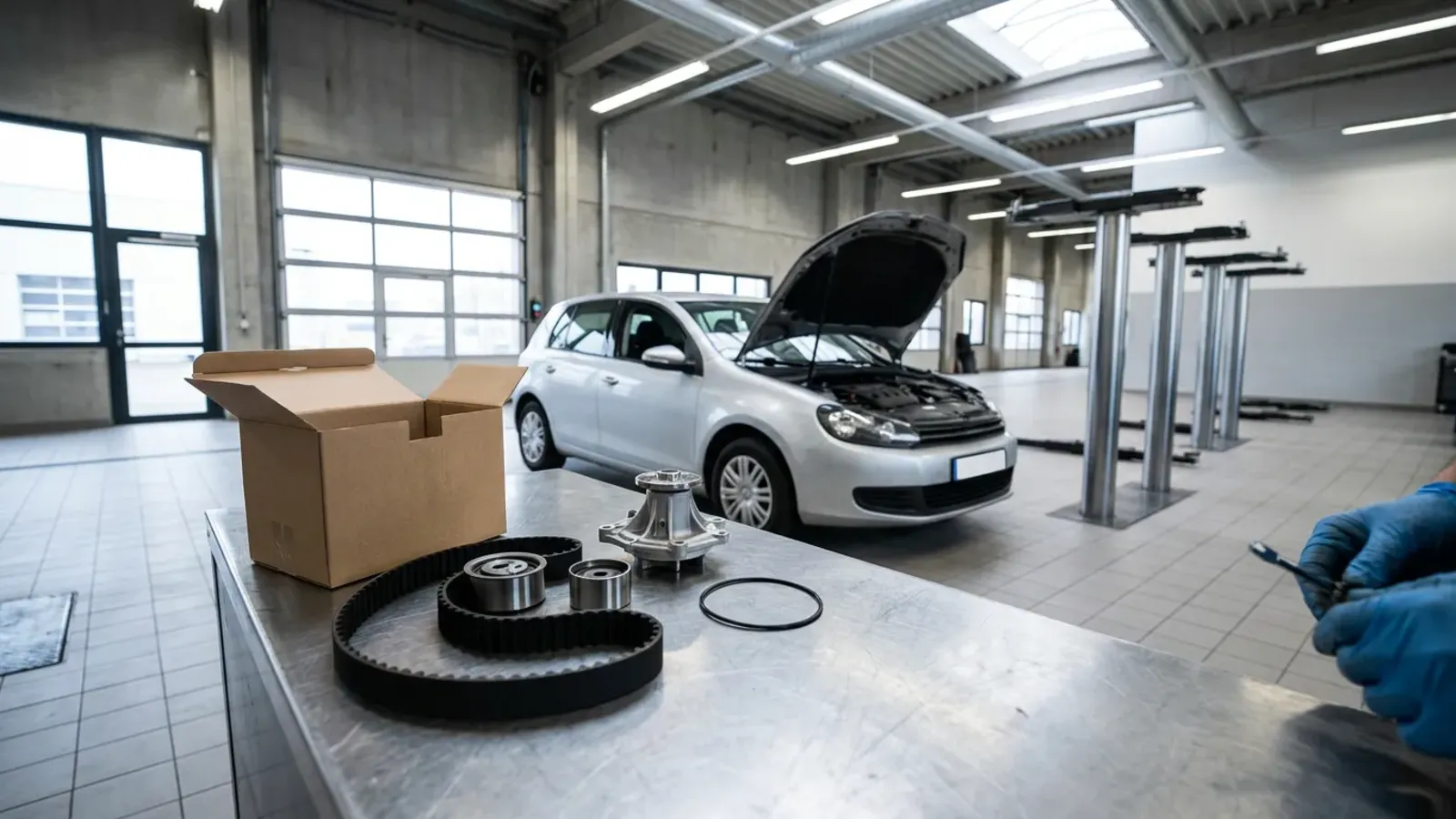
- timing belt with rollers and water pump per the plan – a snapped belt damages the valves;
- oil of the specification suited to DPF versions, at a shortened interval with city driving;
- DPF: topping up the additive fluid and replacing the filter on the date in the plan;
- after hard driving, a moment at idle so that the turbo cools down;
- check of the crankshaft pulley and ancillary belt at every service.
What do we check on the 2.0 HDi before purchase and at a service?
- Engine code, version and proof of timing belt replacement.
- Cold start: knocks from the front of the engine, smoke, starting time.
- Control unit reading: injector corrections, airflow meter, DPF condition.
- Test drive: clutch, dual-mass flywheel, turbo power build-up.
- Oil leaks and intake tightness.
As a Peugeot authorised dealer workshop, we check Peugeot history and service campaigns by VIN in the manufacturer's system. Citroëns and Fords with this engine we service as an all-makes workshop and Bosch Car Service.
Frequently asked questions
Is it worth buying a car with the 2.0 HDi?
Yes, if it has a documented timing belt replacement and regular oil changes. The ancillaries generate the most costs, so it is worth checking them before purchase.
Which 2.0 HDi version is best?
The 8V versions are the simplest to repair. Among the 16V, the 136–140 hp versions are popular and sensible. The condition of the specific car should decide the choice.
Does the 2.0 HDi have a timing belt?
Yes, the timing is driven by a toothed belt. The replacement date depends on the version and year – we check it by VIN.
Are the 2.0 HDi and 2.0 TDCi the same engine?
Ford used engines from the same family as the 2.0 TDCi. Ancillaries and software may differ, so we diagnose them by engine code.