A faulty or sooted-up EGR valve most often causes jerking when accelerating, loss of power, rough idling and the engine warning light, and in a diesel also black smoke. The most common cause is carbon build-up, which makes the valve stick open or closed. Before repairing, the fault must be confirmed by diagnostics, because the same symptoms are caused by an air flow meter, an intake leak or injectors. Disabling or removing the EGR is contrary to the regulations and means a failed technical inspection.
What does the EGR valve do?
EGR (exhaust gas recirculation) means recirculating exhaust gas. The EGR valve lets part of the exhaust gas from the exhaust manifold back into the intake system. The mixture then has less oxygen, burns at a lower temperature, and fewer nitrogen oxides (NOx) form in the exhaust. Pierburg, the manufacturer of EGR valves and coolers fitted at the factory in many cars, states that this can reduce the NOx content of the exhaust by as much as half.
The valve is controlled by the engine control unit. According to HELLA materials, the amount of recirculated exhaust depends on engine speed, coolant temperature and engine load. On a cold engine, at full load and at high revs the valve is usually closed or almost closed, and it works hardest at partial load, that is, in typical city driving.
- Pneumatic valves: opened by vacuum, controlled by a solenoid valve (pressure converter). Found mainly in older cars.
- Electric and electromotor valves: with their own motor or electromagnet and a position sensor that tells the control unit how far the valve is open.
- EGR cooler: in most diesels and some petrol engines the exhaust is cooled by coolant before it returns to the intake. Many coolers have a bypass flap that bypasses the cooler on a cold engine or during DPF regeneration.
EGR in a diesel and in a petrol engine: how do they differ?
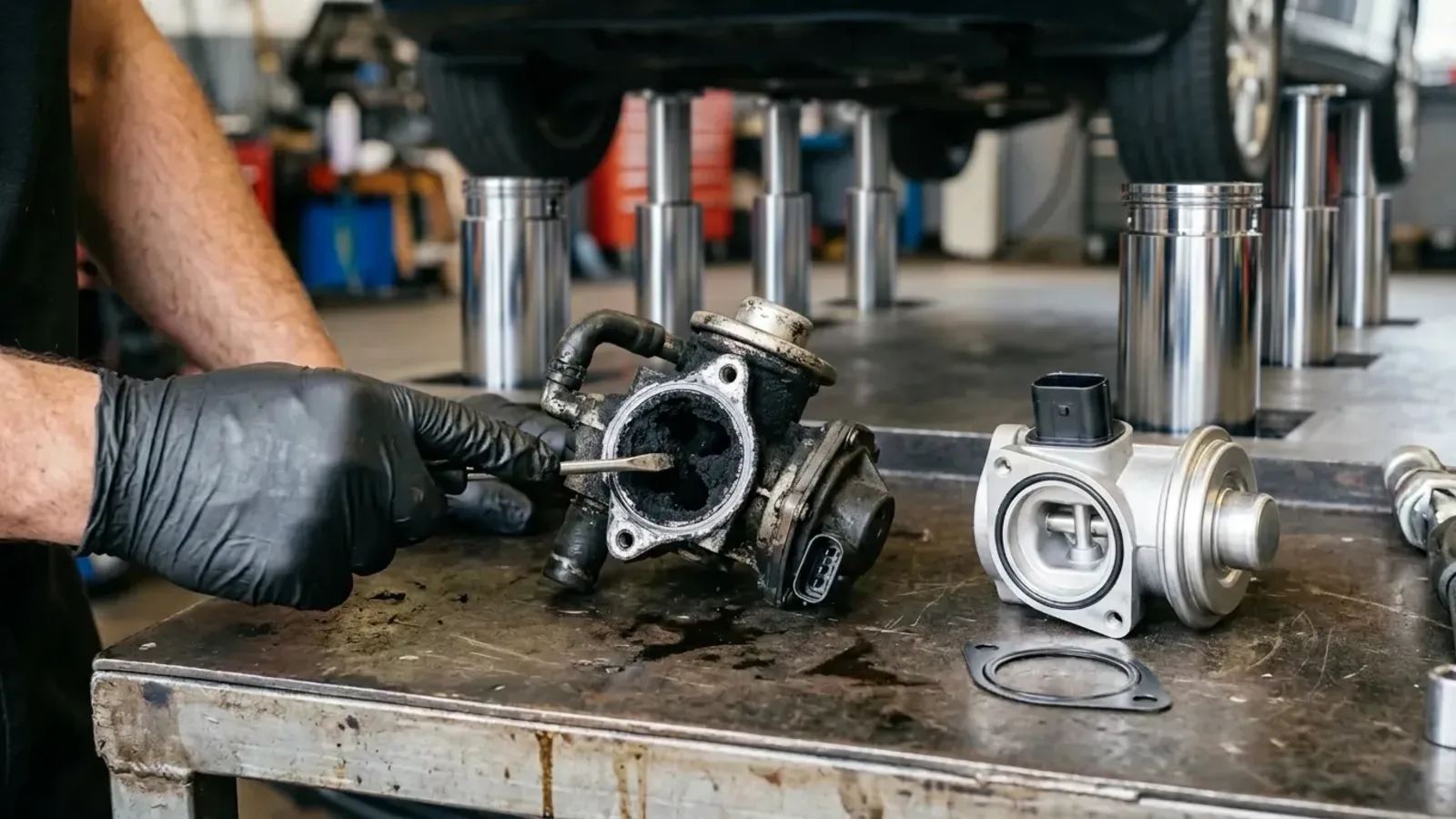
The EGR valve is found in both types of engine, but problems with it are much more common in diesels. Diesel exhaust contains a lot of soot. When it mixes with oil vapour from the crankcase breather, a hard, sticky carbon deposit builds up in the valve, the throttle body and the intake manifold.
| Diesel | Petrol | |
|---|---|---|
| Main purpose | Reducing NOx | Reducing NOx, and according to Pierburg also fuel consumption and CO2 emissions |
| Amount of soot in the exhaust | High: the main cause of coking | Lower, but burning oil also creates carbon deposits |
| Typical failure symptoms | Jerking, loss of power, limp-home mode, black smoke | Rough idle, stalling, jerking, check engine |
| Solutions without an external valve | Rare | Some engines achieve “internal” recirculation through variable valve timing |
Symptoms of a faulty EGR valve
The symptoms depend on the position in which the valve has stuck. A valve stuck open lets exhaust in where the engine needs fresh air. A valve stuck closed usually interferes less with driving, but the control unit still detects a fault.
- Jerking when accelerating, the engine “choking” when you press the accelerator.
- Loss of power, the car accelerates poorly, sometimes going into limp-home mode with reduced power.
- The engine warning light (check engine) and a fault code stored in the control unit.
- Rough idling, hunting revs, and in extreme cases stalling after stopping.
- Black smoke from the exhaust when accelerating (in a diesel): too little air to burn the fuel charge.
- Higher fuel consumption and faster clogging of the DPF.
The same symptoms can be caused by a dirty air flow meter, a leaking intake hose or intercooler, a faulty boost pressure sensor, the turbocharger or the injectors. Replacing an EGR valve “by symptoms” without diagnostics is a common way to spend money with no result.
EGR fault codes: P0400–P0409
Codes in the P0400–P0409 range are generic OBD codes relating to exhaust gas recirculation. Their exact meaning and the conditions under which they are stored may differ by manufacturer, and many brands additionally use their own codes. A code points to an area of the fault, not to a ready-made part to replace.
| Code | General meaning | What is usually checked |
|---|---|---|
| P0400 | Incorrect flow in the EGR system | Valve operation, passage clearance, air flow meter |
| P0401 | EGR flow too low | Carbon in the valve or passages, valve does not open fully |
| P0402 | EGR flow too high | Valve sticks open, does not close fully |
| P0403 | EGR control circuit fault | Wiring, connector, power supply, solenoid valve or valve motor |
| P0404 | EGR circuit range/performance | Discrepancy between the commanded and actual valve position |
| P0405–P0408 | EGR sensor A/B signal too low or too high | Position sensor, wiring, connectors |
| P0409 | EGR sensor A circuit fault | The sensor and its wiring |
In its materials for workshops, for these codes Pierburg recommends in turn: checking the actuators (with a test from the tester), the vacuum lines for pneumatic valves, the sensors, and comparing the signals with the setpoint values. Simple OBD interfaces for a phone will show the code, but usually will not let you actuate the valve or carry out an adaptation.
Cleaning or replacing the EGR valve?
Cleaning an EGR valve is popular because it is cheaper than a new part. It is worth knowing the manufacturer's position, though: Pierburg (MS Motorservice) strongly advises against cleaning EGR components. Cleaning will not repair a worn valve motor, a position sensor or play on the stem, and aggressive chemicals or scraping can damage a working part.
- Cleaning may make sense for a simple valve with a light coating, when the electronics and actuator are sound and the carbon mainly affects the passages and manifold. The decision is made after removal and assessment.
- Replacement is right when the valve sticks mechanically, has a faulty motor or position sensor, fails the actuator test, or is integrated with the cooler in a way that makes proper cleaning impossible.
- After replacement an adaptation is often needed: a longer test drive or a basic settings procedure in the tester. Skipping it produces errors despite the new part.
- In every case the cause of the carbon build-up must be removed. Pierburg lists here, among others, oil in the intake from a faulty breather, a worn turbo or valve stem seals, an excessive oil level or the wrong engine oil, and injection faults.
EGR cooler and the link between EGR and the DPF
The EGR cooler works in the coolant circuit and in hot exhaust, so it also clogs and can leak. Among the typical faults of low-pressure EGR systems, Pierburg lists leaks from the EGR cooler and its surroundings. A warning sign is a loss of coolant without any visible external leak, or white smoke with a sweetish smell. In that situation it is not worth delaying, because coolant in the intake can seriously damage the engine.
EGR is directly linked to the particulate filter. A valve stuck open increases the amount of soot in the exhaust, so the DPF clogs faster and regenerations are more frequent. A faulty cooler bypass flap, in turn, can make it harder to reach the temperature needed for regeneration. That is why, with a recurring DPF warning light, the EGR system is checked too.
Disabling or removing the EGR: why not?
Software disabling of the valve, blanking the passage or removing the EGR is sometimes advertised as a permanent solution. It is an interference with the factory emission control system, contrary to the regulations, and on top of that it does not remove the cause of the problem (for example oil in the intake).
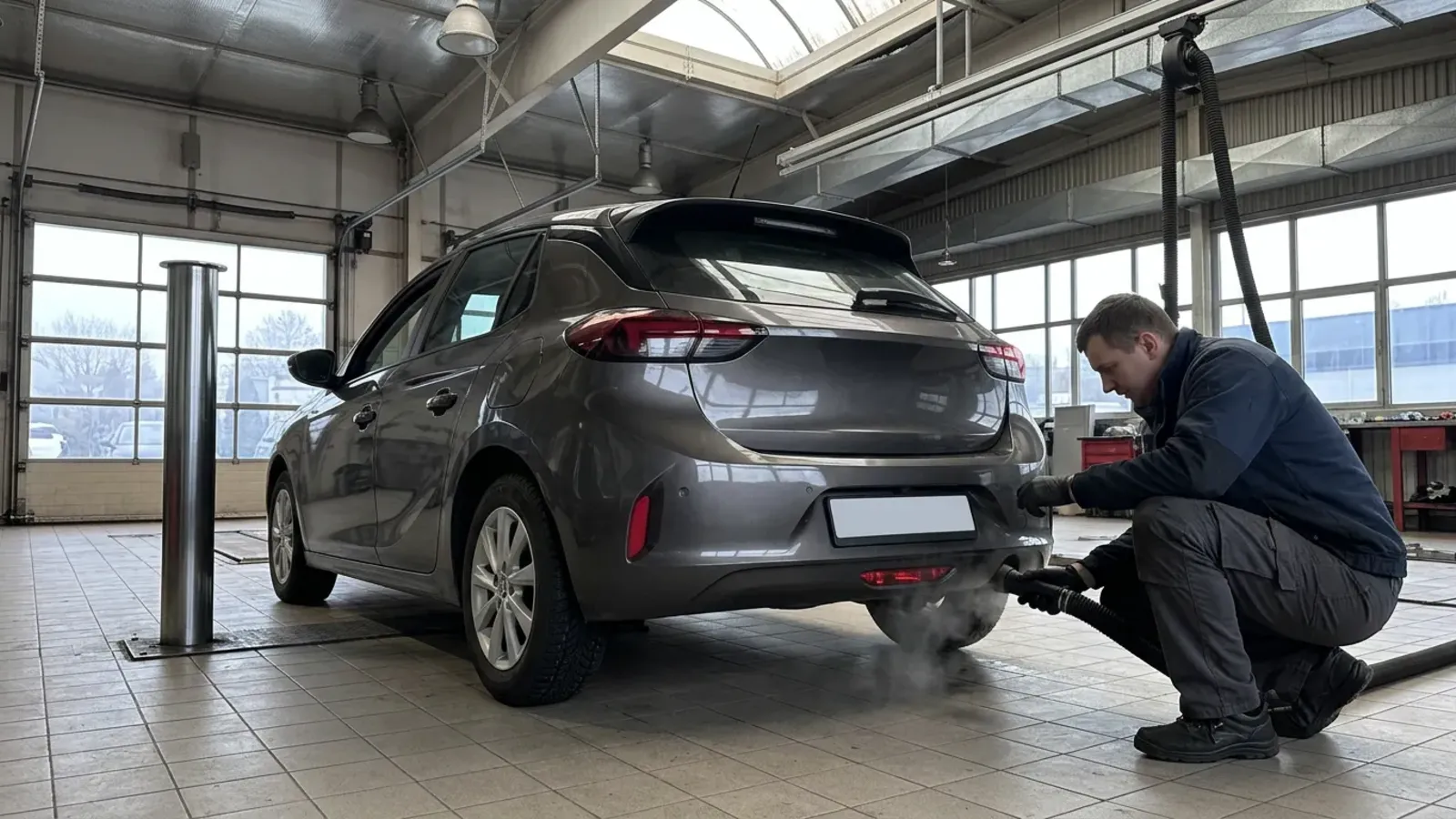
- Technical inspection: the regulation on the scope and method of vehicle technical inspections (Journal of Laws 2024, item 141, annex no. 1, item 8.2.1.1 for petrol engines and item 8.2.2.1 for diesels) classes the absence of a factory-fitted exhaust emission control device, or its clearly incorrect operation, as a major defect. A major defect means a failed inspection. The inspector can also read emission-related fault codes from the OBD system.
- Roadside check: the Road Traffic Act (art. 132, para. 1, point 1, letter c) allows the registration certificate to be retained when a vehicle breaches environmental protection requirements.
- A disabled EGR means higher nitrogen oxide emissions than those with which the car was approved for traffic, and the control unit runs on modified software.
You can have the EGR system diagnosed and repaired at Serwis Osowa, ul. Odyseusza 20 in Gdańsk. We are an authorised Opel and Peugeot service centre and a Bosch Car Service, and we repair all makes. Call: 58 552 55 25 (Mon–Fri 7:30–17:00, Sat 9:00–14:00). We start with computer diagnostics, and the scope of further work and the quote are confirmed by a service advisor.
Frequently asked questions
Can you drive with a faulty EGR valve?
Briefly and gently, usually yes, to get to a workshop. Long driving with the valve stuck open speeds up sooting of the intake and clogging of the DPF, and limp-home mode limits power when overtaking. If you are also losing coolant, do not delay diagnostics.
How do I tell whether it's the EGR valve and not the air flow meter?
You cannot settle it from the symptoms, because they are very similar. A workshop reads the codes, compares live parameters (commanded and actual valve position, air flow, boost pressure) and runs an actuator test. Only that points to the guilty part.
Will fuel additives clean the EGR valve?
Do not count on it. Carbon in the EGR valve forms from exhaust gas and oil vapour in the intake, while fuel additives work mainly on the injectors and the combustion chamber. If the valve sticks, diagnostics and a mechanical repair are needed.
Does driving in town harm the EGR valve?
The EGR valve works most at partial load, and short trips on a cold engine encourage deposits. Regular longer runs on the open road help the DPF and reduce the amount of soot, but they will not replace a working breather, the right oil and removing the cause of excessive smoking.
Does anything need coding after replacing the EGR valve?
In many cars, yes. After fitting a new valve the control unit has to learn its positions, which is done with an adaptation procedure in the tester or during a longer test drive, depending on the model. Without it, errors can appear despite a working part.
Sources
- HELLA Tech World – Electric exhaust gas recirculation valve: causes of failure and fault finding
- MS Motorservice (Pierburg) – Exhaust gas recirculation system: proven technology for reducing harmful substances
- MS Motorservice Technipedia – Troubleshooting in exhaust gas recirculation system on Otto and diesel engines (causes of carbon build-up, advice against cleaning, adaptation)
- Pierburg – OBD and exhaust gas return system: finding and remedying faults (codes P0400–P0408)
- Journal of Laws 2024, item 141 – consolidated text of the regulation on the scope and method of vehicle technical inspections (annex no. 1, items 8.2.1.1 and 8.2.2.1 – exhaust emission control devices)
- Road Traffic Act, art. 132 – retention of the registration certificate