Brakes squeal when the pad vibrates against the disc and that vibration turns into a high-pitched sound. A short squeal in the morning, after rain, after washing the car or during the first few hundred kilometres after new pads are fitted is usually harmless. A constant metallic squeal every time you brake can be the pad wear indicator, while grinding, a pulsating pedal or the car pulling to one side mean the brakes need checking soon.
Why do brakes squeak?
A squeal is vibration. The pad's friction material does not slide perfectly smoothly over the disc; it grips and releases in very quick succession. If the caliper, pad and disc start to resonate, you hear a high, piercing sound. In its workshop material, Bosch stresses that there are many causes of vibration and noise when braking and worn pads are not always to blame.
Parts manufacturers limit this effect by design: they use chamfered edges and slots in the friction material, damping shims (anti-noise shims) on the pad backing plate and retaining springs. When one of these parts is worn, fitted incorrectly or missing, squealing can occur even with new pads.
When is brake squeal normal?
- In the morning and after standing in damp weather: a film of rust forms on the discs overnight. The pads scrape it off during the first few stops, which you may hear. After a few applications the sound goes away.
- After rain, washing the car or driving through a puddle: water on the discs briefly changes the friction and causes a short squeal or hiss.
- After the car has stood for a long time: light rust on the disc's braking surface comes off after a dozen or so stops. A thick layer of corrosion and grooves are another matter.
- After new pads and discs: Brembo recommends bedding in for about 300 km, braking effectively but with short, progressive applications, without sudden or very hard braking. During this time you should watch for vibration and noise.
- In hybrids and electric cars: they often brake mainly through energy recovery, so the discs work less and pick up a film of rust more easily. A squeal on the first firmer stop does not have to mean a fault.
What "normal" squealing has in common: it is short, happens in a specific situation and disappears after a few stops. If you hear it every time you brake for several days, it is worth having the brakes checked.
When are squeaking brakes dangerous?
Some pads have an acoustic wear indicator. According to HELLA, it is a purely mechanical metal plate on the pad backing plate which, once the wear limit is reached (usually about 2 mm of friction material), touches the disc and makes an unpleasant, sharp squeal. It is a signal that the pads need replacing soon, not a sound to wait out. Cars with an electrical wear sensor light up a warning lamp instead of squealing.
- Metal-on-metal grinding: the pad's friction material may have run out and the backing plate is rubbing on the disc. Braking is weaker and the disc is quickly damaged. Keep driving to a minimum.
- A pulsating pedal or vibrating steering wheel when braking: often a distorted or unevenly worn disc, sometimes hub runout.
- The car pulling to one side when braking: among the causes of one-sided pad wear and pulling, Bosch lists a seized caliper or piston and caliper guides that do not work properly.
- A squeal or hiss without pressing the brake, a burning smell and a very hot wheel rim after driving: the pad may be rubbing on the disc all the time because of a sticking caliper.
- A soft, sinking pedal or the red brake warning light: this is no longer about noise. Stop and check the brake fluid, and if in doubt, do not drive on.
Which sound means which cause? A table
| Sound and situation | Possible cause | What to do |
|---|---|---|
| Short squeal on the first stops in the morning or after rain | Film of rust or water on the discs | Nothing: it should go away after a few stops |
| Squeal in the first days after new pads | Pads and discs bedding in | Drive gently for about 300 km, then reassess |
| Sharp, metallic squeal every time you brake | Acoustic pad wear indicator | Replace the pads soon, measure the discs |
| Grinding metal when braking | Friction material worn through, backing plate rubbing on the disc | Workshop urgently, limit driving |
| Squeal under light braking that goes quiet under hard braking | Pad vibration: missing or worn damping shims, dry contact points, glazed friction material | Brake inspection, cleaning and lubricating the contact points |
| Squeal once the brakes are hot, e.g. after a long descent | Hard or low-quality friction compound, overheating | Assess pads and discs, choose parts to suit the car |
| Hiss or squeal without braking, hot wheel rim | Sticking caliper, guide pin or piston | Workshop urgently: risk of overheating |
| Vibrating pedal or steering wheel, humming | Distorted disc, disc or hub runout | Measure runout and disc thickness |
In its guide to noise and vibration, Brembo notes that squealing after a replacement usually does not come from faulty new parts but from the condition of the other components: dirty or rusty disc-to-hub contact surfaces, old or wrongly fitted damping shims, worn springs, corroded caliper slides and pistons, or no grease between the caliper bracket and the pads.
Can you spray WD-40 on squeaking brakes?
No. A penetrating spray, oil or grease on the disc or pad friction material may silence the squeal for a moment, but it reduces friction, which means braking force. Friction material contaminated with oil usually cannot be cleaned effectively and the pads need replacing. The regulation on technical inspections (Journal of Laws 2024, item 141, Annex 1, points 1.1.13 and 1.1.14) lists contamination of pads and discs with oil or grease as a braking system defect.
- Grease has its place, but only at the points specified by the manufacturer: on the caliper guide pins and where the pad backing plate meets the bracket. A dedicated brake grease is used, in a thin layer.
- Too much grease is also harmful: it can get onto the friction surface.
- Brake cleaner is not a lubricant: it degreases and evaporates, but on its own it does not remove the cause of the squeal.
- If you have accidentally sprayed something on the discs, drive carefully, check braking performance in an empty car park and show the car to a mechanic.
What should you do when your brakes squeak?
First, tell the situations apart: a short squeal in damp weather can be monitored, while a constant squeal, grinding, vibration or pulling call for a brake inspection. A proper check goes beyond a quick look at the pads.
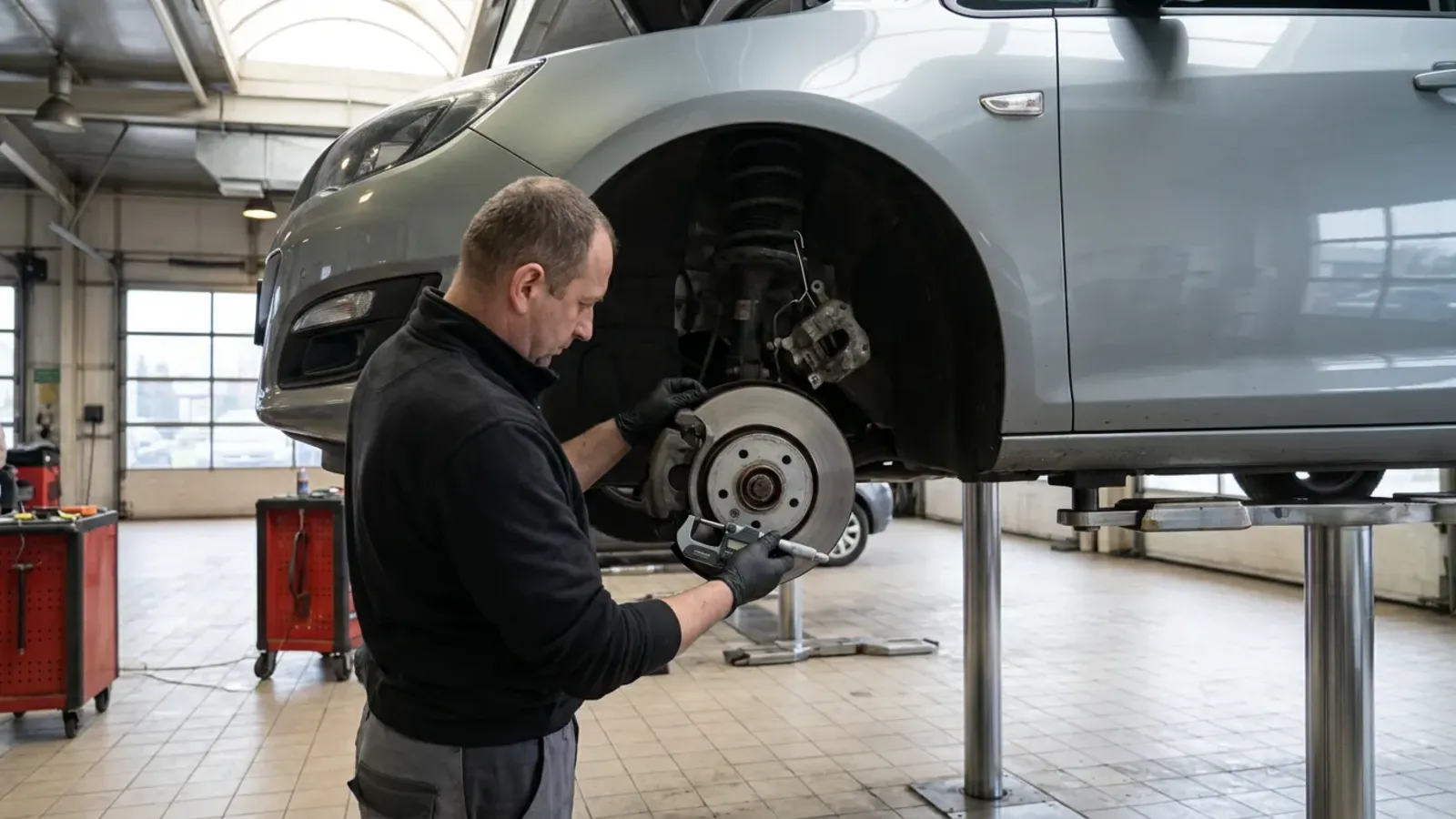
- Measuring the friction material on all pads, including the inner ones that are harder to see through the wheel. Uneven wear points to a caliper problem.
- Measuring disc thickness and comparing it with the minimum. Brembo recommends measuring at at least 4 points, taking the lowest reading, and replacing the disc when it is below the MIN TH value stamped on it.
- Checking the caliper guide pins and pistons, rubber boots, springs and damping shims. Brembo advises against reusing old shims.
- Replacement in axle pairs: pads always as a set per axle, both discs at once even if only one is below the minimum. When discs are replaced, new pads are always fitted.
- Checking the level and condition of the brake fluid, tightening the wheels with a torque wrench and a test drive.
Pads and discs are also assessed at the periodic technical inspection (MOT equivalent): excessive pad wear, worn discs, scoring and cracks are defects under Annex 1, points 1.1.13 and 1.1.14 of the regulation on technical inspections. It is better to replace them early than to find out only at the inspection.
You can have your brakes inspected and repaired at Serwis Osowa, ul. Odyseusza 20 in Gdańsk. We are an authorised Opel and Peugeot service centre and a Bosch Car Service, we repair all makes, including cars from the USA, and we diagnose ABS/ASR/ESP systems. Call: 58 552 55 25 (Mon–Fri 7:30–17:00, Sat 9:00–14:00). Quote after diagnosis; the scope of work is confirmed by a service advisor.
Frequently asked questions
Why do my brakes squeak after a night and then stop?
Overnight, moisture and a thin film of rust settle on the discs. On the first few stops the pads scrape it off and you hear a squeal or hiss for a moment. If the sound disappears after a few stops, this is normal.
Can new brake pads squeak?
Yes, during the bedding-in period, which according to Brembo lasts about 300 km. If the squeal does not go away after that, the cause may be missing or wrongly fitted damping shims, dry contact points with the bracket, old discs with an uneven surface or a sticking caliper guide pin.
Can I drive with squeaking brakes?
With a short squeal in damp weather, yes. With a constant metallic squeal every time you brake, the pads need replacing soon. With grinding metal, pulling to one side, a soft pedal or the red brake warning light, keep driving to a minimum and get the car to a mechanic as soon as possible.
Is it only cheap pads that squeak?
No, any pad can squeak if there is another fault in the system. Harder, more metallic compounds and pads poorly matched to the disc are noisier more often, so it is worth choosing parts for the specific car, not just on price.
Do the discs have to be replaced every time the pads are?
Not always. It depends on the measured disc thickness against the MIN TH minimum and on its condition: grooves, a lip, discolouration, runout. Brembo gives replacing the discs at every other pad change as a general rule, but new pads are always fitted with new discs.
Sources
- Brembo – Noises and vibrations (causes of squeal and vibration, damping shims, lubrication, bedding in)
- Brembo – Minimum brake disc thickness (MIN TH marking, measuring at 4 points, replacing discs in pairs)
- Brembo – Indications and bedding in (bedding in pads and discs for about 300 km)
- HELLA Tech World – Brake pad wear indicator (acoustic wear indicator, limit of about 2 mm)
- Bosch – Service and repair tips: brake pads (one-sided wear, pulling, noise, seized caliper)
- Journal of Laws 2024, item 141 – consolidated text of the regulation on the scope and method of vehicle technical inspections (Annex 1, points 1.1.13 and 1.1.14 – pads and discs)