A lit ABS warning light means that the control unit has switched off the anti-lock system after detecting a fault, most often in a wheel speed sensor or its wiring. Ordinary brakes still work, so you can carefully drive to a workshop, but under hard braking the wheels may lock up, and in many cars the ESP does not work either. If the red brake warning light is on together with the ABS or the pedal is soft, stop driving.
What does the ABS warning light mean and what still works?
ABS is a system that does not let the wheels lock during hard braking. The control unit compares signals from the wheel speed sensors of each wheel. When one slows down too quickly, a pump with a valve block reduces the pressure in its caliper for a fraction of a second. As a result the car brakes and can still be steered.
The orange warning light with the letters ABS comes on when the ignition is switched on and goes out after a few seconds. If it stays on or comes on while driving, the control unit has detected a fault and switched off the ABS. What this means in practice:
- The brakes work normally under ordinary braking. The pedal, braking force and handbrake do not change.
- Under hard braking, especially on wet roads, snow or leaves, the wheels may lock and the car will stop responding to steering.
- In most newer cars the ESP/ESC warning light comes on at the same time, and often traction control as well. These systems use the same wheel sensors, so they switch off together with the ABS.
- In some cars functions that rely on the wheel speed signal stop working or work worse: hill-start assist, tyre pressure drop warning, sometimes cruise control.
ABS light and red brake light – when to stop driving
This is the most important distinction. The ABS warning light is yellow or orange and concerns the electronics. The red brake warning light (an exclamation mark in a circle or the word "BRAKE" in US cars) concerns the braking system itself: an applied handbrake, a brake fluid level that is too low or a brake force distribution fault.
In most cars the ABS control unit is also responsible for electronic brake-force distribution (EBD), which makes sure the rear wheels do not lock before the front ones. Manufacturers warn in their manuals (for example Hyundai, Kia, Subaru) that when the ABS and brake warning lights are on at the same time, the braking system may not work normally under sudden braking, and the rear of the car loses grip more easily.
- Stop in a safe place and check that the handbrake is fully released.
- Check the brake fluid level in the reservoir under the bonnet. If it is below the MIN mark, do not drive on. A drop in level can mean a leak or very worn pads.
- If the brake pedal is soft, sinks, or the car brakes poorly, call a recovery truck.
- If the fluid is normal and both warning lights are still on, drive only slowly and over a short distance, straight to a workshop.
The ABS light alone with a normally working pedal is a signal to get to a workshop in the next few days. ABS together with the red brake warning light is a signal to stop and check.
The most common reasons the ABS light comes on
In workshop practice most cases involve one wheel: the sensor, its wiring or the ring from which the sensor reads rotation. Faults in the control unit itself and the pump are rarer, but they are the most expensive.
| Cause | Typical symptoms | Urgency |
|---|---|---|
| Damaged wheel speed sensor | ABS and ESP lights steady, often after rain, washing or winter | Medium – diagnostics within a few days |
| Dirty sensor or tone ring (filings, rust, mud) | Light comes on at a certain speed or after driving a short distance | Medium |
| Cracked or corroded ABS ring (tone ring), damaged encoder in the bearing | ABS activates by itself at low speed, pedal "pulses" unnecessarily | Medium to high |
| Chafed wire or corroded sensor connector | Light flashes or comes on over bumps and when turning | Medium |
| Play in or replacement of a wheel bearing without care for the sensor | Light after suspension work, bearing hum | Medium to high |
| Low battery voltage | Light after a hard start, often together with other warning lights | Low to medium – check the battery |
| Fuse, ABS pump relay | Light straight after starting, ABS not working at all | Medium |
| Fault in the ABS control unit or pump (modulator) | Steady light, no communication with the module, sometimes several faults at once | High – limit driving |
| Low brake fluid level | Usually the red brake warning light, sometimes together with ABS | High – check before driving further |
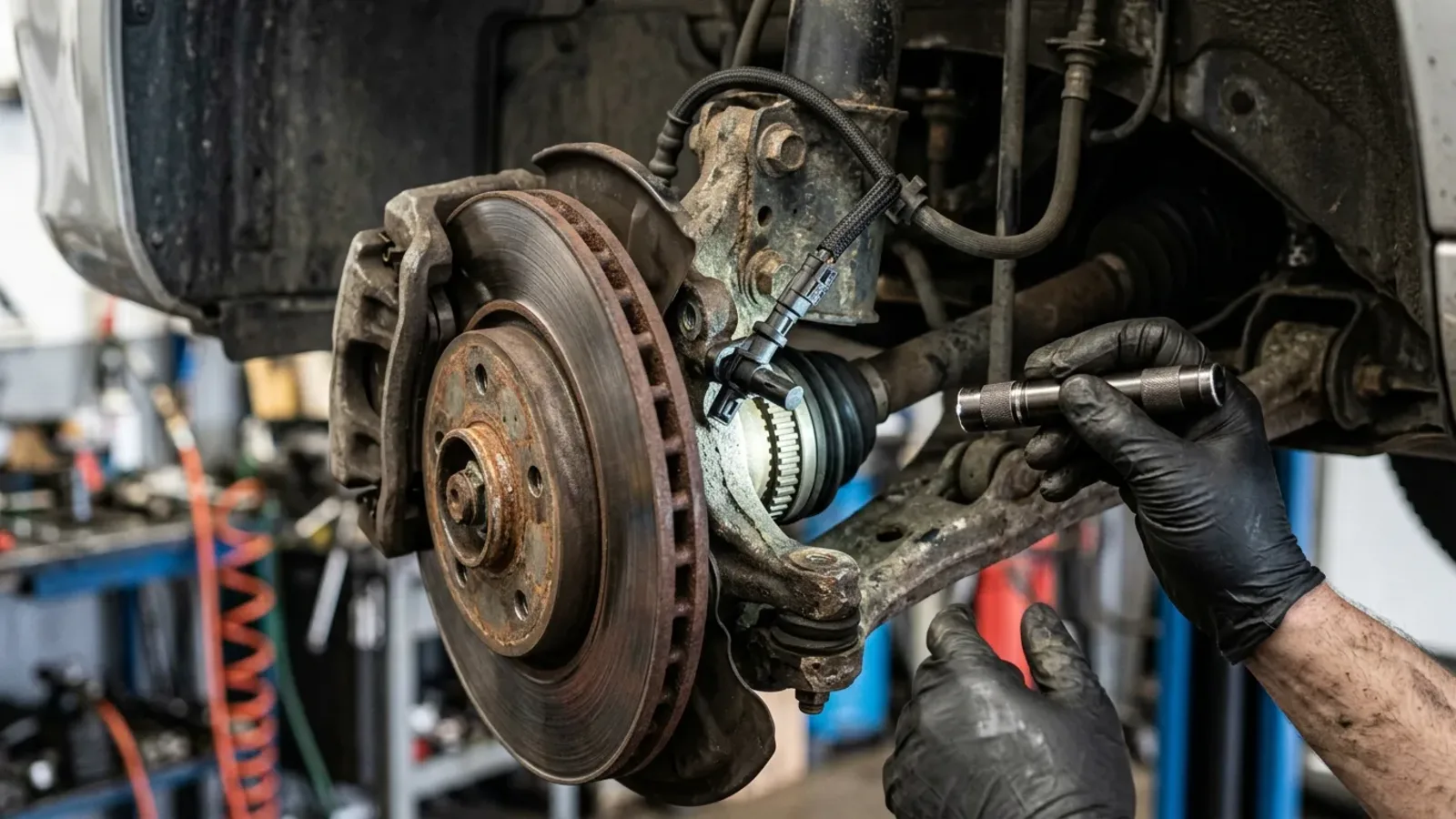
It is worth knowing that many newer cars have no separate toothed ring. Its role is played by a magnetic ring built into the wheel bearing seal. A bearing fitted the wrong way round or damaged during fitting gives exactly the same symptoms as a faulty sensor.
Can you drive with the ABS light on?
Yes, if only the ABS warning light is on and the brake pedal works normally. Remember, however, that you are driving a car without the system that saves the situation under sudden braking. On a wet road, on leaves or at the first frost, which in Tricity is a large part of the year, that is a real difference.
- Increase your distance from the car in front and brake earlier and more gently.
- Under sudden braking without ABS, do not hold the pedal fully down continuously. If the wheels lock, ease off for a moment and press again to regain steering.
- Avoid dynamic driving and high speeds, because the ESP does not work either.
- Do not put the repair off for weeks. A sensor fault can in time spread to the wiring or connector, which lengthens the diagnosis.
ABS warning light and the technical inspection
You will not pass the inspection with the ABS light on. The regulation on the scope and manner of carrying out vehicle technical inspections (consolidated text: Dz.U. 2024 poz. 141, annex no. 1 point 1.6) requires the ABS self-diagnostic warning light to be checked by inspection or through a diagnostic interface. The defects listed include a warning light that does not work, a light indicating a system fault, missing or damaged wheel speed sensors, damaged wiring and a failure reported by the electronic interface. They are classified as major defects, that is ones giving a negative inspection result.
With a negative result you have 14 days to repair the car and return to the same station. Removing the warning light bulb will achieve nothing: the inspector checks that the light comes on during the test after switching on the ignition, and a warning light that does not work is also a defect.
What does ABS diagnostics look like in a workshop?
Replacing a sensor "by eye" is the most common way to spend money with no result. The fault code usually points to the wheel and the type of problem (no signal, implausible signal, open circuit), but does not say whether the sensor, wiring, tone ring or bearing is to blame.
- Reading codes from the ABS/ESP control unit. Note: simple phone OBD2 interfaces usually see only the engine control unit, not the ABS.
- Viewing the speed of all wheels live during a test drive or on a lift. A wheel that "loses" its signal shows up straight away.
- Inspecting the sensor, tone ring or bearing encoder, and checking bearing play.
- Measuring the wiring and connector from the sensor to the control unit, checking the fuses and power supply.
- Only after the cause is confirmed – replacing the part, clearing the faults and a check drive.
You can have ABS diagnostics and repair done at Serwis Osowa, ul. Odyseusza 20 in Gdańsk. We are an authorised service centre for Opel and Peugeot and a Bosch Car Service, and we repair all makes, including US cars. Call: 58 552 55 25 (Mon–Fri 7:30–17:00, Sat 9:00–14:00). The scope and price are confirmed by the service advisor.
Frequently asked questions
Why does the ABS light come on and go out after a moment?
Most often it signals an intermittent contact: a chafed wire, moisture in a connector or a dirty sensor. After a restart the control unit checks the system afresh and may switch it on, but the fault code usually stays in memory. It is worth reading it before the fault becomes permanent.
Can the ABS light come on after changing pads or tyres?
Yes. When working near the wheels it is easy to stretch or chafe the sensor wire or get it dirty. It also happens that a fault appears after fitting wheels with a different rolling circumference from what the manufacturer specifies. If the light came on right after a visit involving the wheels, start checking there.
Can I clear the ABS fault myself?
Technically yes, but there is no point without removing the cause. With a permanent fault the light will come on after a few metres of driving or at the next start. Clearing the fault before the inspection does not help either, because the inspector checks the warning light's operation and can read the control unit through the interface.
Can a weak battery turn on the ABS light?
It can. The ABS pump and control unit need a stable voltage, and if it drops during starting the control unit can store a fault and switch off the system. If the light appeared after a freezing night together with other warning lights, check the battery and charging first.
Does a faulty ABS lengthen the braking distance?
On a dry, even surface the difference is often small, because ABS above all preserves steering. On a wet, slippery or uneven surface, locked wheels brake worse and the car stops turning, so in practice the risk of an accident rises noticeably.
Sources
- Dz.U. 2024 poz. 141 – consolidated text of the regulation on the scope and manner of carrying out vehicle technical inspections (annex no. 1 point 1.6 – ABS anti-lock system)
- Hyundai i30 – owner's manual, chapter on electronic brake-force distribution EBD and the ABS/brake warning lights
- Subaru Impreza 2010 – owner's manual (ABS and brake warning lights on at the same time, EBD failure)
- AutoCentrum – Braking without ABS (system design, typical sensor faults)