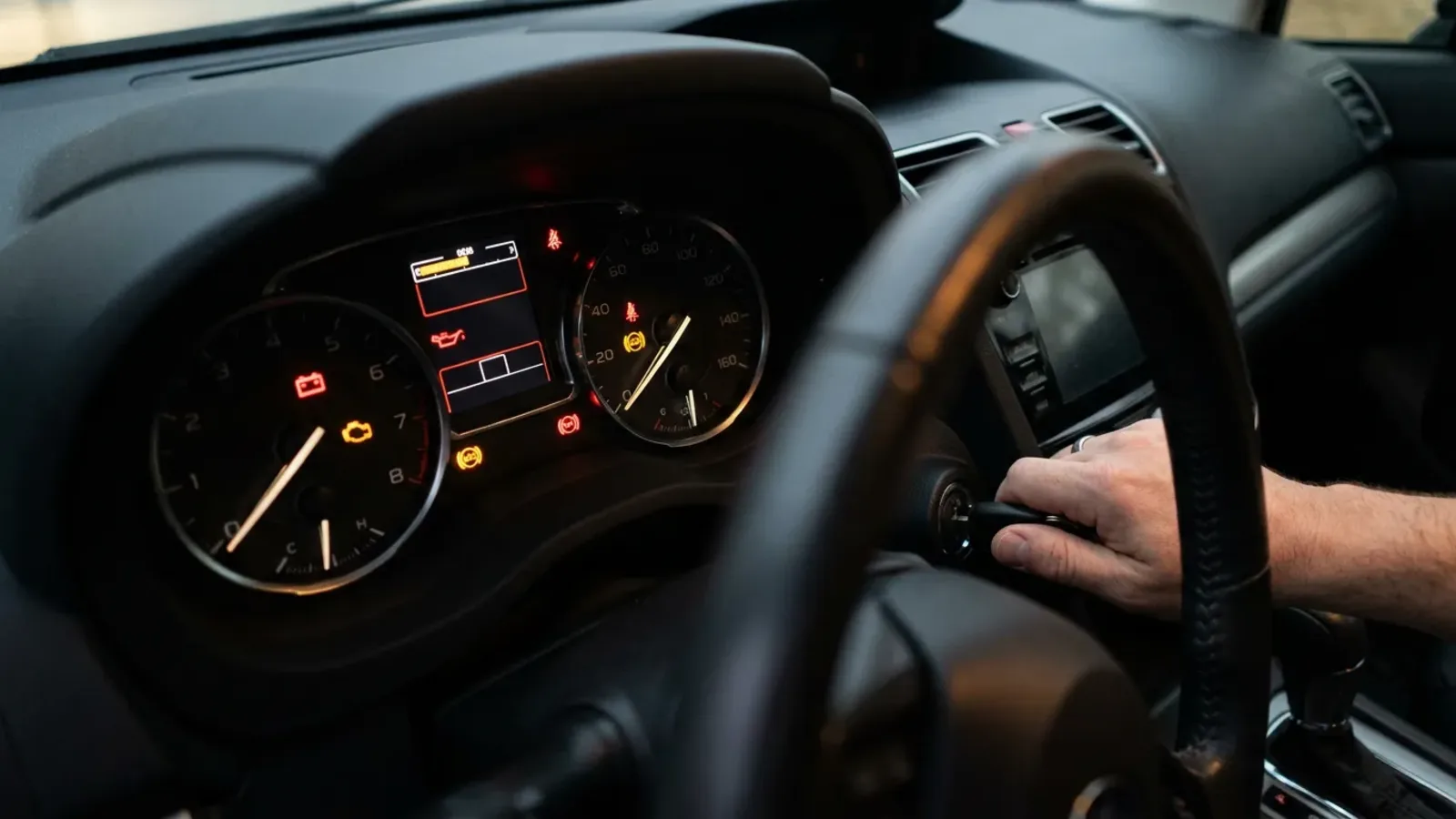
You read dashboard warning lights by colour first: red means danger and usually the need to stop the car, yellow or orange is a fault or warning with which you can carefully drive to a workshop, and green and blue only tell you that a function is switched on. Only then do you look at the symbol and check it in your car's manual. The most dangerous are the red warning lights for oil pressure, coolant temperature and the braking system.
How to read the colours of warning lights in a car
Warning light colours are not random. The international standard ISO 2575, which describes symbols and indicators in road vehicles, assigns specific meanings to colours. Red means danger. Yellow (amber, orange) means a warning or a system fault. Green means normal, safe operation or a function being switched on. Blue is reserved for a few symbols, above all the main beam. White is used where none of the other colours fits.
- Red – stop as soon as it is safe, or remove the cause straight away (for example fasten your seat belt, close the door).
- Yellow or orange – something needs checking. You can usually keep driving, but calmly and to a workshop.
- Green, blue, white – information. Nothing is wrong, the function is simply switched on.
Two practical notes. First, after you switch on the ignition most warning lights come on briefly and go out. This is a bulb test. If one stays on after the engine starts, it signals a fault. If the ABS or airbag light does not come on at all during the test, that is a problem too. Second, the same symbol is sometimes described slightly differently by different makes, and a flashing warning light often means something more urgent than a steady one. Your car's manual always takes precedence over general tables.
Red warning lights: when to stop immediately
Red warning lights are not put off until later. Some of them signal a state that can destroy the engine within minutes or take away effective braking.
| Warning light | Meaning | Keep driving? | What to do |
|---|---|---|---|
| Oil pressure (oil can) | Engine oil pressure too low | No | Stop and switch off the engine. Check the oil level. Do not restart if the light comes back – call a recovery truck. |
| Coolant temperature (thermometer) | The engine is overheating | No | Stop, switch off the engine and wait for it to cool. Do not open the hot expansion tank. |
| Charging (battery) | The alternator is not charging, the car is running on battery reserve | Only briefly | Switch off unnecessary consumers and drive straight to a workshop. If the belt also drives the water pump, watch the temperature. |
| Braking system (exclamation mark in a circle, BRAKE) | Handbrake applied, low brake fluid level or a system fault | No, unless it is the handbrake | Release the handbrake. If the light stays on, stop and check the fluid. Do not drive with a soft pedal. |
| Airbags (SRS, passenger with airbag) | Fault in the airbag system or seat belt pretensioners | Yes, carefully | The airbags may not deploy in a collision. Book diagnostics as soon as possible. |
| Power steering (steering wheel with exclamation mark) | Power steering failure | Carefully, over a short distance | The steering wheel may be very heavy. Drive slowly to a workshop or call for help. |
In many cars the power steering and airbag warning lights are yellow. The colour depends on the manufacturer and the severity of the fault, so always check the manual.
Yellow and orange warning lights: what do they mean?
This is the largest group. A yellow warning light does not mean "pull over on the hard shoulder", but it does mean "do not ignore it". A minor fault left for months often ends in a more expensive repair.
| Warning light | Meaning | Keep driving? | What to do |
|---|---|---|---|
| Engine (check engine, MIL) | The control unit has stored an engine or emissions system fault | Steady: yes. Flashing: limit driving | Book diagnostics. If it flashes, slow down and do not load the engine. |
| ABS | ABS switched off, brakes work without ABS | Yes, carefully | Brake more gently and increase your following distance. If the red brake warning light is also on – stop. |
| ESP / ESC (car with a wavy line) | Flashing: the system is working right now. Steady: fault or system switched off | Yes | Flashing on a slippery road is normal operation. A steady light needs diagnostics. |
| Diesel particulate filter (DPF) | Filter full of soot, regeneration needed | Yes, as per the manual | A longer drive outside town most often helps. If it does not go out or it flashes – workshop. |
| Glow plugs (coil, diesel) | Before starting: glow plugs heating. Flashing while driving: engine fault in some cars | Yes | Before starting, wait for it to go out. If it flashes or is on while driving, book diagnostics. |
| Tyre pressure (TPMS) | Pressure drop in at least one tyre | Yes, but check the tyres | Measure the pressure at a petrol station. If a wheel is clearly flat, do not drive on it any further. |
| AdBlue (droplet, AdBlue text) | Low fluid level or an SCR system fault | Yes, but do not delay | Top up the fluid. When the tank empties, the system may block the engine from restarting. |
| Low fuel level | You are running on reserve | Yes, to a petrol station | Refuel. In a diesel with a DPF, driving on reserve makes filter regeneration harder. |
We cover the three most common yellow warning lights in detail in separate guides.
Green, blue and white warning lights – information only
These lights tell you what is switched on. Green ones are usually dipped beam, indicators, front fog lights, cruise control or eco mode. The blue warning light is the main beam. Remember to switch back to dipped beam before an oncoming car.
- A spanner or the word "Service" – a scheduled service is due. This is not a failure but a reminder.
- An exclamation mark in a triangle (usually yellow) – a general message. You will find the details on the on-board computer display.
- A snowflake or a temperature message – a warning about possible black ice at temperatures close to zero. In Pomerania it comes on often in autumn and winter.
- The letter "A" in an arrow – the start-stop system is active. If the engine does not switch off at traffic lights, the system may be waiting for the battery to charge or the engine to warm up.
A warning light has come on – what to do step by step
- Check the colour. Red – look for a safe place to stop. Yellow – carry on driving calmly and watch the car.
- Check whether the light is steady or flashing. Flashing usually means greater urgency.
- Read the message on the display, if the car shows one. It often gives a specific cause, for example "Low brake fluid level".
- Assess the symptoms: loss of power, juddering, smoke, a smell of burning, a heavy steering wheel, a soft brake pedal. Each of them raises the urgency.
- Once stopped, check what you can without tools: the oil, coolant and brake fluid levels, tyre pressure, and whether the handbrake is released.
- Remember the situation in which the light came on (cold start, motorway, after refuelling, after a car wash). It really speeds up diagnosis.
- Do not clear faults before the service visit. The stored code and the conditions in which it arose are the most valuable information for the mechanic.
Several warning lights on at once, a so-called Christmas tree, after a hard start on a cold morning often has a common cause: low battery voltage. Before you start replacing sensors, check the battery and charging.
Will you pass the technical inspection with a warning light on?
Often not. The regulation on the scope and manner of carrying out vehicle technical inspections (consolidated text: Dz.U. 2024 poz. 141) expressly requires the inspector to check the self-diagnostic warning lights. Classified as major defects, that is ones giving a negative inspection result, are, among others, an ABS light indicating a system fault, an SRS airbag system light signalling a failure, the electronic power steering failure indicator and OBD fault codes related to exhaust emissions.
It also matters whether the warning light works at all. A light that does not come on during the test after switching on the ignition is also a fault. So neither removing the bulb nor switching the warning off in software will help. After a negative result you have 14 days to repair the car and have it re-checked at the same station, limited to the defects found.
Warning light diagnostics in Gdańsk Osowa
The light itself tells you which system is reporting a problem, but not what exactly has broken. For that you need computer diagnostics: reading codes from all control units, not just the engine, viewing live data and checking components. Cheaper OBD2 interfaces usually see only the engine control unit, and the ABS, airbag or power steering warning lights remain invisible to them.
If something is lit on your dashboard that you do not understand, come to Serwis Osowa, ul. Odyseusza 20 in Gdańsk. We are an authorised service centre for Opel and Peugeot and a Bosch Car Service, and we repair all makes, including US cars, in which the warning lights often have words instead of symbols (for example "BRAKE", "Check Engine"). Call: 58 552 55 25, Mon–Fri 7:30–17:00, Sat 9:00–14:00. The scope and price of diagnostics are confirmed by the service advisor.
Frequently asked questions
What does an exclamation mark on the dashboard mean?
It depends on the shape and colour. A red exclamation mark in a circle is usually the braking system: handbrake applied or too little fluid. A yellow exclamation mark in a triangle is a general warning, the content of which is shown by the on-board computer. An exclamation mark in a horseshoe shape with brackets is tyre pressure.
What does the spanner warning light mean?
In most cars the spanner (sometimes with the word "Service") reminds you of an approaching scheduled service by mileage or time. It is not a failure. In some models the spanner also signals a powertrain fault, so if it appears together with a loss of power, check the manual.
Why does a warning light come on and go out after a moment?
The fault may occur only in certain conditions, for example in damp weather, on a cold engine or with a poor contact in a connector. The control unit usually stores a fault code in memory anyway, so it is worth reading it before a minor problem becomes permanent.
Do warning lights look the same across different makes?
The basic symbols are standardised, but the details differ. In cars from the US market you often see words instead of symbols, for example "BRAKE" or "Service Engine Soon". Manufacturers also add their own lights, for example for hybrid systems. The meaning of a specific warning light is always confirmed by the owner's manual.
Will the warning light go out by itself after a repair?
Some will, for example the tyre pressure light after inflating and, if needed, resetting the system, or the engine light after a few driving cycles. Many warning lights, especially ABS, airbags or power steering, go out only after the fault is cleared with a tester following the repair.
Sources
- ISO 2575:2021 – Road vehicles — Symbols for controls, indicators and tell-tales (meaning of light colours)
- Dz.U. 2024 poz. 141 – consolidated text of the regulation on the scope and manner of carrying out vehicle technical inspections (annex no. 1: points 1.6 ABS, 2.6 EPS, 7.1.6 SRS, 8.2 emissions)
- Hyundai Polska – Dashboard warning lights: how to recognise them and what they mean
- Peugeot 301 – owner's manual, AdBlue chapter (reserve approx. 2400 km, start inhibit after the tank empties)