There is no single interval for every automatic gearbox. ZF fills its gearboxes at the factory with “lifetime” oil, yet it still recommends an oil change after 150,000 km, and earlier with high temperatures, heavy loads or an unknown vehicle history. Dual-clutch gearboxes with wet clutches can have shorter intervals, and the binding interval for your car is set by the manufacturer – it is best checked by VIN.
Is automatic gearbox oil really for life?
The phrase “lifetime fill” appears in many owner’s manuals and is the source of the most common misunderstanding. For the car manufacturer, “lifetime” usually means an assumed service life, not every kilometre the car covers with its later owners. Oil in an automatic gearbox does more than lubricate: it transmits control pressure, cools the clutches and has precisely tuned friction properties. Over time the additives wear out and fine particles from the clutch linings and gears build up in the oil.
ZF’s own documents show this clearly. In the product data sheet for ZF LifeguardFluid 8 for 8HP gearboxes, the manufacturer writes that its automatic gearboxes are filled at the factory with lifetime oil, but because of the many factors affecting gearbox life it recommends an oil change after 150,000 km. With high temperatures and loads, or an unknown vehicle history, ZF says changing the oil at shorter intervals can make sense.
The car manufacturer’s service schedule is binding, especially during the warranty period. If the service book does not include an automatic gearbox oil change, that does not mean the gearbox will never need one – it is worth discussing with a service advisor at the scheduled service.
How often to change oil in an automatic, DSG and CVT?
The type of gearbox matters more than the make of car. A conventional automatic with a torque converter (e.g. ZF, Aisin), a dual-clutch gearbox and a continuously variable transmission (CVT) work differently and have different oil requirements.
| Gearbox type | Examples | What manufacturers and sources say | Notes |
|---|---|---|---|
| Automatic with torque converter | ZF 6HP, 8HP, Aisin gearboxes | ZF for its gearboxes: change after 150,000 km, earlier under heavy load | Interval for a specific car per the manufacturer, check by VIN |
| Dual-clutch with wet clutches | VW DQ250, DQ381 | Auto Motor und Sport gives about 60,000 km for the DQ250 and 120,000 km for the DQ381 | The oil cools the clutches, so its condition matters a lot |
| Dual-clutch with dry clutches | VW DQ200 | Per the manufacturer no oil change; experts quoted by Auto Motor und Sport suggest about 100,000 km | Separate oil circuits for the mechatronic unit and the gear set – depending on version |
| Continuously variable CVT | Various Japanese and European designs | Interval per the car manufacturer, check by VIN | Requires CVT fluid to a strictly defined specification |
A shorter interval is worth considering if the car often tows a trailer, sits in traffic, has been driven hard or comes from an unknown source – for example an import with no service history. These are exactly the situations ZF lists as a reason for an earlier change.
What are the symptoms of old oil in an automatic gearbox?
Worn oil rarely gives one clear signal. Usually the gearbox gradually loses its smoothness, and the driver gets used to the changes. What to look out for:
- jerks when changing gear, especially between 1st and 2nd or when downshifting under braking;
- delayed engagement after moving the selector from P or N to D or R;
- “slipping” – the revs rise but the car accelerates less;
- vibration at a steady speed when the torque converter lock-up clutch engages;
- a gearbox fault message or limp-home mode.
The same symptoms can come from faulty solenoid valves, sensors or the control unit, so an oil change alone does not always cure them. ZF also warns that if the oil smells burnt or contains chips or metal fragments, the gearbox is already damaged. In that case it needs diagnosis, not just fresh oil.
Static or dynamic oil exchange: what is the difference?
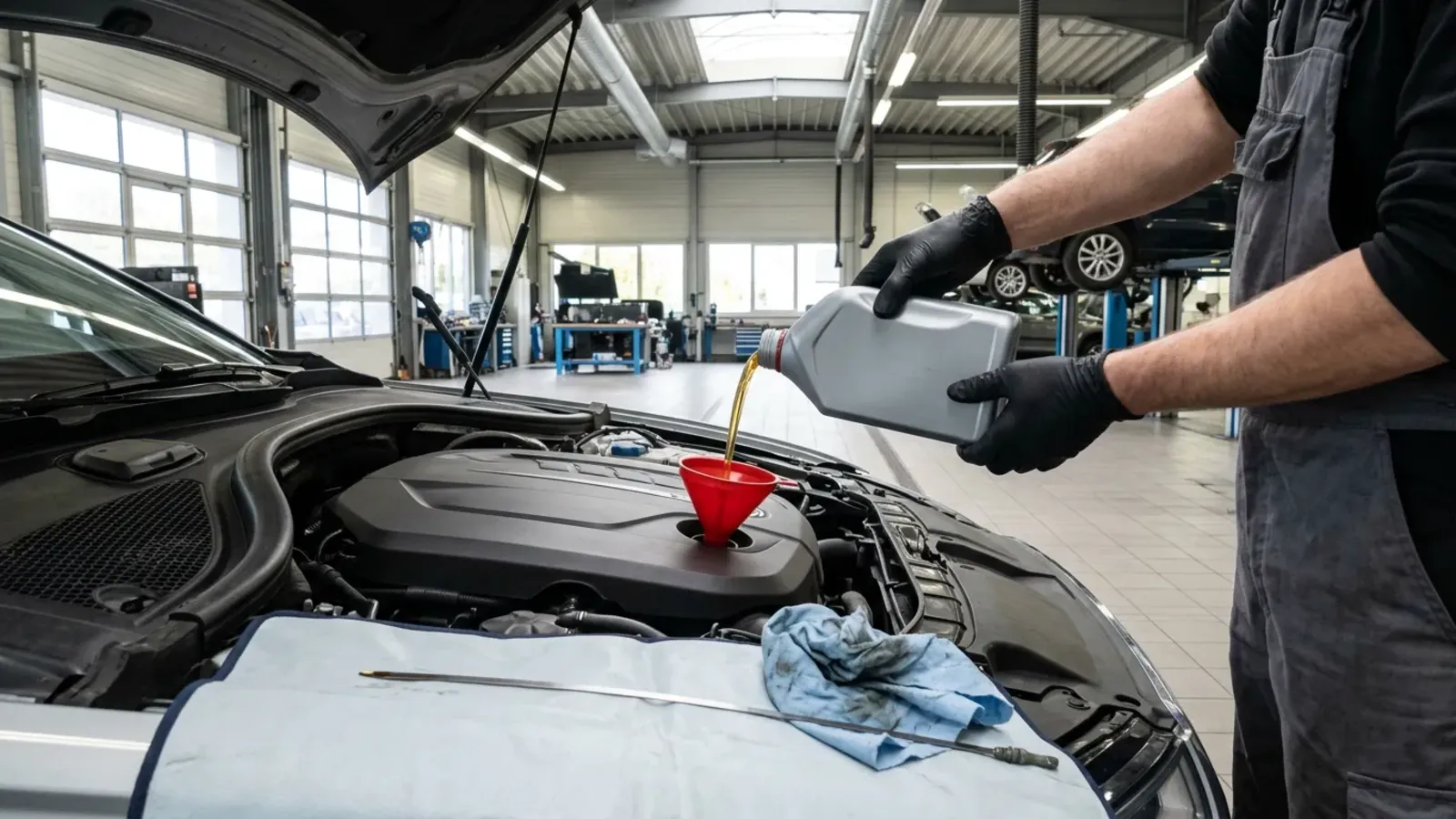
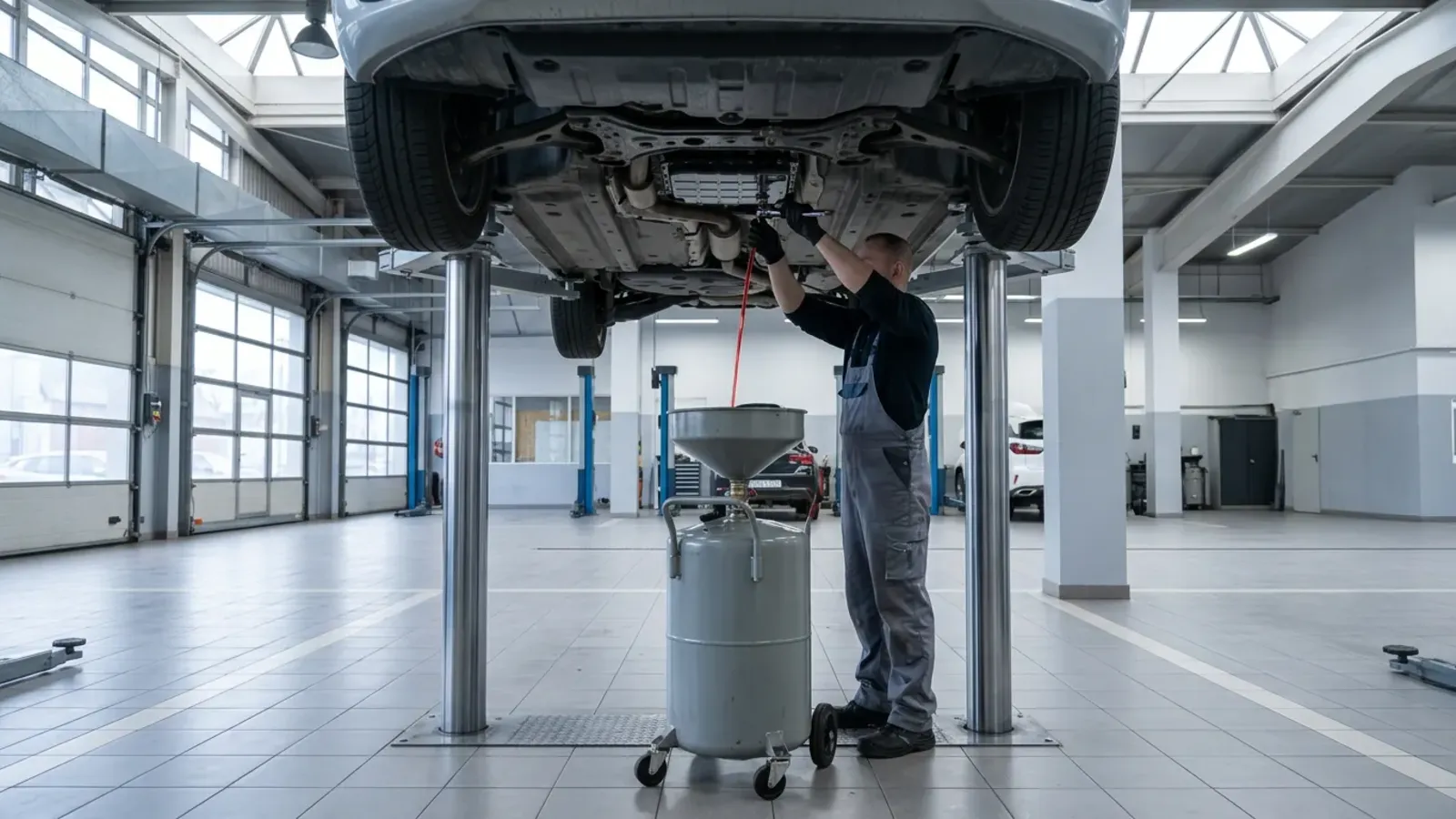
A static exchange means draining the oil through the drain plug and topping up with new oil. It is simple, but in an automatic it does not replace all of the oil, because some stays in the torque converter, the cooler and the passages. Liqui Moly, in its material on automatic gearbox oil changes, states that undoing the drain plug alone lets only about a third of the oil drain out. That is why a static exchange is often repeated after a short mileage, to gradually raise the share of fresh oil.
A dynamic exchange is done with a machine connected to the oil circuit, for example via the oil cooler lines. With the engine running, the old oil is drawn off and new oil is fed in at the same rate – the level in the gearbox must stay constant throughout. It lets a larger share of the oil be replaced in one go.
| Static (partial) | Dynamic (machine) | |
|---|---|---|
| How it is done | Draining the oil, sometimes removing the pan and replacing the filter, topping up | Exchange within the circuit with the engine running |
| How much oil is replaced | Part – the rest stays in the gearbox | Most of it, depending on the procedure and the oil capacity |
| When it works well | Regular maintenance, gearbox in good condition | When you want to replace more oil at once |
| What to watch out for | Often needs repeating | Requires adapters for the specific gearbox and the correct procedure |
Flushing an automatic gearbox and flush additives poured into the old oil are a separate matter. In their procedures, gearbox manufacturers require above all the correct, approved oil. It is better not to use additives outside the specification without the manufacturer’s explicit approval, because they change the oil’s friction properties, on which clutch operation depends.
Filter, the correct oil and a temperature-controlled level check
- Filter and pan: in some ZF gearboxes with a metal pan the filter and seal are replaced, while in gearboxes with a plastic pan the filter and seal are built into it, so the whole pan is replaced.
- Oil specification: in the ZF LifeguardFluid 8 data sheet, ZF stresses that only approved oil may be used in 8HP gearboxes, and other oil can worsen shifting or even lead to gearbox failure. A “universal ATF” is not always approved.
- Level at temperature: in ZF automatics the level is checked at a defined oil temperature read with a diagnostic tester – according to ZF up to 30–35°C for 6HP gearboxes and up to 40°C for 8HP. Too much oil and too little are equally harmful.
- Adaptation: after an oil change some cars need a reset or a gearbox adaptation run with a tester, following the manufacturer’s procedure.
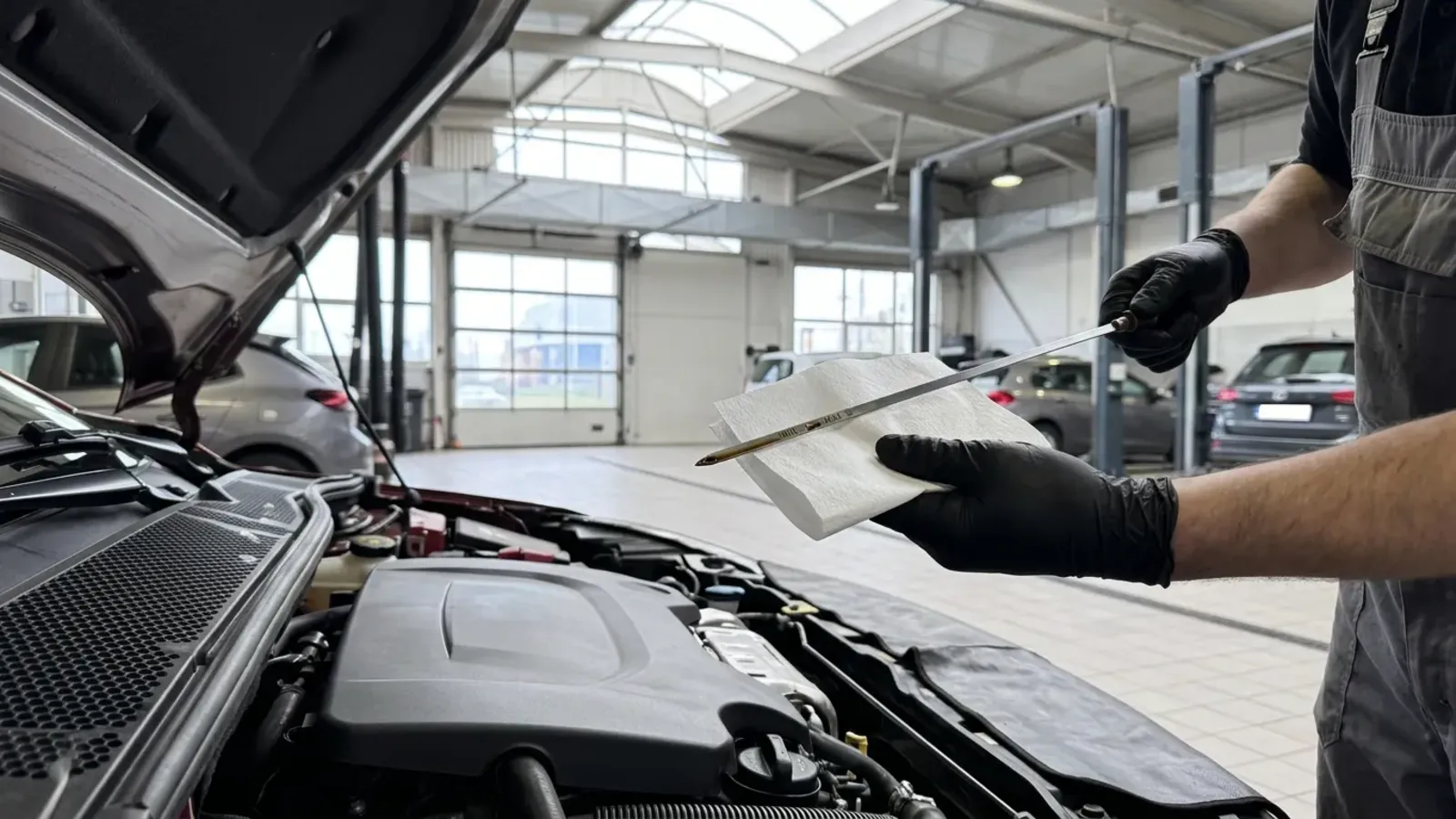
Many modern automatics have no dipstick. The level is checked through an inspection hole at a defined temperature, so “adding a little oil” without a tester and the procedure can be risky.
Should you change the oil in a high-mileage gearbox that has never had it changed?
You often hear that changing the oil in a neglected automatic “kills” the gearbox. Usually it is the other way round: the gearbox was already worn, and the oil change simply coincided with the fault showing itself. The risk is real, however, when the clutches are badly worn and old oil with suspended particles was masking the problem. That is why, at high mileage with no history, the decision is worth preceding with an assessment of the gearbox.
- A test drive and reading faults from the gearbox control unit.
- Assessing the look and smell of the oil and the sediment in the pan.
- Choosing the method: with a gearbox in good condition a fuller exchange, if in doubt a more cautious one, e.g. a partial exchange in several stages.
- After the change, a level check at temperature and, if the manufacturer requires it, adaptation.
You can have the gearbox diagnosed and the automatic gearbox oil changed at Serwis Osowa, ul. Odyseusza 20 in Gdańsk. We are an authorised Opel and Peugeot service centre and a Bosch Car Service, and we repair all makes, including cars from the USA. The method (static or dynamic) and the date are confirmed by a service advisor after checking the car, and the cost depends on the gearbox and the amount and type of oil – quote after diagnosis. Call: 58 552 55 25 (Mon–Fri 7:30–17:00, Sat 9:00–14:00).
Frequently asked questions
How much does an automatic gearbox oil change cost?
The cost depends on the gearbox type, the amount and specification of the oil, whether the filter or pan is replaced, and the method. Serwis Osowa has no fixed price list for this service – the quote is prepared by a service advisor after checking the car.
Can the gearbox start working worse after an oil change?
With a gearbox in good condition and the correct oil, it usually runs more smoothly. Problems after a change most often come from the wrong oil, an incorrect level, a missing adaptation or earlier clutch wear that the old oil was masking.
Does an automatic gearbox flush additive make sense?
Gearbox manufacturers require above all approved oil and their own procedures. Additives outside the specification can change the oil’s friction properties, so it is better not to use them without the manufacturer’s approval.
Is the oil changed in a dry-clutch DSG?
For the DQ200 the manufacturer does not include an oil change in the maintenance schedule, although some specialists recommend one at high mileage. DSG gearboxes with wet clutches, e.g. the DQ250, have defined change intervals.
How do I check which oil my gearbox needs?
Most reliably by VIN and the gearbox designation. Gearbox manufacturers such as ZF publish lists of approved oils, and the car manufacturer gives the specification in the service documentation.
Sources
- ZF – ZF LifeguardFluid 8 product data sheet (lifetime oil, recommended change after 150,000 km, approved oil only)
- ZF Aftermarket – Automatic Transmissions: oil change (level check temperature for 6HP/8HP, filter and pan, signs of damage in the oil)
- Liqui Moly – Automatic transmission fluid change made easy (drain plug removes about 1/3 of the oil, constant level during dynamic exchange)
- Auto Motor und Sport – DSG oil change: intervals for DQ200, DQ250, DQ381