Getting your car ready for winter is above all a load test of the battery, checking the freezing point of the coolant, winter screenwash, working wipers and tyres with good tread. Add to that a check of the lights, brakes, heating and air conditioning, which in winter dries the air and helps with misted windows. The battery causes the most trouble, because frost reduces its performance and starting a cold engine takes more current. It is worth doing this check in November, before the first frosts.
What should you check on your car before winter?
Below is the list we follow for a pre-winter check. Most items are quick measurements, but each one covers a specific problem that shows up in winter: the car won't start, the windows won't clear, the screenwash freezes in the jets.
| Item | What we check | Why it matters in winter |
|---|---|---|
| Battery | Load test (cranking current), resting voltage, alternator charging, terminals | In frost the battery delivers less current, and a cold engine is harder to turn over |
| Coolant | Freezing point with a refractometer, level, hose tightness | Frozen coolant can crack the radiator, heater matrix or engine block |
| Screenwash | Type of fluid in the reservoir and whether the jets are clear | Summer fluid freezes in the jets and lines, and in winter the windscreen gets dirty fastest |
| Wipers | Condition of the blade rubber, arm pressure | Hard, cracked rubber smears salt and dirt and limits visibility |
| Tyres | Tread depth and evenness, age, pressure, TPMS sensors | Less grip, and pressure drops along with the temperature |
| Lighting | All bulbs, headlight aim, condition of the lenses | Short days, fog, wet roads reflecting light |
| Brakes | Pads, discs, lines, water content of the brake fluid | Slippery roads and salt that speeds up corrosion |
| Heating and air conditioning | Vents and blower working, compressor, cabin filter | Air conditioning dries the air, so the windows stop misting up sooner |
| Seals and locks | Condition of the door and boot seals, how the locks work | Moisture on the seals freezes and the doors won't open |
| Fuel and DPF (diesel) | Fuel filter, DPF messages stored in the control unit | Paraffin in the fuel clogs the filter, short trips make DPF regeneration harder |
Tyres are a separate topic, covered in our guide on when to switch to winter tyres. Just a reminder here: Poland has no general obligation to drive on winter tyres, but tyres must be roadworthy and the minimum permitted tread depth is 1.6 mm. When changing tyres, check the pressure straight away, because it drops in the cold.
In winter, air conditioning is not there to cool. When the windows mist up, turn on the windscreen vent with the air conditioning: the dried air picks up moisture from the glass faster than warm air alone. If the windows still mist up, check the cabin filter and whether there is standing water in the car, e.g. on the mats.
How do you check the battery and coolant before the frost?
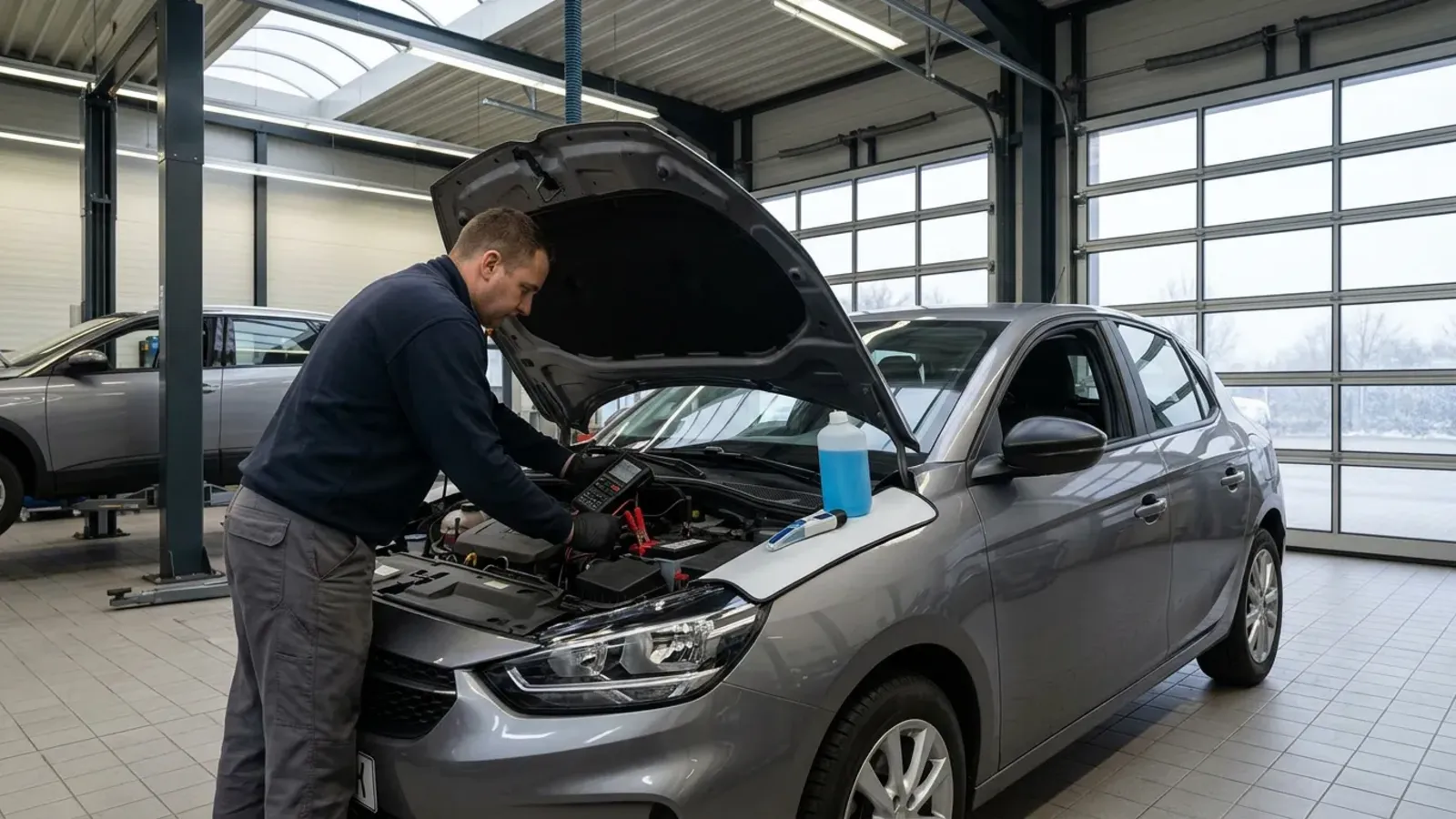
The battery is best checked with a tester that measures its ability to deliver cranking current, not just the voltage. A battery that shows the correct voltage in autumn may fail to start the engine after a frosty night. The test usually also shows whether the battery is fit for further use and whether the alternator is charging it properly. If the result is poor, it is better to replace the battery at the workshop than in a car park in the morning.
We check the coolant with a refractometer. A drop of coolant on the prism shows the temperature at which it will start to freeze. Neither the colour of the coolant nor topping up "by eye" will tell you that. A typical glycol concentrate diluted 1:1 with water protects down to approx. −37 °C. If water has been topped up for years, the protection may be much weaker.
- Do not mix coolants blindly: top up with a coolant that meets the car manufacturer's specification.
- Fill up with winter screenwash before the frosts arrive, and use up the summer fluid in the system first.
- Do not dilute winter screenwash with water unless the manufacturer allows it, or you will raise its freezing point.
- Wipe the door seals and protect them with a silicone product so they do not freeze.
If your car has already failed to start one morning, begin with our guide on what to do when the car won't start. There you will find the differences between the symptoms of a flat battery, the starter motor and the fuel supply.
What diesel fuel should you use in winter and what about the DPF?
Diesel fuel contains paraffin, which crystallises in frost and can clog the fuel filter. That is why filling stations sell fuel suited to the season. The Polish regulation on quality requirements for liquid fuels, based on the PN-EN 590 standard, sets the cold filter plugging point (CFPP) for each period.
| Period | Dates | CFPP no higher than |
|---|---|---|
| Summer | 16 April – 30 September | 0 °C |
| Transitional | 1 March – 15 April and 1 October – 15 November | −10 °C |
| Winter | 16 November – end of February | −20 °C |
| Diesel with improved low-temperature properties ("arctic") | when the station stocks it | −32 °C |
If the car has stood for a long time with fuel from the autumn and a hard frost is forecast, fill up with winter or arctic diesel. Do not add petrol to diesel: it is an old practice that can harm the pump and injectors in modern injection systems.
The second winter issue in a diesel is the DPF. In winter we make more short trips, the engine takes longer to warm up and the control unit does not get the conditions it needs to burn off the soot. If most of your trips are a few kilometres, plan a longer drive at a steady speed every now and then. We cover what the DPF warning light means and when diagnostics are needed in a separate guide.
How does winter affect the range of a hybrid or electric car?
In frost the traction battery delivers and accepts energy more slowly, and cabin heating draws power from the same battery. In an AAA study at −6.7 °C (20 °F) with the heating on, the average range of the electric cars tested fell by 41%. That is the result of one specific test, not a rule for every car, but it shows the scale of the effect.
- If your car has this function, pre-heat the cabin and battery while the car is still plugged in to the charger.
- Use the heated seats and steering wheel: they use less energy than heating the whole cabin.
- Expect slower charging of a cold battery, especially on rapid chargers.
- In a hybrid the combustion engine starts more often to heat the cabin and itself, so fuel consumption rises in winter.
- Hybrids and EVs also have a 12 V battery. If it is weak, the car may not switch to ready-to-drive mode even with a charged traction battery.
What should you carry in the car in winter?
A short list of things that genuinely come in handy in winter. Most of it fits in the compartment under the boot floor.
- An ice scraper and snow brush: clear the snow off the roof before driving, not just off the windows.
- Spare winter screenwash.
- Jump leads and work gloves.
- A torch or head torch, a high-visibility vest, a warning triangle and a fire extinguisher.
- A blanket and a charged power bank for your phone.
- Keep lock de-icer in your coat pocket or at home, not in the frozen car.
Pre-winter car check in Gdańsk Osowa
You can have a pre-winter check done at Serwis Osowa, ul. Odyseusza 20 in Gdańsk. We are an authorised Opel and Peugeot service centre and a Bosch Car Service, and we repair all makes, including hybrids and electric cars. We will check the items on the list, and while the car is with us we can change the tyres and store your summer set. The scope of work and the quote after inspecting the car are confirmed by the service advisor.
Call: 58 552 55 25 (Mon–Fri 7:30–17:00, Sat 9:00–14:00). If you are changing tyres anyway, it is simplest to book the check and the tyre change as one visit.
Frequently asked questions
When is the best time to get a car ready for winter?
In October or November, before the temperature starts regularly dropping below zero. Then you can check the battery, coolant and screenwash calmly, before one of them lets you down on the morning of the first frost.
How long does a car battery last?
It depends on the battery type, how the car is driven and its equipment, so it is better to rely on a test than on age. A battery that has been in a car used mainly for short trips for a few years is worth checking before every winter.
Should you use the air conditioning in winter?
It is worth it. Air conditioning dries the air in the cabin, so the windows stop misting up sooner. Running the compressor regularly also helps keep the system in good condition, because lubricating oil circulates with the refrigerant.
Are winter tyres compulsory in Poland?
There is no general obligation to drive on winter tyres. Tyres must, however, be roadworthy, and the tread must not be shallower than 1.6 mm. For winter driving we recommend winter tyres or all-season tyres with the 3PMSF symbol.
When does winter diesel appear at filling stations?
Under the regulation on quality requirements for liquid fuels, the winter period runs from 16 November to the end of February, and during it the fuel must have a CFPP no higher than −20 °C. From 1 October to 15 November transitional fuel with a CFPP of −10 °C applies.
Sources
- Regulation on quality requirements for liquid fuels, Journal of Laws 2024, item 1018 – annex 3: diesel CFPP (0/−10/−20 °C, arctic diesel −32 °C) and seasonal periods
- Kramp – Antifreeze K12+ product sheet (mixing ratios: 1:1 with water, protection down to max. −37 °C)
- AAA Newsroom – Cold weather reduces electric vehicle range (41% range loss at 20 °F with heating, 2019)
- Warta – Are winter tyres compulsory in Poland? (no obligation, roadworthy tyres required)
- Interia Motoryzacja – Air conditioning vs warm air: what really works on misted windows (air conditioning dries the air)