Start with what you hear after turning the key or pressing START. If nothing happens or you only hear clicking, the usual culprit is a flat battery, a poor terminal connection or the starter motor. If the starter cranks but the engine does not fire, the problem usually lies in the fuel supply, the ignition, the diesel glow plugs, the immobiliser or the crankshaft position sensor.
Where to start when the car won't start?
An engine needs four things to start: current to turn the starter, fuel, air and ignition (a spark in a petrol engine, sufficient compression heat in a diesel). On top of that, the electronics must “agree” to the start, meaning the immobiliser has to recognise the key. Before you hunt for a fault, check the trivial things, which happen more often than you might think.
- Is the automatic selector in P (or N), and in a manual is the clutch pressed? Many cars will not engage the starter without it.
- With a keyless system, are you pressing the brake (automatic) or the clutch (manual) together with the START button?
- Is there fuel in the tank? The gauge can be inaccurate at a low level, especially on a slope.
- Do the dashboard warning lights come on normally, or do they dim when you try to start?
Cranks, clicks or silent: what does each symptom mean?
This split is the quickest way to narrow down the cause. The table shows typical scenarios and what you can do yourself before you call a workshop.
| Symptom | Most common causes | What to do |
|---|---|---|
| Silence, warning lights off or barely lit | Completely flat battery, loose or corroded terminal, faulty earth connection | Check the terminals, try jump-starting or a booster pack |
| Silence, warning lights on as normal | Ignition switch, START button, gearbox lock-out (P/N, clutch sensor), starter relay or solenoid | Check the P/N position and clutch, do not keep cranking, have it diagnosed |
| A single “click”, starter does not turn | Weak battery, starter solenoid or brushes, poor earth | Jump-start; if that does not help, it is a starter problem |
| Fast, rattling clicking | Flat battery: the voltage drops under load | Jump leads or booster, then a battery and charging test |
| Starter turns slowly, “heavily” | Weak or worn battery, frost, oil too thick | Do not crank for more than a few seconds at a time, recharge or jump-start |
| Cranks normally, does not fire (petrol) | No fuel, fuel pump, crankshaft position sensor, ignition, immobiliser | Check the fuel and the immobiliser light, then computer diagnostics |
| Cranks normally, does not fire (diesel, winter) | Glow plugs or their control unit, wax in the fuel, fuel filter, injectors | Wait for the glow plug light to go out; in frost, move the car somewhere warm |
| Fires briefly and stalls | Immobiliser, fuel pump, blocked filter, intake leak | Check the immobiliser light, try the spare key, have it diagnosed |
A single start attempt should not last longer than about 10 seconds. Pause for half a minute between attempts. Long cranking drains the battery and overheats the starter.
Why does the battery most often fail in winter?
At low temperatures the chemical reactions in the battery slow down, so it delivers less current. At the same time a cold engine with thicker oil puts up more resistance to the starter. A battery that still coped in summer gives up at the first frost. In Pomerania there is also damp: fog, drizzle and salt encourage terminal corrosion and current leakage across a dirty battery case.
- Short journeys, typical of commuting around Gdańsk and the Tricity, are not enough for the alternator to recharge the battery after starting. In winter, heated windows, heated seats and the blower add to the load.
- A car that stands for weeks loses charge through the standby current of its electronics. Varta recommends topping up the battery roughly every two months if the car is used rarely.
- Varta also advises having the battery checked with a load tester at a workshop at least once a year, before winter. Measuring the voltage with a multimeter alone will not show how much strength the battery really has.
- If the battery keeps going flat, also check the charging system (alternator) and the leakage current. Replacing the battery alone will not cure a fault in the electrical system.
The starter cranks but the engine won't fire: what could it be?
- Immobiliser. If the key light or the car-with-padlock light flashes or stays on, the control unit has not recognised the key. Try the spare key. With keyless keys, a weak battery in the fob can also block starting; many cars have an emergency spot to hold the key against (check the manual).
- Fuel pump. When you switch the ignition on, in many cars you can hear a short buzz of the pump from around the rear seat. If it is missing, the cause may be the pump, a fuse or a relay.
- Crankshaft position sensor. Without its signal the control unit does not know when to deliver fuel and spark. Typically the engine cranks evenly but never even “catches”. Sometimes the fault appears only on a warm engine.
- Diesel glow plugs. In frost, worn glow plugs or a faulty glow plug controller cause long cranking, smoke and rough running just after starting.
- Diesel fuel. In severe frost, diesel without winter additives can “drop out” wax, and a clogged fuel filter completes the problem.
- Petrol ignition. A faulty coil or spark plugs rarely block starting completely, but with several at once, or in damp conditions, the car may not start.
In these cases the fastest route is computer diagnostics. The control unit usually stores a fault code (no signal from the crankshaft sensor, an immobiliser fault, low fuel pressure), and the mechanic checks live data during a start attempt. You can read more about the warning lights that may come on in our article on dashboard warning lights.
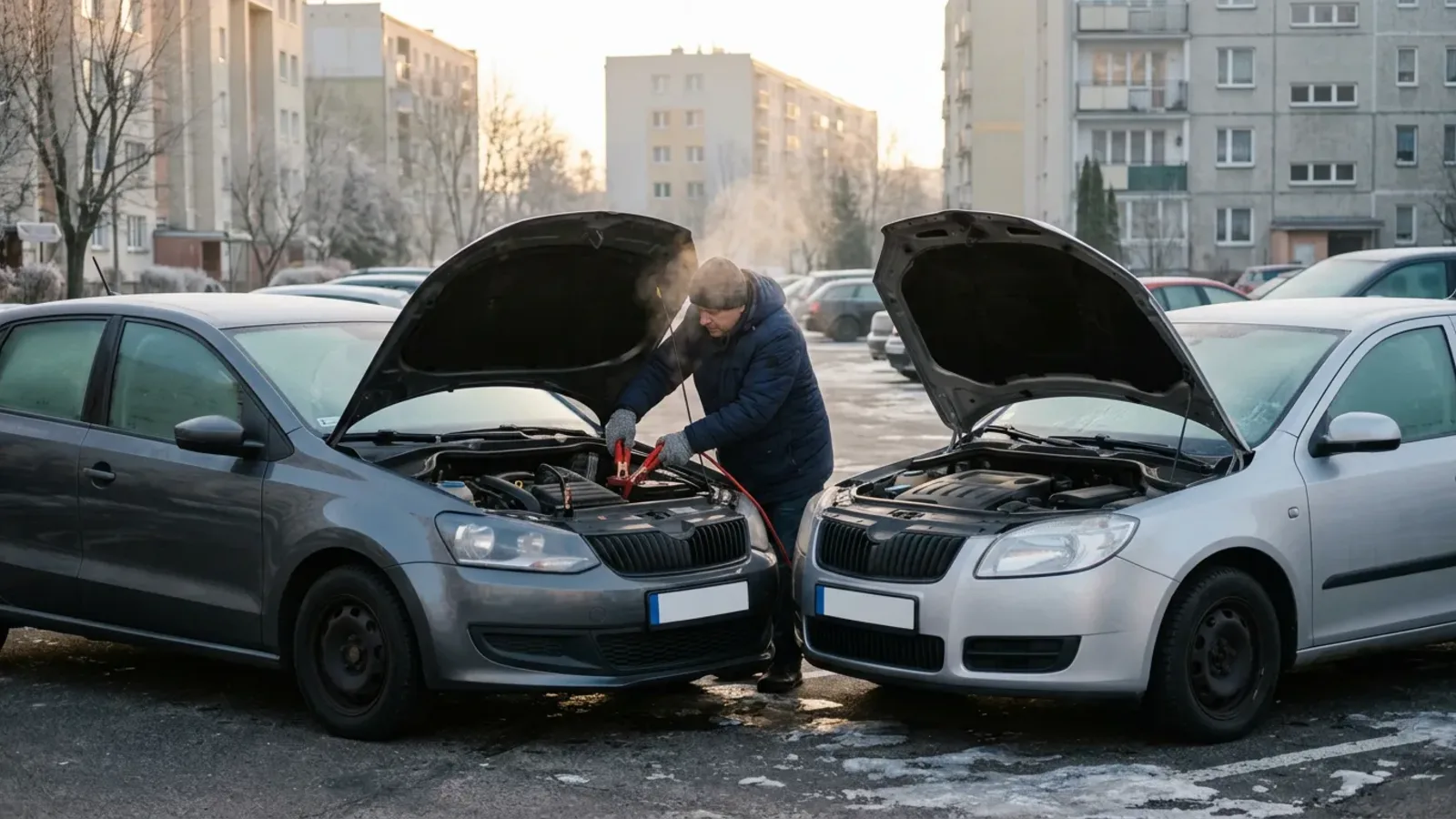
How to jump-start a car safely?
Always compare the procedure with your car's manual. In many models the manufacturer specifies special connection points under the bonnet, and the battery may be in the boot or under a seat. Below is a sequence in line with typical manufacturer recommendations (including the Škoda and Seat manuals).
- Check that both batteries are 12 V and that the donor battery is not clearly smaller in capacity. The cars must not touch. Switch off the ignition and all consumers in both.
- Do not jump-start a battery that may be frozen, swollen, cracked or has too low an electrolyte level: there is a risk of explosion.
- Red lead: first to the plus (+) of the flat battery, then to the plus of the donor battery.
- Black lead: first to the minus (−) of the donor battery, then to an earth point on the car with the flat battery, either the earth point indicated in the manual or bare metal on the engine block, away from the battery. Do not connect it to the minus of the flat battery.
- In cars with start-stop the minus usually must not go to the battery terminal, because the battery condition sensor (IBS) sits next to it. Use the earth point specified by the manufacturer.
- Start the donor car's engine and let it run for a moment. Then start the car with the flat battery. If it does not fire within about 10 seconds, stop and try again after half a minute.
- Disconnect the leads in the reverse order. Make sure the clamps do not touch each other or fall onto moving engine parts.
After a successful start do not switch the engine off straight away, and ideally drive in for a battery and charging test.
Start-stop, AGM and EFB: what to remember when replacing the battery?
Cars with a start-stop system have EFB batteries (for simpler systems) or AGM (for more demanding ones, for example with energy recovery during braking). Varta recommends always replacing an AGM battery with an AGM. An ordinary battery in such a car will wear out very quickly, and start-stop may stop working.
In some cars, after replacement the new battery must also be registered in the energy management system. Varta lists BMW, Mercedes and the VW Group brands here, where registration requires a diagnostic tester. Other brands use a reset or an adaptation, and in some it is not needed at all. Without registration the car may charge the new battery according to the old one's profile, which shortens its life. That is why replacing the battery in a modern car is more than unscrewing two terminals.
When to stop trying and call for help?
- You can smell petrol under the bonnet or under the car. Stop cranking the starter, do not smoke, move away from the car and call breakdown assistance. A fuel leak near sparks is a fire risk.
- A petrol engine is “flooded” after many attempts: you can smell fuel from the exhaust and the spark plugs are wet. Further attempts only make things worse.
- Smoke comes from the engine bay, there is a smell of burnt insulation, or the starter keeps running after you release the key.
- You hear a metallic grinding or knocking when starting, and the engine suddenly “seizes” while cranking. Do not try again: it may be a mechanical fault.
- After three or four series of attempts nothing changes. You will drain the battery to zero and overheat the starter.
If the car has made it to us or has been brought on a recovery truck, at Serwis Osowa at ul. Odyseusza 20 in Gdańsk we will carry out computer diagnostics, a battery and charging system test, and electrical repairs. We are an authorised Opel and Peugeot service centre and a Bosch Car Service, and we repair all makes, including cars from the USA. Call 58 552 55 25 (Mon–Fri 7:30–17:00, Sat 9:00–14:00). The scope and quote are confirmed by a service advisor.
Frequently asked questions
Can you bump-start a car by pushing it?
In an older car with a manual gearbox sometimes yes, but manufacturers of modern cars usually forbid it. It risks damaging the catalytic converter with unburnt fuel, and in an automatic or a hybrid it is impossible. It is safer to use jump leads or a booster.
What voltage should a healthy battery have?
A charged 12 V battery after several hours at rest usually shows about 12.6 V or slightly more. A reading clearly below 12.4 V suggests it is discharged. Voltage alone, however, does not tell you the battery's condition: a load tester does that.
After jump-starting, do you need to drive to recharge the battery?
Driving helps a little, but a short run around town will not charge a deeply discharged battery. It is better to charge it with a charger and check with a tester whether it is fit for further use.
Why does the car only start on the second or third try?
Most often it is a weakening battery, a drop in fuel pressure after standing, worn glow plugs in a diesel or an intermittent crankshaft position sensor. If the problem keeps recurring, it is worth having it diagnosed before the car leaves you stranded in a car park.
Can a weak battery cause errors on the dashboard?
Yes. At low voltage during starting, several control units can store errors at once, and various warning lights come on. After charging the battery and clearing the errors they usually disappear, but it is worth confirming with a tester.
Sources
- Varta – FAQ (AGM/EFB in start-stop cars, battery registration, pre-winter check, charging during standstill)
- Škoda Octavia – owner's manual: jump-starting the engine (sequence, earth point with start-stop, 10 s / 30 s)
- Bosch – battery brochure (AGM batteries in start-stop cars)
- Otomoto News – Car won't start: causes (starter, ignition, glow plugs, crankshaft sensor, immobiliser)