A faulty crankshaft position sensor most often shows up as the engine stalling while driving, starting problems, or no ignition at all even though the starter is cranking. It is often accompanied by the engine warning light and a code in the P0335–P0339 range. Without a signal from this sensor, the control unit does not know when to deliver the spark and fuel, so in many cars the engine simply will not start. Before you replace the sensor, it is worth checking the wiring, the connector and the reluctor ring, because they are just as often to blame.
What does the crankshaft position sensor do?
The crankshaft position sensor (also called the crankshaft speed sensor) measures how fast the crankshaft is turning and what position it is in. Bosch states this directly in its product data sheet: the engine control unit uses this data to set injection and ignition timing. It is one of the few sensors without which the engine usually will not run at all.
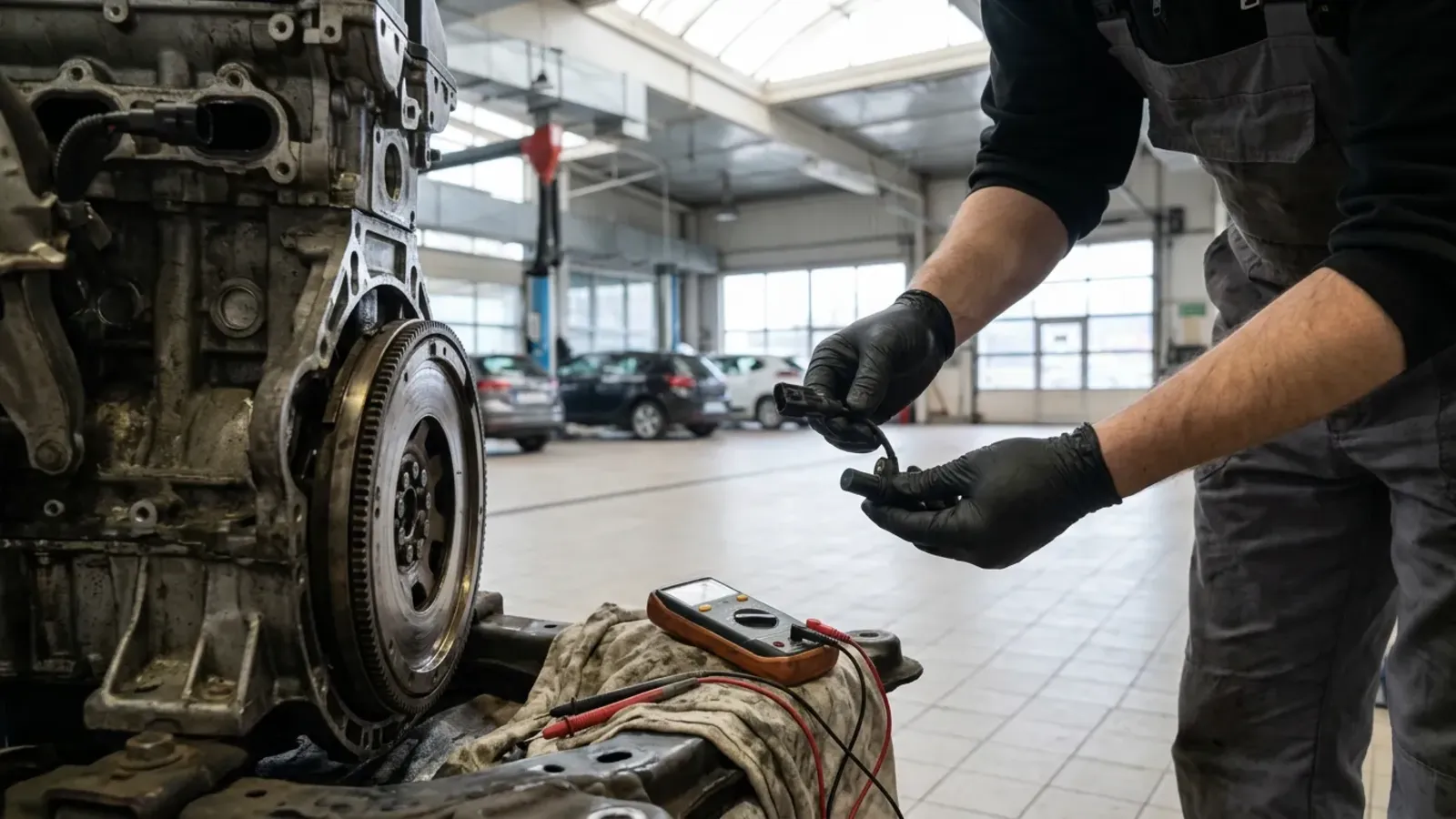
The sensor reads, without contact, a reluctor (trigger) wheel with teeth fitted to the crankshaft or the flywheel. One or more teeth are missing from the wheel, and this gap is the reference point the control unit uses to recognise the crankshaft position. HELLA states that the sensor is usually mounted near the flywheel ring gear, but its exact location depends on the engine design.
| Inductive sensor | Hall sensor | |
|---|---|---|
| Power supply | Not needed, it generates its own voltage | Needs a supply from the control unit |
| Typical connector | Usually 2 pins | Usually 3 pins |
| Signal | Sine wave that rises with engine speed | Square-wave (digital) signal |
| Ohmmeter test | Possible, according to HELLA approx. 200–1000 Ω depending on the reference value | Must not be done: the meter voltage can damage the sensor |
HELLA points out that the number of pins does not always settle the sensor type. If the type is not certain, it is not tested with an ohmmeter; instead the signal is checked with an oscilloscope or in the scan tool's live data.
What are the symptoms of a faulty crankshaft position sensor?
The sensor rarely wears out gradually like brake pads. More often it works correctly most of the time and the signal drops out under particular conditions: on a hot engine, over bumps, in damp weather. That is why the symptoms can be irregular and hard to reproduce on the spot.
- The engine stalls while driving or when stationary, sometimes without any warning, and will not restart straight away.
- The starter cranks, but the engine does not fire. In many cars the rev counter stays at zero while the starter is turning: a sign that the control unit cannot see the crankshaft rotating.
- Long or difficult starting, especially on a warm engine. Some drivers describe a pattern: the car stalls once warmed up and starts again after it has cooled down.
- Jerking, cutting out and rough running, misfires.
- Engine warning light (check engine) and a fault code stored in the control unit.
- Incorrect or jumping rev counter readings.
If the engine suddenly stalls while driving, you also lose power steering and brake assistance. If the car has stalled once for no obvious reason, do not wait for it to happen again on the road: book a diagnostic check.
Fault codes P0335–P0339: what do they mean?
Codes P0335–P0339 are generic OBD codes for the crankshaft position sensor "A" circuit. They say that the control unit has noticed a problem with the signal, but they do not settle whether the sensor itself, a wire, the connector or the reluctor wheel is to blame. Manufacturers also have their own codes, and the exact conditions for storing them differ between makes.
| Code | General meaning | What to check |
|---|---|---|
| P0335 | Crankshaft position sensor circuit fault | Connector, wiring, power supply, the sensor itself |
| P0336 | Signal out of range / incorrect performance | Sensor air gap, reluctor ring, contamination with metal particles |
| P0337 | Low signal in the sensor circuit | Short to ground, damaged wiring harness |
| P0338 | High signal in the sensor circuit | Short to supply, damaged connector |
| P0339 | Intermittent signal | Loose contact, broken wire, corrosion |
A correlation fault with the camshaft sensor (e.g. from the P0016–P0019 group) often appears alongside the crankshaft code. This may point to a sensor, but also to a mechanical problem, for example a timing chain that has jumped or stretched, or timing set incorrectly after a repair. In that situation, replacing the sensor alone will not fix anything.
Crankshaft position sensor vs camshaft sensor: how do they differ?
The names are similar and often confused. The crankshaft sensor tells the control unit how fast the engine is turning and where the pistons are. The camshaft sensor (as a rule a Hall sensor) adds information on which stroke a given cylinder is on. According to HELLA, only the combination of both signals lets the control unit determine when the piston of cylinder 1 is at top dead centre.
- Without the crankshaft signal the engine usually will not start or will stall: it is the basic signal.
- With a faulty camshaft sensor, many engines take longer to start and switch to an emergency program, but they can still run.
- Both sensors light the engine warning lamp and store a code, so reading the fault memory quickly shows which circuit to look at.
How to test the crankshaft position sensor before replacing it?
HELLA recommends a simple order: first read the fault memory, then inspect the wiring, connector and the sensor itself for breaks, corrosion and correct connection, and finally check for contamination and damage. Among the causes of failure, the manufacturer lists internal short circuits, broken or shorted wiring, mechanical damage to the reluctor wheel and contamination with metal particles.
- Reading the codes and live data: does the control unit see engine speed while cranking on the starter.
- Inspecting the harness: chafing at the engine block, melting from the exhaust, green deposits in the connector.
- Removing the sensor and checking its tip: metal particles attracted by the magnet, signs of rubbing against the ring.
- Measuring the signal with an oscilloscope: an even sine wave (inductive) or a square wave changing with engine speed (Hall), plus the supply voltage for a Hall sensor.
- For an inductive sensor: measuring resistance and short to ground against the data for the specific engine.
- Checking the reluctor ring and the distance between the sensor and the wheel, especially after replacing the clutch, flywheel or timing belt/chain.
The last point matters, because a fault after a repair is a common scenario: when a clutch or dual-mass flywheel is replaced, the sensor can be accidentally damaged or its wire trapped, and with timing work the timing may be set incorrectly. It also happens that a cheap replacement sensor has a different length or signal characteristic from the original part.
Crankshaft position sensor replacement: diagnosis and repair in Gdańsk Osowa
Replacing the sensor itself is usually not a big job, but access varies a lot between engines: sometimes the sensor is easy to reach from above, and sometimes covers have to come off, the car has to be raised or other components removed. After fitting, some cars also need a reluctor wheel adaptation in the scan tool. Before ordering the part, it must be confirmed that the sensor is to blame, not the harness, the connector or the timing.
At Serwis Osowa, ul. Odyseusza 20 in Gdańsk, we start with computer diagnostics and a signal measurement, and only then replace the part. We are an authorised service centre for Opel and Peugeot and a Bosch Car Service, and we repair all makes, including cars from the USA. Call: 58 552 55 25 (Mon–Fri 7:30–17:00, Sat 9:00–14:00). We prepare the repair quote after diagnosis, because it depends on the engine and the cause of the fault.
Frequently asked questions
Can you drive with a faulty crankshaft position sensor?
It is not worth it. If the sensor stops giving a signal, the engine may stall while driving, and with it power steering and brake assistance weaken. If the car has already stalled even once for no obvious reason, it is better to have it diagnosed as soon as possible.
Why does the car stall when warm but start when cold?
This is one of the typical symptoms of a fault in the crankshaft position sensor or its wiring: once warm, a cracked component or connector loses contact, and after cooling down it conducts again. The same pattern can, however, be caused by another electrical or fuel supply fault, so a measurement is needed, ideally while the symptom is occurring.
Can a crankshaft position sensor fault occur without the engine warning light?
Yes, especially with intermittent faults. A brief signal dropout can stall the engine before the control unit classifies it as a permanent fault. The code may then be stored as sporadic or not at all, and diagnosis requires watching live data and checking the harness.
Does a new crankshaft position sensor need coding?
The sensor itself is usually not coded, but on some engines a reluctor wheel adaptation is carried out in the scan tool after replacement. Without it, the control unit may be worse at recognising misfires. Whether it is needed depends on the specific model.
How much does it cost to replace a crankshaft position sensor?
The cost depends on the price of the sensor for the engine in question and on how hard it is to reach. Serwis Osowa does not have a fixed price list for this repair: we give a quote after diagnosis, once it is known whether the sensor or its wiring is to blame.
Sources
- HELLA Tech World – Crankshaft sensor (function, sensor types, symptoms, causes of failure, testing order, resistance)
- HELLA Tech World – Camshaft sensor: function, fault symptoms and troubleshooting (interaction with the crankshaft sensor, emergency program)
- Bosch Mobility – Crankshaft speed sensor, product data sheet (measuring crankshaft speed and position, Hall or inductive sensor, gap in the reluctor wheel)