
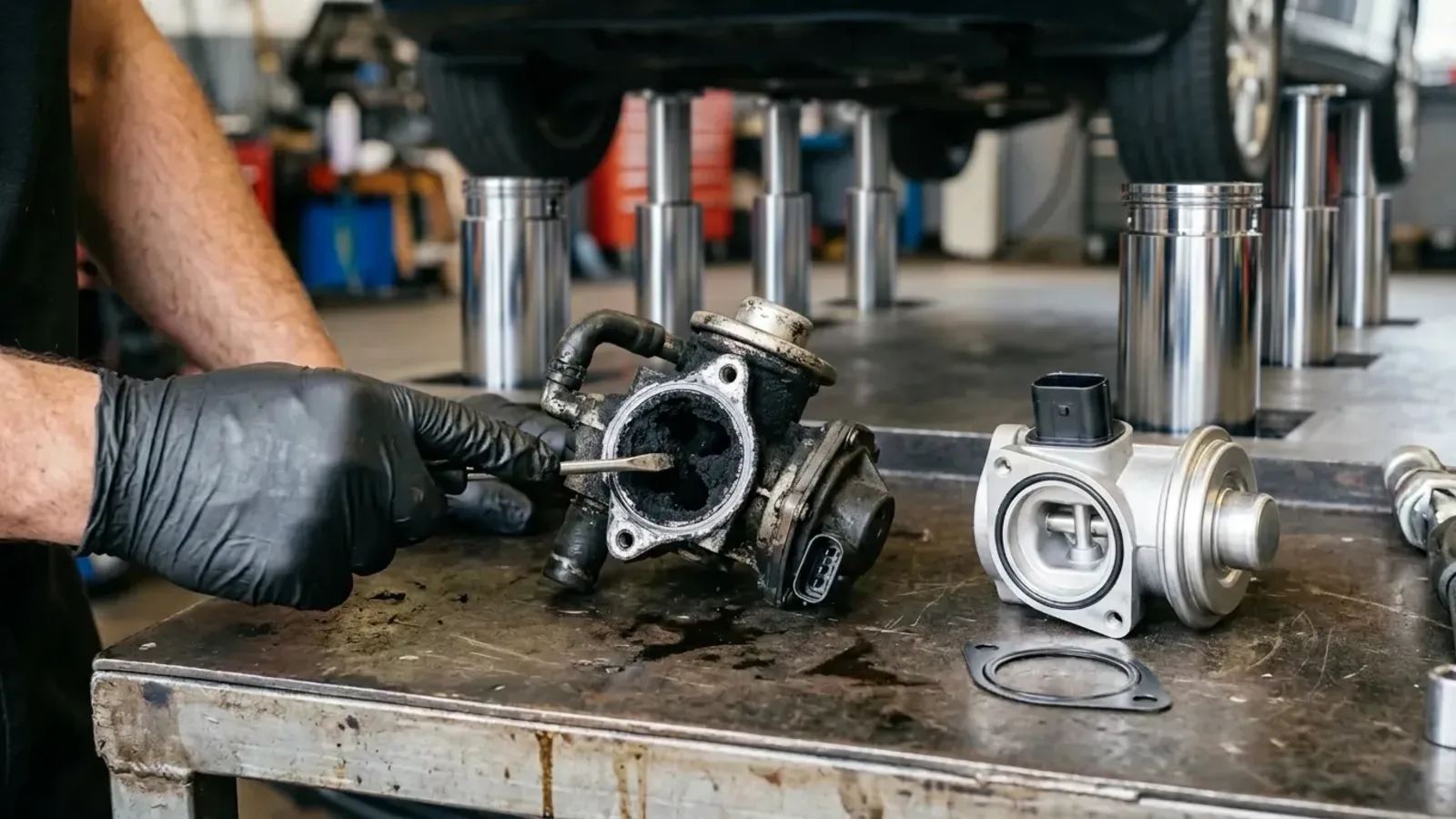
Opinions on the 2.0 TDI depend on whether it is the older unit-injector version (PD, approx. 2003–2009) or a common rail one (EA189 from 2007, EA288 from 2012). The PD has known weaknesses: the oil pump in versions with balancer shafts, cracking 16V cylinder heads and camshaft wear. Common rail versions are clearly less troublesome, and their typical faults concern ancillaries: the DPF, EGR, turbo and water pump.
- Identifying PD, EA189 and EA288
- DPF, EGR and turbo diagnostics
- Timing belt with water pump
- Assessment before purchase
Which cars have the 2.0 TDI engine?
The 2.0 TDI is one of the most popular diesels in Poland. It is fitted to VW Group cars, SUVs and vans, with outputs from 75 hp in vans to 240 hp in the Bi-TDI version.
| Generation | Years (approx.) | Example models |
|---|---|---|
| PD (EA188), unit injectors | approx. 2003–2009 | Golf V, Passat B6, Touran, Octavia II, Superb II, Leon II, Audi A3 8P, A4 B7 |
| Common rail EA189 | from 2007 (in most models mainly 2008–2013) | Golf VI, Passat B6 and B7, Tiguan I, Octavia II, Superb II, Yeti, Audi A4 B8, Q5 |
| Common rail EA288 | from late 2012 | Golf VII, Passat B8, Arteon, T-Roc, Octavia III, Superb III, Karoq, Kodiaq, Leon III, Ateca, Transporter T6 |
PD or common rail – how do 2.0 TDI versions differ?
In the PD, each cylinder has a unit injector driven by the camshaft. This gives high injection pressure, but also harsh, noisy running and a heavy load on the camshaft. In common rail, a high-pressure pump feeds fuel to a shared rail and the injectors are controlled electronically. Auto Świat stresses that this is a “big difference” and that specialists recommend the CR versions.
- All generations have a timing belt, which also drives the water pump.
- The EA189 was covered by a recall/service campaign after the emissions scandal (software update). According to VW, the EA288 was not affected.
- Some EA288 versions have SCR and AdBlue; Twin Dosing appeared in the EA288 evo variant.
Most common 2.0 TDI faults and their symptoms
This overview combines data from Auto Świat (PD and CR) and autocentrum.pl (EA288). We point out which generation each item applies to.
| Fault | Symptom | Cause | What we do |
|---|---|---|---|
| Oil pump drive (PD with balancer shafts) | Oil pressure warning light | Wear of the hexagonal pump drive | Stop immediately, measure pressure, repair the drive |
| Cracked cylinder head (PD 16V) | Coolant loss, overheating, bubbles in the expansion tank | Casting defect in some versions | Leak test, head assessment |
| Camshaft and tappets (PD) | Noisy, uneven idle, loss of power | Premature wear under heavy camshaft load | Camshaft inspection, replacement together with tappets |
| Unit injectors (PD) | Uneven running, smoking, loss of power | Wear, usually at high mileage | Injection test, reconditioning or replacement |
| DPF and EGR (CR) | DPF or engine warning light, limp mode | City driving, carbon build-up, leaking EGR cooler (EA288) | Diagnostics, regeneration, EGR repair |
| Water pump, tensioner (CR) | Coolant loss, noise from the timing drive | Wear of belt-driven components | Replacing the timing kit together with the pump |
| Turbo and dual-mass flywheel (CR) | Loss of power, vibrations, knocking | Wear of VTG vanes, age of the dual-mass flywheel | Boost diagnostics, vibration assessment |
Autocentrum.pl also describes in the EA288 a silicate sachet in the coolant reservoir that can burst and contaminate the cooling system, as well as increased oil consumption in the 184 hp versions. We check this during servicing, but not every car has these problems.
How to service a 2.0 TDI: oil, timing belt, DPF
On the EA288, the factory belt interval is 210,000 km. Autocentrum.pl recommends shortening it to approx. 120,000–150,000 km or 5–7 years, always with the water pump. Auto Świat quotes a similar opinion from mechanics for the EA189. In the PD, the oil must meet the specification approved for unit injectors, and in a CR with DPF, a low-ash specification for the filter.
| Area | PD | Common rail (EA189, EA288) |
|---|---|---|
| Oil | VW specification for PD (e.g. 505.01), changed more often than LongLife | VW specification for diesels with DPF (usually 507.00) |
| Timing | Belt with water pump according to the plan | Belt with pump; in practice approx. 120,000–150,000 km |
| Oil pressure warning light | Stop the car immediately | Stop the car immediately |
| DPF | Only in some versions | Drive on longer routes, do not skip regeneration |
Used car with a 2.0 TDI – how to choose a good one?
Common rail versions are a more sensible choice today than the PD, especially as PD cars already have very high mileage. Auto Świat notes that most 2.0 TDI problems start after 100,000–120,000 km, so for used cars the service history is crucial.
- Engine code: PD, EA189 or EA288. For the EA189, check the recall/service campaign status.
- Oil pressure and cold start; knocking from the bottom of the engine is a warning sign on a PD.
- Coolant loss: head, EGR cooler, water pump.
- DPF load, regeneration history, AdBlue errors on an EA288 with SCR.
- Vibrations when switching off and pulling away, especially with DSG.
2.0 TDI repair in Gdańsk Osowa
We service 2.0 TDI diesels in VW, Audi, Škoda and Seat cars as a Bosch Car Service, outside the authorised dealer workshops of those brands (EU Block Exemption rules (GVO)). We carry out timing belt/chain work with the water pump, injection, DPF, EGR and boost diagnostics, and mechanical repairs. We do not remove the DPF or EGR. Quotation after diagnosis.
Serwis Osowa, ul. Odyseusza 20, Gdańsk, tel. 58 552 55 25.
Frequently asked questions
How can I tell a PD 2.0 TDI from a common rail?
By the engine code on the plate or from the VIN. As a rough guide, cars up to approx. 2008 are mainly PD and newer ones are CR. Because of the transition period, do not rely on the model year.
Is the 2.0 TDI EA288 better than the EA189?
According to autocentrum.pl, the EA288's reliability compares well with its rivals, although it has its own typical faults, e.g. the EGR cooler and cooling system components. Both CR generations are rated better than the PD.
What should I do if the oil pressure light comes on in a PD 2.0 TDI?
Stop and switch off the engine. In versions with balancer shafts this may mean the oil pump drive has failed; continuing to drive risks seizing the engine.
How often should the timing belt/chain be replaced in a 2.0 TDI?
The manufacturer states up to 210,000 km, but mechanics recommend approx. 120,000–150,000 km or a few years, always with the water pump. We check the interval for your specific car from the VIN.
Sources
- Auto Świat: 2.0 TDI engine with a trap. PD and CR are a big difference
- Auto Świat: 2.0 TDI engine – failures, faults, reviews, how to service
- autocentrum.pl: 2.0 TDI EA288 – typical faults and failures [guide]
- Auto Świat: Best diesels of recent years (1.6/2.0 TDI, 1.5 dCi, 1.6 CRDi)
- autocentrum.pl: Recall for vehicles with EA189 diesel engines (VW notice, 20.10.2015)